When desire has conceived. James 1:15-27


I ended the last post on the book of James with this:

Let no one say when he is tempted, “I am being tempted by God”; for God cannot be tempted by evil, and He Himself does not tempt anyone. But each one is tempted when he is carried away and enticed by his own lust. (James 1:13-14 NASB)

So, if you think you get to blame this trial, you are going through, on God, you can’t because God doesn’t send these tests. Currently, we are all enduring a trial; it is called COVID 19 or, the Wuhan virus since that is where it came from. You are foolish if you do not understand that God has ordained this egregious man-made and deadly virus as part of the sorrows or, as Matthew’s gospel puts it, labor pains that are leading up to 1. The catching away of the church, and 2. The time of God’s wrath that is about to be poured out upon the earth.

Well, if I can’t blame God, then who?

Although you don’t want to accept it, you were tempted when you got carried away by your own desires.

But each one is tempted when he is lured and enticed by his own desires. (James 1:14 NET.)

Lured – Enticed; attracted; invited by the hope of pleasure or advantage.

Enticed – Incited; instigated to evil; seduced by promises or persuasions; persuaded; allured.

Desires = Lusts – It is the Greek word epithumia and means a longing (especially for what is forbidden).

Look at what James continues to say.

James 1:15 NET. Then when desire conceives, it gives birth to sin, and when sin is full-grown, it gives birth to death.

When desire conceives?

Conceive is the Greek word sullambanō and means to seize (arrest, capture), specifically to conceive.

A rewrite of James 1:15a, will look like this:

“Then when my longing for what is forbidden has seized, arrested and captured me,”

Then what happens?

If I am thinking in terms of making a baby, we used to have the concept, that once you made it, there is no walking away from it, and if you weren’t married to the girl, you now would be, because you have a responsibility in this product of your pleasure.

But we aren’t necessarily talking about making a baby are we, we are talking about our poisoned desires and passions giving birth to something, ah, but what?

James 1:15b, “.. when desire conceives, it gives birth to sin,”

Sin, isn’t that the thing that will send me to hell?

First off, SIN does not mean exactly what you think it means. It is an old English word that means to miss the bullseye in target archery. If you are familiar with my writings, then you would know that I used to shoot competitive archery, but I was NOT good at it. The point here is that I can visualize, as I write, a target, with a ten ring of about three inches in width when close, but at distances, looks to be about the size of an American quarter.

If you are equating SIN to your everyday life, a life in which you have to be able to put every shot into that small circle, you are asking for what seems impossible. Fortunately, it is possible because we have the Holy Spirit to help us. Difficult as our lives can be, our mission, as followers of Christ, is to try.

Secondly, while we all have a proclivity to SIN, we are forgiven of all sin. This forgiven state was extended to everyone, but the payment due for our sin was paid by Jesus on the cross. (Hebrews 9:28; Isaiah 53:5; 2 Corinthians 5:21.) An obvious factor is that people have to accept what Jesus did for them in order to gain the full benefits of this acquittal.

Your desire grows inside you until it results in sin. Then the sin grows bigger and bigger and finally ends in death. (James 1:15c ERV)

Lured by the attraction, which is really just the desires that your brokenness yearns for until that longing for the forbidden thing comes full term, and then the indulgence called SIN is birthed. It pulls at you, crying feed me, I’m hungry, change my diaper; and now it wants a baby brother to keep it company. One way or another, this lustful demand for your devotion is going to kill you.

Does this pursuit of desire end in the death of the soul, and an end to your relationship with the Father?

I don’t think so, at least not on His part, but there are people in the prison systems that will kill you if the “drug” doesn’t get you first. While I am not a big fan of John MacArthur, we, at least, agree on this point.

James 1:16-17 NASB Do not be deceived, my beloved brethren. (17) Every good thing given and every perfect gift is from above, coming down from the Father of lights, with whom there is no variation or shifting shadow.

The things I see in this verse are:

  • That it is possible to be deceived,
  • that things you perceive as good, could come from some other source – like Satan.
  • You could believe that God, like many politicians, can change their vote, party affiliations, and the things they say, to suit their immediate needs, and therefore cannot be trusted.
  • What if you thought that God’s plan, and therefore what He sends you, is not perfect; where would that leave you?

If you learned anything, you should learn that every good and perfect gift comes down from the Father of lights; and that there is NO variation in Him, nor shifting. Look at how the NET Bible translates verse 17.

James 1:17 NET. All generous giving and every perfect gift is from above, coming down from the Father of lights, with whom there is no variation or the slightest hint of change.

Having gone through a dark time myself, I had to figure out what God’s nature and character were. Oh sure, I knew what the fairy tales they had been telling me looked like, but things did not make sense. For example: how could God, who gave His own Son to die for me, hate me and my sin the next day? God would have to go out of character to do that, and verse 17 tells me, without a doubt, that there is NO changing or shadows in God’s character.

Almost as though to say, and don’t you dare forget this, He gives us verse 18.

James 1:18 NET. By his sovereign plan, he gave us birth through the message of truth, that we would be a kind of firstfruits of all he created.

The Amplified Bible tells us:

“And it was of His own [free] will that He gave us birth [as sons].”

Freewill and sovereign plan, seem to be the same thing.

The NASB states:

“In the exercise of His will He brought us forth by the word of truth so that we would be a kind of firstfruits among His creatures.:( James 1:18 NASB)

The fact that we can discuss this life we have in Jesus is proof that He brought us forth.

In the beginning, was the Word, and the Word was with God, and the Word was God. He was in the beginning with God. All things came into being through Him, and apart from Him, nothing came into being that has come into being. (John 1:1-3 NASB)

James 1:19 – 27 are entitled:

Hearing and Doing the Word

James 1:19-20 NASB This you know, my beloved brethren. But everyone must be quick to hear, slow to speak and slow to anger; (20) for the anger of man does not achieve the righteousness of God.

Consider that you were brought forth by the Word of Truth, not as though this is some secret word that must be spoken in order to gain entrance; Jesus was and is that Word. He, as we can see in John’s gospel, is the magnificent creator of all things. In light of that information, here are some words to live by.

  • Everyone must be quick to hear.
  • Slow to anger
  • (Because) “The anger of man does not achieve the righteousness of God.”

Dr. J Vernon McGee says this, almost as if it is a scriptural passage, “The anger of man is contrary to the will and work of God.”

There is a multitude of interpretations for verse 20. We may think that anger is what God might be looking for, but anger tends to be the exact opposite.

(AMP)  For man’s anger does not promote the righteousness of God [wishes and requires].

(CJB)  for a person’s anger does not accomplish God’s righteousness!

(MSG)  God’s righteousness doesn’t grow from human anger.

Knowing that anger is not what He is looking for, we have our next instruction.

James 1:21 NLT  So get rid of all the filth and evil in your lives, and humbly accept the word God has planted in your hearts, for it has the power to save your souls.

“The word here rendered filthiness, occurs nowhere else in the New Testament, and It means filth; and is applied to evil conduct considered as disgusting or offensive.” (Albert Barnes’ Notes on the Bible)

This next commentary makes sense.

“According to the Greek, this is a once-for-all action. Why should we do this? Progress in our spiritual lives cannot occur unless we see sin for what it is, quit justifying it, and decide to reject it. James’s word picture here has us getting rid of our evil habits and actions like stripping off dirty clothes. After we “get rid,” then we need to humbly accept the message of God, seeking to live by it because it has been planted in our hearts and becomes part of our being.” (Life Application New Testament Commentary)

This entire process, as we migrate through James, is a progressive change in our way of life. If you have already been living in this manner, then see it as a refresher course or reminder; But, if on the other hand, you let life run you, then you need to make some huge adjustments. James 1:22 is such an adjustment.

James 1:22 KJV  But be ye doers of the word, and not hearers only, deceiving your own selves.

While I can understand what the KJV is telling me, clarity would be good. How about the CEV? It has a very straightforward approach.

Obey God’s message! Don’t fool yourselves by just listening to it.” (CEV)

The ERV is very simplistic but effective.

Do what God’s teaching says; don’t just listen and do nothing. When you only sit and listen, you are fooling yourselves.” (ERV)

Not only are we fooling ourselves by not putting the Word into action, but –

James 1:23-24 NASB For if anyone is a hearer of the word and not a doer, he is like a man who looks at his natural face in a mirror; (24) for once he has looked at himself and gone away, he has immediately forgotten what kind of person he was.

Time, once again, to break these verses down.

  • If anyone is a hearer and not a doer,

We are still talking about how to look at the Word of God.

James 1:25 NASB But one who looks intently at the perfect law, the law of liberty, and abides by it, not having become a forgetful hearer but an effectual doer, this man will be blessed in what he does.

Looks, in the Greek, means to stoop down and to peer inside and to become absorbed by what you see.
If you intend to learn, then that is the kind of attention you have to give to a subject. Maybe not, but you are certainly giving this a tremendous amount of attention, and that, is a good thing.

Intently is the same Greek word parakupto which was translated looks. It means to stoop down and to peer inside.
Whenever you see duplicated words in Hebrew or Greek, the basic understanding is that you are about to learn something vitally important.

The perfect law is the Greek word teleios and means complete, faultless, and perfect.
Earlier, as an example, I looked at John’s gospel, where it described the creation and who did the creating.

In the beginning, was the Word, and the Word was with God, and the Word was God. He was in the beginning with God. All things came into being through Him, and apart from Him, nothing came into being that has come into being. In Him was life, and the life was the Light of men. The Light shines in the darkness, and the darkness did not comprehend it. (John 1:1-5 NASB)

In this, did you get any sense of something less than complete, faultless, and perfect? Yeah, me neither. It was God/Jesus/the Holy Spirit, in and at their finest, creating the most splendid of creation for their creation, humanity.

So, you paid attention, and have not forgotten, putting what you learned to work. You will be blessed in what you do.

I will tell you straight out, verse 26, 27 is going to hard on many of you, especially if you insist on saying, I am NOT under the law but under grace.

James 1:26-27 NASB If anyone thinks himself to be religious, and yet does not bridle his tongue but deceives his own heart, this man’s religion is worthless. (27) Pure and undefiled religion in the sight of our God and Father is this: to visit orphans and widows in their distress and to keep oneself unstained by the world.

  • If anyone thinks himself to be religious, and yet does not bridle his tongue but deceives his own heart, this man’s religion is worthless.”

I know many people who think they are religious and can’t seem to bridle their tongues. So it’s time to ponder the meanings of words again.
Religious, as we see in James 1:26, is the Greek word thrēskos and means ceremonious in worship (as demonstrative), that is, pious: – religious.
In other words, this person is putting on a pretty good show. Well, guess what, your good show means nothing, especially if you can’t hold your tongue. Do you realize that most people perceive that the idea of holding your tongue means cussing alone, and that is certainly an aspect of this, but there is more; as it also applies to the person who uses their religiosity to shred those who can’t understand the words they use as they dispense their high theology.

Example time. And yes, I have used this before. A former pastor recommended the book The Shack, by William Paul Young. He had read it and was so touched by it that he bought a stack and sold them for face value. I bought one. Struggling to understand who God was, this book changed my life. In it, I found mercy, grace, and a comprehension of God’s love, which I have never known. I also had some immediate questions, and so I turned to a man who had an earned Doctorate in Theology, who used to attend the church and attempted to open a conversation about The Shack. He immediately responded with harshness and said, I would never waste my time discussing a book that was so theologically unsound. I never bothered that man again; I did, however, take my questions to God, and when I came to things that challenged me, I could hear the Holy Spirit say, keep reading, and I will explain it as we go, and He did. Mr. High Theology couldn’t seem to bridle his tongue. Can you imagine the amazing conversations we might have had, exploring the love of a boundless God?

Give me a moment to address cussing.

I will tell you that I can cuss with the best of them, and I usually find I am susceptible to doing that when I am tired and pushed. It is possible that we/I think that the bluster can push uncomfortable people and situations away from us. I suppose, like animals growling, it could be perceived as a warning, but most of the time, it is an attempt to make the person saying the garbage look braver than they really are. Since FEAR is a monstrous factor in all of our lives, then simply admitting to the Father that you are afraid may be a part of your solution.

I spent some time in a small group called “the man cave.” Several of the attendees acted as though they belonged in a cave, as they refused to bridle their tongue. I remember thinking, oh yeah, it’s that grace thing that we love to take advantage of. As I got to know them better, the two major offenders were highly intelligent men; odd, considering that most perceive those with unbridled tongues, as having limited, and uneducated vocabularies. That scenario demonstrated, to me, that what they were doing was purely a choice. How do I know that? Because my mother would not permit foul language to be used in her presence. Family members had to develop at least two language sets, one that was usable around mom and the church crowd, and one that they used with much of the world.

Something I have not brought into this conversation is the fact that the Holy Spirit, in my worst of times, has always been there calling me back to the Father. This is important because I understood, through faulty teaching, that God was angry with me and could not have anything to do with me. No, an unbridled tongue does not cut you off from God, but it certainly makes you look like a fool to many others.

Continuing in James 1:27

“Pure and genuine religion in the sight of God the Father means caring for orphans and widows in their distress and refusing to let the world corrupt you.” (James 1:27 NLT)

All the pretense, and yes, the “church” is full of it, means nothing to God. What carries weight is this:

    • “Care for the orphans in their distress.”
    • “Care for the widows in their distress.”
    • “ And refuse to let the world corrupt you.”

The KJV version of verse 27, reads like this:

“Pure religion and undefiled before God and the Father is this, To visit the fatherless and widows in their affliction, and to keep himself unspotted from the world.”

Pure can also mean clean.
This has nothing to do with ceremonial washings but leans more living a life that has been purified by the fire. (This fire is the fire of life that you have successfully made it through and can therefore now show God’s love to other people in a relevant manner.)

Religion – I don’t even like the word, as it has terminology like High Theology associated with it; and, usage of phrases like that have dominance and oppression attached to them.

In the Greek it is the word thrēskeía and includes, the worship of God; but It also conveys that there was a worship of angels since they were the messengers; a spin through Hebrews can help to clarify how wrong that is. So, a proper understanding of pure religion would be an untainted worship of God, in the manner suited to you, that excludes the false worship of angels and a few other things.

Undefiled before God – The Greek word is amiantos and means free from that by which the nature of a thing is deformed and debased, or its force and vigor impaired.

Maybe this will help.

The “Law” states that you shall not take the Lord, your God’s name in vain. I had that law thrown in my face for years when I was younger, and we could not even say Gosh, as that would be declared a derivative of God’s name. I am not kidding you. Get real! To take God’s name in vain is to diminish its power and authority through some manner of common, or nonsensical usage. At what point does God say to you, are you serious at this point, and, do you really want this person damned to hell? While we all have our moments when we think a person deserves to go the place of permanent, fiery, torment, where there is no relief, but the words of Jesus, who is God, may change your mind about that.

For you will be treated as you treat others. The standard you use in judging is the standard by which you will be judged. (Matthew 7:2 NLT)

So, if you can read words like this, and still feel good about flinging God’s name around, in a vain manner, then perhaps you deserve what comes your way.

That was an unexpected twist, but a necessary one, sadly, though, it gives the impression that God works around our human frailties to make His kingdom work, and that will never happen. Remember, we are the ones who are broken, NOT Him. So if you think you will be sent to hell because you can’t bridle your tongue, you are wrong. Allow me to remind you of something.

But if we are living in the light, as God is in the light, then we have fellowship with each other, and the blood of Jesus, his Son, cleanses us from all sin. (1 John 1:7 NLT)

When you look up the word cleanses in The Ultimate Cross-Reference Treasury, you get this: A reference to Matthew 8:2.

Suddenly, a man with leprosy approached him and knelt before him. “Lord,” the man said, “if you are willing, you can heal me and make me clean.” (Matthew 8:2 NLT)

That man not only asked Jesus to stop the disease in his body, but he also asked for restoration and a declaration to the community that he should be, once again, accepted. We did not see Jesus going through all that, and I think it was because Jesus would have circumvented a perverted temple system, which made these people pay to be declared clean to the public. If Jesus had done all that this man asked, He would have been prematurely put on that cross, and Jesus was no fool. There was a time for that, and it had not come yet.

The Ultimate Cross-Reference Treasury Goes on to say He, “Not only forgives but removes. The cleansing is present and continuous (Vincent). The thought is not of the forgiveness of sin only, but of the removal of sin. The sin is done away, and the purifying action is exerted continuously (Westcott).

If sin has been forever forgiven, then what is this judgment we see?

But you, why do you judge your brother? Or you again, why do you regard your brother with contempt? For we will all stand before the judgment seat of God. (Romans 14:10 NASB)

You also see this theme in 2Corinthians 5:10. This is that Bema seat so many throw at you in hopes of manipulating you, as they announce that you will stand before the judgment seat. Let’s look at the words for a moment.

Bema, a Greek word that has, as one of its meanings, judgment, but it is so much more. “By implication (according to the Word Study Dictionary), it is an elevated place to which the ascent is by steps.”

Where else do we see something like this?

At the Olympic games, at the finish of an event, where the winners are awarded for a job well done. We also the usage of the word for judgment seat in Acts 12:21, where we see Herod having a raised platform with steps built, from which he addressed the crowd.

Look at 2Corinthians 5:10, as this is more revealing.

For we must all appear before the judgment seat of Christ, so that each one may be recompensed for his deeds in the body, according to what he has done, whether good or bad. (2 Corinthians 5:10 NASB)

There is that ominous word judgment once again, but Paul adds some additional words for clarity.

  • “So that each one may be recompensed for his deeds in the body,”

The word recompensed is the Greek word kolumbaō, pronounced kom-id’-zo, and according to Strong’s Concordance, means to tend to, take care of, to properly provide for, and by implication to carry off as if from harm.

  • In short, we are there to receive our reward.

Since we come with nothing but unacceptable, filthy rags, is it us taking care of Christ?

Hardly, therefore the logic of this process is Jesus receiving into the kingdom those who are His own and giving us rewards for jobs well done. One of those jobs became apparent as we were doing this study.

Blessed is a man who perseveres under trial; for once he has been approved, he will receive the crown of life which the Lord has promised to those who love Him. (James 1:12 NASB)

Imagine that, one of our jobs is to persevere under trial. I wasn’t aware I signed up for that, but having come to know this Jesus more fully, I, like Paul and James, consider myself a bondservant to Christ the Messiah. This crown of life only happens at this Bema seat. So, instead of fearing God for our failures, and we have all made many, how about putting some faith in His ability to see us through the blood of Jesus Christ.

Posted in bible study, birth, conceive, death, desires, endurance, enticed, fall into, lust, sin, Thoughts on scripture | Tagged , , , , , , , , , , , , , , , , , , , , , , , | Leave a comment

If any of you lack faith. James 1:5-14.


When we last talked about James, we ended on this note.

For you know that when your faith is tested, your endurance has a chance to grow. So let it grow, for when your endurance is fully developed, you will be perfect and complete, needing nothing. (James 1:3-4 NLT)

    • So, our faith gets tested.
    • Our endurance has a chance to grow.
    • And, because of that, our endurance becomes fully developed.

Developed is the same as “perfect result” in the NASB. It is a combination of two words:

  1. teleios meaning brought to its end or finished, and wanting nothing necessary to completeness. And –
  2. ergon meaning business, employment,  that in which anyone is occupied. And, that which one undertakes to do, enterprise, undertaking.

So we, as we walk through this life in Christ, are about an undertaking which will eventually come to an end; almost as if we were employed on a contractual basis.

If you want to think about it as work, then what is your payment?

For the believer, our reward is focused on the simple joys that we find in the Lord, not driving around in $100k vehicles; that and an eternity of peace with the Father.

This idea of a lifetime of tests and trials is definitely not a huge selling point when making a pitch for people to come to Jesus. Would you have signed up for this blessed life in Christ, if Pastor Greg Laurie had told you, it would be a life filled with trials, some of which, like the loss of your son due to reckless driving, will attempt to rip your heart out? Perhaps not.

We have been using terms like tests, trials, perseverance, endurance, and faith, but now it seems as if we are thrown a curveball, as James states:

James 1:5 NASB But if any of you lacks wisdom, let him ask of God, who gives to all generously and without reproach, and it will be given to him.

I think I can comprehend how wisdom would play into the conversation, however, the statement could imply that our inability to manage the trials, is completely on us. Now, that might be the case, and one of my previous pastors admonished the audience with, “if you are having problems in your life, you brought them on yourselves.” I don’t think that assertion is entirely true, simply because we have an enemy that is out to kill anything that looks like Jesus.

“Be sober, be watchful: your adversary the devil, as a roaring lion, walks about, seeking whom he may devour, whom withstand steadfast in your faith, knowing that the same sufferings are accomplished in your brethren who are in the world. And the God of all grace, who called you unto his eternal glory in Christ, after that ye have suffered a little while, shall himself perfect, establish, strengthen you.” (1 Peter 5:8-10 ASV)

I included a few extra verses because the story doesn’t merely end with the enemy in deadly pursuit, it ends with us, standing steadfast in our faith. What else does it say? It says we know that others are suffering in a similar manner. You see, you are not alone in this, we are all being attacked. Your purpose is not to wallow forever, it is to strengthen and establish others, as God, in Christ Jesus, has strengthened you.

Wisdom is the Greek word sophia and yes, it means wisdom, however, the Word Study Dictionary also conveys this: 1. Skill in the affairs of life, practical wisdom, wise management as shown in forming the best plans and selecting the best means, including the idea of sound judgment and good sense. 2. In a higher sense, wisdom, deep knowledge, natural and moral insight, learning, science, implying cultivation of mind, and enlightened understanding.

Dr. J. Vernon McGee helps to define wisdom by stating: 

“You and I have troubles and trials and problems. How are you going to solve this problem? How are you going to meet this issue? How are you going to deal with this person? If you lack wisdom in regard to a problem, you need to go to God in prayer.”

So there you are, struggling, crying, and clamoring out to God in every manner possible. Are you asking in faith when you do this?

It seems like a laughably simple question doesn’t it; but the obvious part of this, is that most of us do just what I described – we struggle, clamor, whimper, and cry, and there isn’t, most of the time, a stitch of faith in any of it. Fortunately, we serve a God of Mercy, that and Jesus sits by the Father interceding for us, constantly.

Who will bring a charge against God’s elect? God is the one who justifies; who is the one who condemns? Christ Jesus is He who died, yes, rather who was raised, who is at the right hand of God, who also intercedes for us. (Romans 8:33-34 NASB)

By the way, the one who is bringing a charge against you is Satan, and he has already been convicted.

Here is what the Message has to say about James 1:5.

If you don’t know what you’re doing, pray to the Father. He loves to help. You’ll get his help, and won’t be condescended to when you ask for it. (James 1:5 MSG)

Sometimes the Message just pulls it all together.

James 1:6 NASB But he must ask in faith without any doubting, for the one who doubts is like the surf of the sea, driven and tossed by the wind.

he,” in this verse, is the one who is doing the asking, and they look a lot like you and I, even if it is not up to religious standards.

What is faith, or what does it look like?

I have had moments when my faith was rock solid. I knew that when I prayed God would come through, and in a few rare moments, He did. But then there were times it seemed as if God did nothing, and my words might as well have been swamp water. Don’t get me wrong, fancy, well-spoken words have nothing to do with this. It is the motivation in your heart that gets the job done. And, most often you will not be able to explain where the faith to pray came from. In those times when you are struggling, you must learn to lean upon the Holy Spirit, because He will give you a prayer, that in some cases has sounded like nothing less than groaning, for I could not put words together, but I had to pray.

Alright, you prayed, but you whimpered your way through it, hoping that the God you have been avoiding would listen. There was no faith in that, and you doubted He would come through the moment you opened your mouth. James tells us, you are like the guy out in the surf, on a board, and you don’t know what you are doing. Those waves are going to beat you up and drive you further out to sea. Who wants to be that guy? No one.

James 1:7 NIV  That person should not expect to receive anything from the Lord.

Ever?

Just wait, we will try to fix this.

James 1:8 NIrV  He can’t make up his mind. He can never decide what to do.

Who is James talking about?

The one who doubts when they ask.

James 1:9 TLV  But let the brother in humble circumstances boast in his high position—

I will be honest here, many of the translations come across as though we should be praying for money; enough money so that we could snub our noses at others. That thought is so out of character for this conversation that James is having. I used to be involved in the “faith” movement, and the constant push for money and the associated greed made me sick. This TLV translation seems to say it best, however, it leaves you and I to guess as to what it means.

Look at what Dr. McGee says:

“You may say, “I’m just a poor individual. I don’t have very much. I don’t have any wealth.” My friend, if you are a child of God you have a lot of wealth. You have treasure in heaven. And have you ever stopped to think what you have down here, what you have in Christ? We have everything in Him. Paul wrote, “Therefore let no man glory in men. For all things are yours; Whether Paul, or Apollos, or Cephas, or the world, or life, or death, or things present, or things to come; all are yours, And ye are Christ’s, and Christ is God’s”

Regardless of my circumstances, God sees me in the Son, and the Son, is doing quite well, thank you. Knowing this is no reason to get boastful with people, but you can certainly thank the Father for bringing you into His family.

A confession here. I am notorious for speaking about a subject while being unaware of what the following verses may bring. Such was the case here. Verses 10,11 speak as though this discussion was planned and intentionally integrated. When you do bible study, I suggest that you do a good read of the chapter, and that way you will have an overview, knowing that an obscure verse like 9, will be quickly answered. Fortunately, for me, the Holy Spirit, which leads us and guides us into all truth, has just done that, and so here is verse 10,11.

James 1:10-11 TLV  and the rich person in his humble position, because like the flower of the grass he will pass away.  (11)  For the sun arises with a scorching heat and withers the grass, and its flower falls off and the beauty of its appearance is destroyed. So also the rich man in the midst of his pursuits will wither away.

None of this answers the question of why James touched on the subject of wealth in a conversation about prayer. Perhaps James brought it up because there is a prosperity theme that runs through the promises to God’s people; and, it is a topic that God covers in His conversations with Abraham, and then the children of Israel – they thoroughly expect God to bless them, and since we have been grafted into the vine, then God should bless us as well. Ah, but what is a blessing? For some, it is the simplest of things. If your prayers are not being answered and your situation seems dire, then you might easily say, that your circumstances are humble.

Look up the word humble in your Strong’s concordance and you will find this: tapeinós, meaning depressed or humiliated. Both of these effects are primarily motivated by what you think of how others perceive you. My recommendation, don’t make money your focus. But in consideration of what James 1:11, we are looking at a brother in humiliating circumstances. Those circumstances could have come from a variety of means, and in our current quarantined world, in which the majority of people have lost their jobs because of a disease that has shut down the world. Even if it is NOT your fault, it is often humiliating to stand in a massive line just to get toilet paper, and now meat. 

With that, we return to the subject of testing our faith.

James 1:12 NASB Blessed is a man who perseveres under trial; for once he has been approved, he will receive the crown of life which the Lord has promised to those who love Him.

Blessed is the person who perseveres under trial. To persevere is to hang in there, persist, and carry on – as if the negativity doesn’t matter.

I went through an intense test like this when it came time to get married for the first time. To start this story off appropriately, you must know that I found what I thought was the trophy wife; she was beautiful and well made. But there was a nasty flaw that I chose to ignore because like Samson, I wanted her. A little over six months before I married her, she broke up with me and started dating my younger brother. Because I had been involved in the “faith” movement, I knew all the right verses, such as “anything you ask the Father, in my name, believing, you shall receive.” Well, I guess my prayers worked, and I believe they worked because God is true to His word, and I was willing to fight like a Honey Badger to get what I wanted. Are you beginning to detect the selfish underlying motivations I was dealing with? For six months, while she was with my younger brother, I cried my eyes out, pounded the steering wheel of my car, and reminded God of what His word said. We are not married anymore and I am choosing to leave the dirt out, but there were two huge lessons that I learned through this fiasco.

    • God is faithful to His Word, and will “often” give you what you ask for.
    • Be careful what you ask for because it is not always the best thing for you. That woman almost destroyed me.

Take a look at James 1:12 through Eugene Peterson’s eyes.

Anyone who meets a testing challenge head-on and manages to stick it out is mighty fortunate. For such persons loyally in love with God, the reward is life and more life. MSG 

A question we did not get to deal with, and always comes up, is this:

Is God doing the testing?

The answer is NO, regardless of what it looks like.

Scripturally we know this:

James 1:13 MKJV  Let no one being tempted say, I am tempted from God. For God is not tempted by evils, and He tempts no one.

Jesus is God, and Satan tried to take Him on, on several occasions. When you read about this time, it seems as if they were mere minutes apart.

Then Jesus was led by the Spirit up into the wilderness, to be tempted by the Devil. And when He had fasted forty days and forty nights, He was afterwards hungry. And when the tempter came to Him, he said, If You are the Son of God, command that these stones be made bread. But He answered and said, It is written, “Man shall not live by bread alone, but by every word that proceeds out of the mouth of God.” (Matthew 4:1-4 MKJV)

Note the cutting jab, “if You are the Son of God.” I can guarantee you that Satan knew exactly who He was. One of my faith teachers declared after the Holy Spirit lit upon Him and God declared that this is my beloved son in whom I am well pleased, that there would have been no doubt in Satan’s mind, but then, what do you do with the fact Mary and Joseph brought Jesus, on the 8th day of his human life, to the temple to have Him circumcised, according to the law. Both Simeon, the priest, and Anna, the prophetess, openly and verbally declared that they had witnessed God’s salvation – the Messiah. You can look this up in Luke 2.

Let’s take James 1:13 apart.

    • “when he is tempted” – “I am being tempted”
    • “For God is not tempted”
    • by evil”

And the verse ends with this:

    • “And He Himself does not tempt”
    • “anyone”

It seems somewhat logical that God would test and try us, perhaps to find out if we are loyal to Him, but an excursion through these words has made something rather clear to me.

It will make more sense if I point something out.

    • Christ died for sins, plural – past, present, and future.
    • Because we are in Christ, we are made righteous.

So, God is no longer looking for a reason to judge us, because the judgment for sin was all put on Jesus Christ.

If God has no reason to judge us, then there is no need for such testing or a trial.

Now, I know that the religious will read this and scream that I am living in falsehood because I am not acknowledging sin. Oh, that is where you are wrong, for while we live in these bodies we are inundated with sin – a missing of the mark. Thankfully though, Jesus was submissive, and God never looks at those who are His as anything less than the Son.

What is my take away from this?

That the tests you and I go through come from only one other source. Yes, I am aware that these tests often look like people, but they are only a convenient tool for the enemy.

This idea of testing evokes a question, does God also use people to carry out, I cringe to say it, His wrath?

Absolutely, and a primary example was the Babylonian empire.

We will pick up at verse 15 of James chapter one next time. Until then, God bless and cause your needs to be met.

Posted in bible study, complete, Faith, fall into, Hope, In Christ, James, lacking nothing, perfect, Prayer, tests, Thoughts on scripture | Tagged , , , , , , , , , , , , , , , , , , , , , , , , , | Leave a comment

The book of James, an introduction and study of chapter 1 verses 1-4.


The book of James

Written about A.D. 45-50.

In a world that denies the validity of Jesus and God’s word, but is willing to accept the validity of someone like Socrates or Plato wholeheartedly; I would like to offer Dr. Gary Habermas. As I sat in an Apologetics conference, Dr. Habermas came on stage. He had notes, but he never opened them. Everything said was said from memory and a genuine understanding. Sadly, I do not remember exactly which philosopher he was talking about, but I found an article entitled “Recent Perspectives on the Reliability of the Gospels. (Originally published in the Christian Research Journal /vol.28, no.1, 2005.) This excerpt is from Dr. Habermas’ website

“Older strategies that support the historical reliability of the New Testament often begin their case by pointing out that the New Testament documents enjoy superior manuscript evidence.  Recent indications are that the New Testament is supported by more than 5500 copies and partial copies in Greek and other languages, while most ancient classical Greek and Roman texts have fewer than ten each.  Moreover, there is comparatively little significant variation between these manuscripts, even when they are derived from different textual families.

While this extraordinary quantity and quality of the available texts do not tell us if the New Testament writings are historically reliable, most scholars think that the far more manuscripts and portions do indicate that we essentially have what the authors originally wrote.  This is obviously a crucial point to begin.

Further, the New Testament copies are much earlier—that is, closer to the original writings—than the classical texts.  Most of the New Testament is available from copies that are only 100-150 years after its completion, while a copy of the entire New Testament dates from about another 100 years after that.  In contrast, the classical counterparts generally date from 700-1400 years after their original compositions.  This enormous difference significantly closes the distance between the authors and the earliest copies, placing the dates of the New Testament copies much closer to the events themselves.  This makes it at least possible that the biblical writers were in a better position to know what actually occurred.1

Generally speaking, critical scholars readily admit these initial two points of manuscript number and date.  John A. T. Robinson agrees that “The wealth of manuscripts, and above all the narrow interval of time between the writing and the earliest extant copies, make it by far the best-attested text of any ancient writing in the world.”2  Even the skeptical Helmut Koester attests: “Classical authors are often represented by but one surviving manuscript . . . . But there are nearly five thousand manuscripts of the NT in Greek . . . . the manuscript tradition of the NT begins as early as the end of II CE… Thus it seems that NT textual criticism possesses a base which is far more advantageous than that for the textual criticism of classical authors.”3

In the conference I attended, Dr. Habermas spoke of James, the half brother of Jesus, as you can see above in my introduction, and how he wrote his letter to the early church about 45 to 50 years after the death of Jesus. Dr. Habermas continued, but if you think that is too far removed and memory is diminished, then you should know that the Apostle’s creed was documented to be about 30 years after the death of Jesus. The point here is that there were those who physically walked with Jesus and were still alive, and so this is eyewitness testimony.

There have been those who have said that James wrote his epistle to combat the teachings of Paul; they argue that James emphasizes works while Paul emphasizes faith. However, the earliest of Paul’s epistles, 1Thessalonians, was written about A.D. 52-56. Therefore, even Paul’s first epistle was not written until after the Epistle of James, which was the first book of the New Testament to be writtenIt is clear that James’ theme is not works, but faith—the same as Paul’s theme, but James emphasizes what faith produces.” From Dr. J. Vernon McGee’s commentary

It is obvious, based on this letter, that James figured out that wisdom was the better course of action.

One other thing before I move on, and it is also from Dr. McGee that get this discussion.

“The problem of authorship is a major one. There is no question that James wrote the Epistle of James, but which James was the author? Some find at least four men by the name of James in the New Testament. I believe that you can find three who are clearly identified:

1. James, the brother of John and one of the sons of Zebedee. These two men were called “sons of thunder” by our Lord (see Mark 3:17). He was slain by Herod, who, at the same time, put Simon Peter into prison (see Acts 12:1-2).

2. James, the son of Alphaeus, called “James the less” (see Mark 15:40). He is mentioned in the list of apostles, but very little is known concerning him. I automatically dismiss him as the author of this epistle.

3. James, the Lord’s brother. He was a son of Mary and of Joseph, which made him a half brother of the Lord Jesus. In Matthew 13:55, we read: “Is not this the carpenter’s son? Is not his mother called Mary? and his brethren, James, and Joses, and Simon, and Judas?” In the beginning, the Lord’s brethren did not believe in Him at all, but the time came when James became head of the church at Jerusalem. In Acts 15, James seems to have presided over that great council in Jerusalem. At least he made the summation and brought the council to a decision under the leading of the Holy Spirit. I believe it was this James whom Paul referred to in Galatians 2:9, “And when James, Cephas, and John, who seemed to be pillars, perceived the grace that was given unto me, they gave to me and Barnabas the right hands of fellowship; that we should go unto the heathen and they unto the circumcision.” This James is the man whom we believe to be the author of this epistle.

We are aware that Jesus’ family did not believe him; this is evidenced in Mark 3:21

Matthew 13:55 NASB “Is not this the carpenter’s son? Is not His mother called Mary, and His brothers, James and Joseph and Simon and Judas?

Count it all joy.

James 1:1 NASB James, a bond-servant of God and of the Lord Jesus Christ, To the twelve tribes who are dispersed abroad: Greetings.

What do we know immediately about who James is writing to?

That they are not only Jews but are also those caught up in the dispersion. Isn’t it a strange irony that Saul – soon to be known as Paul, played a significant role in that dispersion. Another dimension to this overarching theme – Count it all joy. These Jews, who were followers of Christ, were running for their lives. For many, in so many ways, this was a horrendous burden. The immediate reactions of most people would be to pack quickly and run; there would be time later for the animosity to develop. It is in light of this that James moves beyond his greeting and says, count all of it as a reason to have joy. If you look up the words in Greek, the possibilities range from the immediate to everything, but there is no getting around the imperative tone surrounding the word joy. So, this then becomes a very appropriate word to these believers then, and to us, in these days of quarantine over a created, deadly, scenario that has several purposes to it. If you don’t think that is true, then why aren’t you having fellowship with your church body?

Because James speaks in a broad sense about those in the dispersion, we can also understand that there is the anticipation that his letter would be copied and spread abroad.

Does the fact that he is writing to Jews exclude us?

The answer to the question is NO, and the Apostle Paul speaks to that kind of thinking in his second letter to Timothy.

2 Timothy 3:16 NASB All Scripture is inspired by God and profitable for teaching, for reproof, for correction, for training in righteousness;

What else can we perceive in this sentence, about James?

That James, a brother of Jesus who did not believe, now, not only believes but is willing to lay his own life down because he believes. Something life-changing has happened, and that had to have been the resurrection, and, because of this life-changing event, James now addresses himself as the bondservant of God and of the Lord Jesus, the Messiah.

Where else do we see this phrase, a bondservant?

The Apostle says almost the exact same thing in his letter to the church in Rome.

Romans 1:1 NASB Paul, a bondservant of Christ Jesus, called as an apostle, set apart for the gospel of God,

Did Paul merely copy James, or did they both separately come to grasp the depth of this relationship we have with Christ? I will leave this question for you to ponder.

Testing of Your Faith

James 1:2 MKJV  My brothers, count it all joy when you fall into different kinds of temptations,

While to some, it seems like a simple directive, and I suppose it is, what makes it difficult is when you are wallowing neck-deep in pain, persecution, or you are the victim of a robbery, a swindle, or any number of things, that WE think we can control and hence bring about some form of justice to the perpetrator. Ah, there it is, the underlying truth as to why “counting it all joy” is difficult.

A story. Years ago, at a Kenneth Copeland convention where Jerry Savelle was a speaker, Jerry related how things had finally turned around for his family financially, and they bought a home that had a long driveway lined with trees that needed to be trimmed. Jerry told us, “I hired a man that had been recommended, and left the man that morning with specific instructions about which trees to trim.” When Jerry returned later that day, the man had his crews do much more than agreed upon and handed Jerry a very expensive bill that reflected their extra work. Needless to say, Jerry was angry and sought for ways to fight back against this man and his deceitful methods. Joy!, that went right out the window, and the energy Jerry used to fight the man was draining. This is when the Holy Spirit spoke to Jerry and said, “if Satan can’t steal your joy, he can’t keep your goods!” The short end to this is that Jerry had to choose joy. That means, much like my decision to forgive my first wife for cheating on me, the opportunity to rehearse and practice my decision, for a time, popped up frequently.

So, it is not just a matter of choosing joy; it is a confidence that resides deep within you, that knows there is something better on the other side, regardless of how this turns out. We call this our hope.

Translation variations include: regard it, and be very happy.

The Greek word count is hēgeomai and means to lead, that is, command (with official authority); figuratively to deem, or, consider.

Joy is one of the fruits of the Spirit that we find in Galatians 5; and, it is the Greek word Chara and means cheerfulness, calm delight, and exceeding joy.

So I am to consider, or handle the circumstance, no matter how hard or ugly, with cheerfulness, calm, and exceeding joy.

What other examples do we have of someone responding with joy in the midst of a bad situation?

In Acts 13:47-52, we see Paul and Barnabas experiencing trials.

Acts 13:47-52 NASB “For so the Lord has commanded us, ‘I HAVE PLACED YOU AS A LIGHT FOR THE GENTILES, THAT YOU MAY BRING SALVATION TO THE END OF THE EARTH.'” (48) When the Gentiles heard this, they began rejoicing and glorifying the word of the Lord; and as many as had been appointed to eternal life believed. (49) And the word of the Lord was being spread through the whole region. (50) But the Jews incited the devout women of prominence and the leading men of the city, and instigated a persecution against Paul and Barnabas, and drove them out of their district. (51) But they shook off the dust of their feet in protest against them and went to Iconium. (52) And the disciples were continually filled with joy and with the Holy Spirit.

After having a falling out with Barnabas, we now see Paul and Silas out preaching this “new” gospel. As usual, the Jewish leadership rose up against them again, but watch what happened when they allowed the joy to take control.

In front of the Roman officials, they said, “These men are stirring up a lot of trouble in our city. They’re Jews, and they’re advocating customs that we can’t accept or practice as Roman citizens.” The crowd joined in the attack against Paul and Silas. Then the officials tore the clothes off Paul and Silas and ordered the guards to beat them with sticks. After they had hit Paul and Silas many times, they threw them in jail and ordered the jailer to keep them under tight security. So the jailer followed these orders and put Paul and Silas into solitary confinement with their feet in leg irons. Around midnight Paul and Silas were praying and singing hymns of praise to God. The other prisoners were listening to them. (Acts 16:20-25 GW)

Does considering it all joy demand that you play dead?

Not at all. Look at Paul’s example from Acts 16.

Acts 16:37-38 NASB But Paul said to them, “They have beaten us in public without trial, men who are Romans and have thrown us into prison; and now are they sending us away secretly? No indeed! But let them come themselves and bring us out.” (38) The policemen reported these words to the chief magistrates. They were afraid when they heard that they were Romans,

Read 1 Samuel 30 and pay particular attention to verse 6Notice the usage of the word strengthen as it pertains to David. It, too, means to lead with authority. Having come back from a battle, and with your current homes in sight, what does one do? They relax, let down their guard, and throw away any stale rations, as the little misses will have a hot dish waiting for you. But that did not happen, for their new homes had been looted, pillaged, and everything important to them had been taken. David’s family is missing as well, and now some of David’s troops wanted to kill him; consider what David did.

You might ask, what had David done to deserve death?

Nothing really; I happen to think this test had everything to do with the type of men that had joined themselves to David.

David left Gath and ran away to the cave of Adullam. David’s brothers and relatives heard that David was at Adullam and went to see him there. Many people joined David. There were men who were in some kind of trouble, men who owed a lot of money, and men who were just not satisfied with life. All kinds of people joined David, and he became their leader. He had about 400 men with him. (1 Samuel 22:1-2 ERV)

An attack on their city could have been completely random, and they should have understood that, but the fact that they were outcasts and discontents, opens the door to all variety of irrational reactions.

So what did David seize upon at this moment?

There is one word that answers that question, but you have to dig for the answer. It is the word that most of the translators interpreted as strengthen. So, based upon this, I can assume that David pumped some iron and fought back against the bullies that had joined his ranks. Get real, there was no time for this, or anything else for that matter, especially if they are hot-tempered and now have spears pointed at him.

That word strengthened is the Hebrew word châzaq and can also mean to fortifyhardenrecoverrepair, and withstand.

Suddenly I see David differently, more like one who just regained his bearings. You have to remember; it wasn’t that long ago that he killed a lion, a bear, and then cut the head off of Goliath. The question he then may have asked the crowd, who thought they were bold enough to stand against him, who wants to take the first swing at me. Yeah, that’s what I thought.

What do you seize upon when life is falling apart?

It may not have been a bear or a lion, but you have won some battles. Remember those.

There is very little about this idea of counting the hardships as joy, that makes sense unless there is something more, and that is where verse three takes us.

James 1:3 NASB knowing that the testing of your faith produces endurance.

That something more comes in knowing that the tests are producing endurance.

Endurance? You might say, I have no plans on running a 26K race. Ah, but we are in a race, so to speak, and the writer of the letter to the Hebrews spells that out.

Hebrews 12:1 NASB Therefore, since we have so great a cloud of witnesses surrounding us, let us also lay aside every encumbrance and the sin which so easily entangles us, and let us run with endurance the race that is set before us,

When Moses left Egypt with God’s people, he wasn’t running as if in fear, he was striding out confidently. However, there is no doubt that he, along with God’s children, endured forty more years of testing, because, in his heart, he could see this Messiah that was his hope.

Hebrews 11:27 NASB By faith, he left Egypt, not fearing the wrath of the king; for he endured, as seeing Him who is unseen.

David, in the Psalms, speaks of holding to God’s promises as part of this race we are in.

I shall run the way of Your commandments, For You will enlarge my heart. (Psalms 119:32 NASB)

An interesting side note: Not that long ago, the devotional, I and about thirty others were reading, spoke about how, in “this New Testament age, we should not be asking, what does the word say about it, but we should be saying, what does Christ’s love have to say about it.” The premise for the statement has everything to do with the fact that the early Church did not have the Word of God, as we do. The primary thing they had was Jesus’ resurrection, and for many, that was only validated by word of mouth, from someone like Peter, James, or John. If this information, held in this manner, caused such growth and excitement, then we too should be looking at the only thing that is real – the resurrection of Jesus Christ.

The world challenges back with, do you have any hard evidence for this resurrection? 

The answer is yes.

Jesus did what He said He would do;

He arose from the dead.

Many witnessed Him in His resurrection, saw Him walking the streets,

saw Him walk into their presence even though the door was locked,

and, in the case of Thomas, he got to touch Him.

I get it, Christ’s love redeemed me, and did many things for many people – Acts 10:38 proves that out.

As we endure the tests that produce patience, what can we expect to happen?

James 1:4 NASB And let endurance have its perfect result, so that you may be perfect and complete, lacking in nothing.

The variations of translation are vast; here are a few.

  • Moffatt states: let your endurance be a finished product.
  • The NLT proclaims that you must, let it grow.
  • God’s Word translation expresses how we are to “endure until your testing is over.”

This last one most certainly conveys the idea of endurance, but the question is, when will this testing be over?

For when your endurance is fully developed, you will be perfect and complete, needing nothing.

That means, probably not until we die, or change addresses due to the catching away of the church. That may seem a little negative, but it’s true because as soon as you finish one test, the next one comes. Since we are stuck here, working through this act of having joy then our only option is to let is grow.

So let it grow. Is this an admonition from God?

Since all scripture is God-breathed, then yes, it is. When we are in discomfort and pain, all we have on our minds is to relieve that discomfort. For some, it’s called divorce; for others, it is acting out. Sadly, there are a variety of ways to avoid the growth process. If you think suicide is the answer, then let me ask you how that would be letting your endurance grow?

Since we know that God is not doing the testing, then who is?

That’s easy, the enemy. Job’s testing came from the enemy.

The LORD replied, “All right, Satan, do what you want with anything that belongs to him, but don’t harm Job.” Then Satan left. (Job 1:12 CEV)

The skeptics will read this and say, ‘See, God did it to him, but if you had taken the entire context of the Job’s actions into consideration, you would find that Job did this to himself. Consider this:

When the days of their feasting were finished, Job would send for them and sanctify them; he would get up early in the morning and offer burnt offerings according to the number of them all. For Job thought, “Perhaps my children have sinned and cursed God in their hearts.” This was Job’s customary practice. (Job 1:5 NET.)

God’s people were supposed to operate in faith, and there was no faith in his actions concerning his children.

Will the enemy ever stop trying to get your goat?

Not as long as you look like Jesus, and regardless of what you think, if Christ lives in you, then you are in His image, not yours.

Eugene Peterson’s The Message says this about James 1:4 and endurance.

“So don’t try to get out of anything prematurely. Let it do its work so you become mature and well-developed, not deficient in any way.”

1  For many details, see F.F. Bruce, The New Testament Documents: Are They Reliable? (Grand Rapids: Eerdmans, 1960), 16-18; Josh McDowell, The New Evidence that Demands a Verdict (Nashville: Thomas Nelson, 1999), especially Chapter 3.

2 John A.T. Robinson, Can We Trust the New Testament? (Grand Rapids: Eerdmans, 1977), 36.

3 Helmut Koester, History and Literature of Early Christianity, two vols. (Philadelphia: Fortress, 1982), II:16-17.

Posted in apostles, bible study, complete, count it all joy, dispersed, endurance, Faith, fall into, finisher, fixing, James, Jesus, Jews, lacking nothing, perfect, spiritual gifts, temptations, tests, Thoughts on scripture, trials, twelve tribes, understanding | Tagged , , , , , , , , , , , , , , , , | Leave a comment

Daniel’s vision of the ram and goat. Daniel chapter 8.


I am doing a quick study on Daniel chapter 8. If you know my writing, then you know that quick is a relative term for me, as this is eight pages long. I took this study on because a teacher, that I thought to be very knowledgeable in end times prophecy seems to have changed his stance. To be straight, the man wrote a book called the Islamic Antichrist and it caused the prophetic books of the Bible to come alive for me. Suddenly everything made sense. Having studied my Bible in light of this brother’s books, I was able to respond when a pastor of mine, told me, “no one can understand the Revelation!” I said firmly, I can, and I am not challenged by any of the prophetic books any longer.

So the author of The Islamic Antichrist must have experienced some tremendous pressure, as he asked his readers if there was anything they had read that gave them a negative feel for Muslims. Inside myself, I heard this resounding answer, YES!, and I garnered that feeling from you brother. Now, the reality of his question is that he perceived a growing level of animosity and was hoping that he had not fed into that. Think about this response to information and the reaction to such, when you learn that the most logical person to fulfill the roles of Antichrist and false prophet, are Muslims, or strict followers of the Quran. If you are a follower of the Quran then you are a Muslim, and if you are a Muslim, then the Quran demands that you follow the guidelines set forth in the Quran. For us naive Gentiles, who know little to nothing about the Quran, there are older passages that speak of respect and peace, but others have changed the rules, added newer passages, and made it clear that newer passages superseded the older ones, and that the newer ones call for an unquestioning elimination of those who do not bow to Mohamed, particularly, those of the book – the Bible.

So it comes across as though my author has now disavowed any knowledge of his first work; and, to make matters worse, I recently began to listen to him, as he spoke about his changing understanding of Daniel chapter 8 and how it did not speak to the future. To be honest, I cut him off before I became too disillusioned, and because of that, I cannot out-rightly say that he is leading people into false teaching. I will say that what I heard prompted me to look, once again, at what Daniel tells us in chapter 8, and here it is.

Daniel’s vision of the Ram and the Goat

Daniel 8:1-2 NET. In the third year of King Belshazzar’s reign, a vision appeared to me, Daniel, after the one that had appeared to me previously. In this vision, I saw myself in Susa the citadel, which is located in the province of Elam. In the vision, I saw myself at the Ulai Canal.

Daniel tells us that he has had a vision (again,) after the previous vision. Do a quick check and you will find that Daniel has had two previous visions. In Daniel 2:9 God has revealed to him the dream of Nebuchadnezzar. This dream is immensely significant, as it tells us who the first three kingdoms are. Daniel 7:2 shows Daniel interpreting the dream of King Belshazzar.

The passage reads like this:

Daniel 7:2-3 NET. Daniel explained: “I was watching in my vision during the night as the four winds of the sky were stirring up the great sea. (3) Then four large beasts came up from the sea; they were different from one another.

These beasts are empires, with their associated rulers. Daniel 7:4 gives us a description that sounds much like the years that Nebuchadnezzar spent without any sense, and when his sense returned.

If you compare the fourth beast to Nebuchadnezzar’s statue dream, there are some remarkable similarities.

Daniel 7:7 NET. “After these things, as I was watching in the night visions a fourth beast appeared — one dreadful, terrible, and very strong. It had two large rows of iron teeth. It devoured and crushed, and anything that was left it trampled with its feet. It was different from all the beasts that came before it, and it had ten horns.

Daniel 2:33 NET. Its legs were of iron; its feet were partly of iron and partly of clay.

Most pairs of feet have ten toes.

Daniel 8:3 NET. I looked up and saw a ram with two horns standing at the canal. Its two horns were both long, but one was longer than the other. The longer one was coming up after the shorter one.

The ram with two horns is soon explained in Daniel 8:20

Daniel 8:20 NET. The ram that you saw with the two horns stands for the kings of Media and Persia.

Pay attention to this aspect of verse three, as this begins to play a role in the identification of the fourth beast.

” Its two horns were both long, but one was longer than the other. The longer one was coming up after the shorter one.”

Dr. J. Vernon McGee has this to say about these horns

“The higher came up last.” In other words, the horn representing Media came up first when Gobryas the Median general destroyed Babylon. Then later the Persian monarchs gained the ascendancy over the Medes and took the great empire to its highest peak. This ram, then, with its two horns and one horn more prominent than the other, is the Medo-Persian Empire with the Persians being in the ascendancy.”

From Dr. John Gill

“a ram, which had two horns; a symbol of the kingdom of the Medes and Persians, signified by the two horns, Dan_8:20, an emblem of power and dominion, and sometimes used to signify kings and kingdoms; see Dan_7:24 and these as united in one monarchy, under one monarch, Cyrus, and continued in his successors unto the times of Alexander; and therefore called “a ram”, or “one ram” (m), as in the original; and which in sound has some likeness to Elam or Persia: and this kingdom or monarchy may be signified by it, partly because of its strength and power, and partly because of its riches, as some think, as well as because it is a fighting creature, and it may be chiefly because this monarchy was mild and kind, and gentle to the Jewish nation: and it is very remarkable, that, according to Ammianus Marcellinus (n), the ram was the royal ensign of the Persians; whose kings used to wear for a diadem something made of gold, in the shape of a ram’s head, set with little stones:”

Dr. Gill, in the paragraph above, states that Daniel 7:24 demonstrates these kings as a unified monarchy/kingdom.

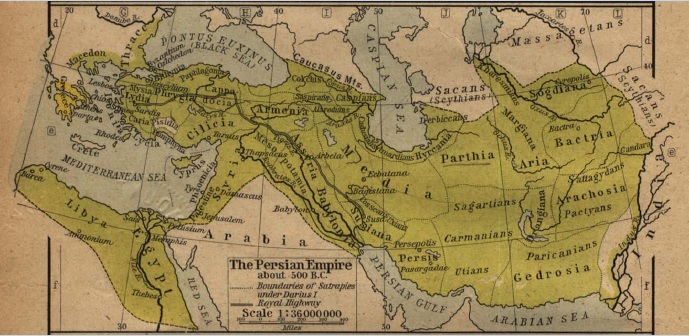
Illustration 1: The Persian Empire, about 500 B.C. From the Historical Atlas by William R. Shepherd, 1923/1926

Daniel 8:4 CJB  I saw the ram pushing to the west, north, and south; and no animals could stand up against it; nor was there anyone that could rescue from its power. So it did as it pleased and became very strong.

As we can see from the map above, the Persian empire was very extensive.

Daniel 8:5 CJB  I was beginning to understand, when a male goat came from the west, passing over the whole earth without touching the ground. The goat had a prominent horn between its eyes.

Many understand this male goat to be Alexander the Great, of the Grecian Empire – they seemed to be unstoppable. The singular horn then indicates one ruling body, Alexander.

Daniel 8:6 CJB  It approached the ram with the two horns, which I had seen standing in front of the river, and charged it with savage force.

“It” would be Alexander’s troops attacking the Medo-Persian empire.

Daniel 8:7 CJB  I watched as it advanced on the ram, filled with rage against it, and struck the ram, breaking its two horns. The ram was powerless to stand against it. It threw the ram to the ground and trampled it down, and there was no one that could rescue it from the goat’s power.

The fact that it was powerless to stand, and that there was no one that could rescue it, does NOT mean that all persons were obliterated.

Daniel 8:8 CJB  The male goat then became extremely strong; but when it was strong, the big horn was broken, and in its place arose what appeared to be four horns in the directions of the four winds of heaven.

The bighorn was Alexander, but the four horns that arose in its place were Alexander’s four generals, and they took the Grecian kingdom as far as they could.

Daniel 8:9 NASB Out of one of them came forth a rather small horn which grew exceedingly great toward the south, toward the east, and toward the Beautiful Land.

Out of the four, came two, the Seleucid kingdom to the North, and the Ptolemaic kingdom to the South. Out of the Seleucid kingdom came Antiochus IV Epiphanes. He is the one who is responsible for the desecration of the temple. The Beautiful land is Israel.

Daniel 8:10-11 NASB It grew up to the host of heaven and caused some of the host and some of the stars to fall to the earth, and it trampled them down. (11) It even magnified itself to be equal with the Commander of the host, and it removed the regular sacrifice from Him and the place of His sanctuary was thrown down.

To be honest, verses 10 and 11 are difficult, that is until we consider the role of Antiochus in Israel’s history, the problem here is that most of this information is not available to us in approved scripture. This might seem like an odd conversation to many of you, but it took on a whole new meaning one day when I tried to have a conversation with a family at church that I had never spoken with before. The husband seemed taken back that I would even try to discuss something biblical. He told me that we should only discuss things that are in the Bible. I responded back with, it’s funny you should say that, for during the time of Herod, an entrepreneurial Jew, noticed that the law in Deuteronomy listed very specific items that would become ceremonially unclean, however, it never listed granite, and so they devised a method of lathing cups, bowls, and jugs from granite. The advantage here is that the granite dinner wear would never be deemed unclean and therefore unusable. This was such a novel idea that it became a standard and exists to this day. Does scripture tells us that, and therefore make it valid? Not exactly, but then there is that amazing moment in time, when Jesus, the tektōn son, ordered the servants at the Jewish wedding to fill up the stone vessels with water. We do not know if the servants were gentiles or not, but if they had been, and the vessels had not been made of granite, those vessels would have been instantly made unclean by their touch and unusable. Did Jesus know the vessels were granite? Apparently, he did, and that is where this point of saying, he was a tektōn son, comes into play; for you see, a tektōn is the Greek word for a craftsman, and a craftsman could even apply to a poet. The scripture does not say that Joseph was a carpenter, it says he was a craftsman. He may well have been a craftsman with granite. Considering that a granite quarry was found just a half-mile outside of Nazareth, it could easily have been a place where Jesus learned a trade lathing the very granite vessels that were at this party. Now, should I ignore outside information, especially when it paints a more accurate picture of the scene? No.

Verses 10-12 of Daniel chapter 8, are very clearly defined when they are read in 1Macabees 1:44-64, and in 2Macabees 4:13-17.

Suddenly Daniel 8 takes a turn toward the future, which is about the time in which we live.

Daniel 8:13-14 NASB Then I heard a holy one speaking, and another holy one said to that particular one who was speaking, “How long will the vision about the regular sacrifice apply, while the transgression causes horror, so as to allow both the holy place and the host to be trampled?” (14) He said to me, “For 2,300 evenings and mornings; then the holy place will be properly restored.”

In Matthew’s gospel, it is recorded that the disciples, upon leaving the temple with Jesus turned and pointed out the outstanding architecture and construction materials that made up the temple, to Jesus. Jesus had his mind on other things and replied with this.

Matthew 24:1-2 NASB Jesus came out from the temple and was going away when His disciples came up to point out the temple buildings to Him. (2) And He said to them, “Do you not see all these things? Truly I say to you, not one stone here will be left upon another, which will not be torn down.”

Interesting how that Daniel 9 tells us that from the order to rebuild Jerusalem until the time of the Messiah, it would be 490 years. That is equal to 70 weeks of years. 483 of those years have transpired. There is nothing to prevent that seventieth week of years from taking place and bringing this all to an end, and yet we are still here. Are you ready?

It is almost as if, there is nothing left to do but flip the switch, and I assure you it will feel like it. And then, the church will be caught away.

Daniel 8:15-18 NLT  As I, Daniel, was trying to understand the meaning of this vision, someone who looked like a man stood in front of me.  (16)  And I heard a human voice calling out from the Ulai River, “Gabriel, tell this man the meaning of his vision.”  (17)  As Gabriel approached the place where I was standing, I became so terrified that I fell with my face to the ground. “Son of man,” he said, “you must understand that the events you have seen in your vision relate to the time of the end.”  (18)  While he was speaking, I fainted and lay there with my face to the ground. But Gabriel roused me with a touch and helped me to my feet.

Gabriel tells Daniel, understand, for the vision is for the time of the end.

The time of the end is a relative term. To the Jews who are looking for the Messiah (still,) this can only happen when He comes riding back onto the scene on His white horse, as the angry judge of the earth. To the church, the time of the end applies to the catching away of the church, and others still, see this as the outpouring of God’s wrath upon the earth.

In all of the above cases, none apply to Daniel.

Daniel 8:19 NASB He said, “Behold, I am going to let you know what will occur at the final period of the indignation, for it pertains to the appointed time of the end.

Much like the disciples, who asked Jesus two specific questions, Daniel is going to get an answer about a very detailed time frame. Another translation tells us,

Daniel 8:19 NLT  Then he said, “I am here to tell you what will happen later in the time of wrath. What you have seen pertains to the very end of time.

Perhaps you didn’t catch the difference. One calls the last seven-year period the indignation, while the NLT appropriately calls it “the time of wrath.” There really is no difference, but it is easy to assign some bluster to the word indignation and still have no action added to it. I see this nonsense all the time with my grandchildren. Wrath, on the other hand, includes a good whipping. Webster’s dictionary defines indignation as 1. Anger or extreme anger mingled with contempt, disgust or abhorrence. Most certainly, these last seven years on earth will be all of the above.

Gabriel tells Daniel, “what you have seen pertains to the very end of time.” The NASB states, “it pertains to the appointed time of the end.” We have spoken of this before, but many get very confused and cannot make a distinction between the end of the seven-years and the coming of Christ for His church.

Revelation 14:7 speaks of that very time when God will come and sit as judge over the earth. Revelation 19 gives a detailed description of what He will look like when He comes.

But if you are looking for a heavily detailed description of Jesus in His return for His church, you won’t find much. Here is what we do have.

1 Thessalonians 4:14-17 NASB (14) For if we believe that Jesus died and rose again, even so, God will bring with Him those who have fallen asleep in Jesus. (15) For this, we say to you by the word of the Lord, that we who are alive and remain until the coming of the Lord, will not precede those who have fallen asleep. (16) For the Lord, Himself will descend from heaven with a shout, with the voice of the archangel and with the trumpet of God, and the dead in Christ will rise first. (17) Then we who are alive and remain will be caught up together with them in the clouds to meet the Lord in the air, and so we shall always be with the Lord.

Titus 2:11-14 NASB For the grace of God has appeared, bringing salvation to all men, (12) instructing us to deny ungodliness and worldly desires and to live sensibly, righteously and godly in the present age, (13) looking for the blessed hope and the appearing of the glory of our great God and Savior, Christ Jesus, (14) who gave Himself for us to redeem us from every lawless deed, and to purify for Himself a people for His own possession, zealous for good deeds.

Revelation, chapters 1-3, speak of the church age, that time in which we live. This is an era that began when Jesus Christ rose from the dead, ascended into the heavens, and sent the Holy Spirit – to lead, guide, teach, and comfort us. Chapter three of Revelation ends by talking about the Laodicean church, the last of the seven personifications of the church. With that, Revelation chapter 4, opens with these words, “after these things,” and thus begins the seven-years of wrath, and the wrath of God being poured out upon the earth.

Thus begins an explanation, by Gabriel, of Daniel’s vision.

Daniel 8:20 NASB “The ram which you saw with the two horns represents the kings of Media and Persia.

When Daniel interpreted the statue for Nebuchadnezzar, he said, you, oh king are that head. With that information, we know, with precision, how the four kingdoms begin. In Daniel chapter five, we see Belshazzar now ruling as king. The chain of events takes us from Nebuchadnezzar to Armel-Marduk, and then to Nabonidus (Belshazzar) but these are all considered the Babylonian kingdom. The kingdom changes hands when Darius the Mede received the kingdom at about the age of sixty-two. (Daniel 5:31). Daniel enjoyed success in Babylonian captivity through the reign of Cyrus, the king of Persia.

A bit of information concerning Darius the Mede. There is no known historical character named Darius prior to Darius the Great, who is too late to fit in here. Since Cyrus became ruler when Babylon fell, some have identified Darius the Mede and Cyrus as one and the same (see Dan_6:28). The IVP Bible Background Commentary: Old Testament. Copyright © 2000 by John H. Walton, Victor H. Matthews, and Mark W. Chavalas.

Daniel 8:21 NASB “The shaggy goat represents the kingdom of Greece, and the large horn that is between his eyes is the first king.

We just covered that information. So we transition from the Babylonian to the Medo-Persian, to the Grecian Empire and Alexander.

Daniel 8:22 NLT  The four prominent horns that replaced the one large horn show that the Greek Empire will break into four kingdoms, but none as great as the first.

Note how the verse tells us what the chain of events will be.

  • Ruled by one, Alexander. He dies and the kingdom splits into four, ruled by four of Alexander’s generals.
  • Now the Grecian kingdom is in four parts. (1) Seleucus, who had Syria and Babylon; (2) Lysimachus, who had Asia Minor; (3) Ptolemy, who had Egypt; and (4) Cassander, who had Greece.

We know from the beginning of our look into Daniel eight, that the four horns end up being two.

Daniel 8:3 NLT  As I looked up, I saw a ram with two long horns standing beside the river. One of the horns was longer than the other, even though it had grown later than the other one.

These two horns were the Seleucid and Ptolemaic empires.

Daniel 8:23-25 NLT  “At the end of their rule, when their sin is at its height, a fierce king, a master of intrigue, will rise to power.  (24)  He will become very strong, but not by his own power. He will cause a shocking amount of destruction and succeed in everything he does. He will destroy powerful leaders and devastate the holy people.  (25)  He will be a master of deception and will become arrogant; he will destroy many without warning. He will even take on the Prince of princes in battle, but he will be broken, though not by human power.

A quick stab at verses 23, 24 for a moment.

The Contemporary English Version tells us this: “when these rulers have become as evil as possible, their power will end, and then a king who is dangerous and cannot be trusted will appear.”

This guy has a variety of descriptives attributed to him: a king of fierce countenance; full of pride, and, an arrogant king. These titles could fit a variety of people, or, ideologies.

Dan_8:25. stern-faced king. The description in verse Dan_8:23-25 pertains to Antiochus IV Epiphanes, who reigned from 175 to 164 B.C. His wisdom was corrupted for use in hypocrisy, intrigue, double-crossing and treachery. For a summary of his actions see comments on Dan_11:21-39.

[The IVP Bible Background Commentary: Old Testament. Copyright © 2000 by John H. Walton, Victor H. Matthews, and Mark W. Chavalas]

Dan_11:21. Antiochus IV Epiphanes (175-164). Antiochus IV, the brother of Seleucus, had been in Rome as a political hostage and was just returning (he had got as far as Athens) when the assassination of his brother took place. His goals included converting Jerusalem into a center for Greek culture and helping the Jews to make the transition to becoming Greek citizens with Greek ways. The intrigues that he became involved in were many, but certainly, the main one concerning Jerusalem was how he handled the high priesthood (see next entry). The text calls him contemptible, and indeed he was. His title “Epiphanes” means “god manifest”—but the people preferred “Epimanes”—“madman.” While he was certainly a member of the royal line, the throne should have gone to Seleucus’s son, Demetrius (who instead was taking Antiochus’s place as a hostage in Rome). Another intrigue concerned the throne. He set up a co-regency with his nephew (a minor), who a few years later was murdered.

While Antiochus fulfills the prophecy in many ways, there is another that is to come.

“”The holy people” refers to Israel. The slaughter of these people by Antiochus Epiphanes seems almost unbelievable. He was as bad as Hitler. However, he is merely an adumbration of the Antichrist who is coming, of whom it is said: “And it was given unto him to make war with the saints, and to overcome them: and power was given him over all kindreds, and tongues, and nations” (Rev_13:7).” Dr. J. Vernon McGee.

An adumbration is a shadow, a faint resemblance, or an imperfect representation of a thing.

Since McGee referenced Revelation 13:7 let’s go there for a minute.

and there was given to it to make war with the saints, and to overcome them, and there was given to it authority over every tribe, and tongue, and nation.” (YLT)

If, we were looking at Antiochus as the complete fulfillment:

  • How does he move forward in time to fulfill Revelation 13:7? He doesn’t.
  • Did Antiochus have authority over every tribe, and tongue, and nation? The answer is NO.
  • Could we say that Antiochus was able to make war with the saints, and to overcome them?

Then it seems, for legitimacy’s sake, I have to ask if God refers to His people as saints. Look for a reference to saints in the Old Testament and you will only find it used twice in the Psalms and again in Daniel’s writings. In Daniel, it is always used in the future tense. So let’s consider what David said.

Psalms 16:3 NASB As for the saints who are in the earth, They are the majestic ones in whom is all my delight.

The word saints are the Hebrew word qadosh and means sacred, holy: – consecrated.

While there may have been a few, like Moses and Joshua, only names like Samuel or Elijah come to mind, and we are certainly not talking about David – he was a man of flaws. But what do I learn about the character of God when I read about these people? God looks at people with different eyes than we do. The Word of God, which I must consider in its entirety, does not portray Israel as saints. If it helps to understand, I give you the Complete Jewish Bible translation.

Psalms 16:2-4 I said to Adonai, “You are my Lord; I have nothing good outside of you.”  (3)  The holy people in the land are the ones who are worthy of honor; all my pleasure is in them.  (4)  Those who run after another god multiply their sorrows; to such gods, I will not offer drink offerings of blood or take their names on my lips. (CJB)

Pay attention to these words: “The holy people in the land are the ones who are worthy of honor; all my pleasure is in them.” The potential is there, but the predominant theme throughout the Old Testament comes across like this:

Deuteronomy 1:35 ‘Not one of these men, this evil generation, shall see the good land which I swore to give your fathers,

So, yes, Antiochus has an immediate impact, but certainly not a future one.

However, there is one more aspect, and we see it in Revelation 13:7 when it says,

and there was given to it to make war with the saints.”

What is God trying to say when He calls this “beast” an “it”? Perhaps, God is trying to tell us that there is an evil spiritual entity, that is migrating through powerful world leaders.

Let’s stay on Daniel 8:25 for a minute.

Daniel 8:25 CJB  He will succeed through craftiness and deceit, become swelled with pride, and destroy many people just when they feel the most secure. He will even challenge the prince of princes; but, without human intervention, he will be broken.

This personification of evil, whom the Quranic verses indicate will be the “Jesus” they are looking for,

  • “will succeed through craftiness and deceit,”
  • “become swelled with pride,”
  • “and destroy many people just when they feel the most secure.”
  • “He will even challenge the prince of princes;”
  • “but, without human intervention, he will be broken.”Having watched enough war movies, I know that the bad guy always gets taken out. Yes, this typically means killed in a dramatic fashion, but that is not necessarily the case here; this is one of those times when the terminology is inappropriate, for this false prophet will not be slain, but dramatically disposed of, almost as if some crane-like device reaches down and picks up both the beast and the false prophet.

Daniel 8:26-27 NLT  “This vision about the 2,300 evenings and mornings is true. But none of these things will happen for a long time, so keep this vision a secret.” Then I, Daniel, was overcome and lay sick for several days. Afterward, I got up and performed my duties for the king, but I was greatly troubled by the vision and could not understand it.

Daniel claims he could not understand. Perhaps that is because he did not need to understand, but the logic in that premise is thin, at best. But it is clear to me, that WE were meant to understand. Read Daniel 12:10 in the NLT for it says, Only those who are wise will know what it means. In Christ, we are wise.

Posted in 70 weeks, Angel Gabriel, Antichrist, bible study, Daniel, destruction, End times, false prophet, Gabriel, God's character, Hell, invasion, Islam, Israel, Jerusalem, Jesus, Jews, judgment, leopard, lion, and bear, Nebuchadnezzar's statue, one world religion, overtaken, Prophetic, rapture, redemption, Rule the nations, ten horns and seven heads, Thoughts on scripture, wrath. | Tagged , , , , , , , , , , , , , , , , , , | Leave a comment

Paul ends his letter to the church in Rome with a validation. Romans 16.


Paul ends this journey through his letter to the church in Rome with what the NASB calls:

Personal Greetings.

It is so much more than that.

Romans 16:1-2 [CEV]  I have good things to say about Phoebe, who is a leader in the church at Cenchreae.  (2)  Welcome her in a way that is proper for someone who has faith in the Lord and is one of God’s own people. Help her in any way you can. After all, she has proved to be a respected leader for many others, including me.

Immediately this phrase, “I have good things to say about Phoebe,” draws my attention. The Contemporary English Version is often a good one, but this phrase is pathetically weak here. The NASB puts it this way, I commend to you our sister Phoebe.

Commend is the Greek word sunistáō meaning to cause to stand with.

What Paul was doing was directing this congregation to treat Phoebe with respect, and to stand by her in ministry.

To add to what I believe I am seeing here, check out Eugene Peterson’s Message, which often leans to the more emotional side of the conversation.

“Be sure to welcome our friend Phoebe in the way of the Master, with all the generous hospitality we Christians are famous for. I heartily endorse both her and her work. She’s a key representative of the church at Cenchrea.”

Now, ask yourself this question, why is an introduction like this necessary?

Have you ever heard someone speak on the fact, that we do not see women, treated as human beings until Jesus comes on the scene? While you might want to argue that point and say, there were, what some would call powerful women in the Biblical narratives, but on the whole, you get junk like King David merely taking Bathsheba, a married woman. After the circumcision of Moses’ sons, we do not see much of his wife; and note how Sarah, after Abraham takes Issac to sacrifice disappears from the conversation. What Jesus did for that woman caught in the act of adultery is amazing and life-changing.

So, is Paul aware of attitudes? Absolutely, and he, being a Jew, knows full well what the Jewish attitude toward women is. Considering that I have heard that Pharisees, as Paul was, were to be married men, and we never see Paul speaking of a wife or in-laws (much.)

I have wanted to be able to hold bible studies at the church. One of my pastors told me that I was too edgy to teach. He offered no explanation of what that meant. I know that if the pastor had told the audience to welcome me as a teacher; I have good things to say about him; and, you need to know that he has a faith in the Lord Jesus Christ and an understanding of the Bible, that many would come, all because I was validated, just as Paul did with Phoebe.

What else did Paul say about her?

  • “I heartily endorse both her and her work.”
  • “She’s a key representative of the church at Cenchrea.”
  • “Help her out in whatever she asks.”
  • “She deserves anything you can do for her.”

And

  • “She’s helped many a person, including me.”

Paul does not define what that help looked like; it could have been financial or she gave him a place to stay. The point is, that Paul showed tremendous respect for her and endorsed her to this new audience.

Continuing on.

Romans 16:3-5 NET. Greet Prisca and Aquila, my fellow workers in Christ Jesus, (4) who risked their own necks for my life. Not only I, but all the churches of the Gentiles are grateful to them. (5) Also greet the church in their house. Greet my dear friend Epenetus, who was the first convert to Christ in the province of Asia.

So many translations call her Priscilla, it is unimportant. What is important, is that Paul is also throwing his support to this couple. The husband, Aquilla, is a Jew, and that alone may play a role in Paul’s support of them. (I suppose it is best to think in terms of those who have served in the United States Marine Corps. They may now be 80 years old but they will insist that once you are a Marine, you are always a Marine.) We learn more about Priscilla and Aquilla in Acts 18.

After this, Paul left Athens and went on to Corinth. There he met a Jew named Aquila, born in Pontus, who had recently come from Italy with his wife Priscilla, for Emperor Claudius had ordered all the Jews to leave Rome. Paul went to see them, and stayed and worked with them, because he earned his living by making tents, just as they did. (Acts 18:1-3 GNB)

When Paul meets them in Corinth, they were effectively exiled from Italy. Since we know that the book of Acts was written around A.D. 33-29, then we know that Paul is writing this letter to the church that meets in Rome, some twenty years later. This would be plenty of time for Prisca and Aquilla to get the news of Claudius death and the rescinding of the Emperor’s order for expulsion.

Paul tells us, they risked their own necks for my life. What do we have that explains what they did?

Paul went to see them, “and stayed and worked with them, because he earned his living by making tents, just as they did. He held discussions in the synagogue every Sabbath, trying to convince both Jews and Greeks. When Silas and Timothy arrived from Macedonia, Paul gave his whole time to preaching the message, testifying to the Jews that Jesus is the Messiah. When they opposed him and said evil things about him, he protested by shaking the dust from his clothes and saying to them, “If you are lost, you yourselves must take the blame for it! I am not responsible. From now on I will go to the Gentiles.” So he left them and went to live in the house of a Gentile named Titius Justus, who worshiped God; his house was next to the synagogue.” (Acts 18:3-7 GNB)

The problem we have with scripture is that we seldom get a clear timeline, and therefore assume that it was merely five minutes between events. So when Paul is not teaching or studying, he is making tents to support himself.

  • “Every Sabbath Paul held his discussions in the Synagogue,”
  • and we are told that he is trying to convince both Jews and Greeks about Jesus as the Messiah.
  • Now that Silas and Timothy have arrived, Priscilla and Aquila have somehow removed Paul’s financial burden and Paul is now able to commit his entire time to preaching the message, and testifying to the Jews that Jesus is the Messiah (this is huge.)

Suddenly, we learn that Paul is receiving not only opposition, but evil things are now being said about him. Is it possible that the opposition was strong enough, and ugly enough, to jeopardize the lives of Priscilla and Aquila? That is possible, but we don’t know. Without casting any dispersion upon the couple, Paul shakes the dust off his clothing/shoes and moves into another house, the house of a Gentile, who happened to live right next to the synagogue.

We do know, based upon the accolades Paul is bestowing upon the couple in his letter to the church at Rome,

  • that they risked their own necks for my life. Not only I, but
  • all the churches of the Gentiles are grateful to them.

And, that Priscilla and Aquila, now back in Rome, have a house church; and that, this church Paul is writing to should also greet the church that gathers in Priscilla and Aquila’s house.

Greetings

Romans 16:6-12 GNB  Greetings to Mary, who has worked so hard for you.  (7)  Greetings also to Andronicus and Junia, fellow Jews who were in prison with me; they are well known among the apostles, and they became Christians before I did.  (8)  My greetings to Ampliatus, my dear friend in the fellowship of the Lord.  (9)  Greetings also to Urbanus, our fellow worker in Christ’s service, and to Stachys, my dear friend.  (10)  Greetings to Apelles, whose loyalty to Christ has been proved. Greetings to those who belong to the family of Aristobulus.  (11)  Greetings to Herodion, a fellow Jew, and to the Christians in the family of Narcissus.  (12)  My greetings to Tryphaena and Tryphosa, who work in the Lord’s service, and to my dear friend Persis, who has done so much work for the Lord.

It feels like this Church is a typical small-town church, where everybody knows each other.

Romans 16:13 GNB  I send greetings to Rufus, that outstanding worker in the Lord’s service, and to his mother, who has always treated me like a son.

” and to his mother, who has always treated me like a son.” Where and how did this interaction take place? Aside from the information in this letter, we are not aware. It could be that Priscilla and Aquila made some introductions, as the Jews who dispelled from Rome may have followed each other. 

Romans 16:14-16 GNB  My greetings to Asyncritus, Phlegon, Hermes, Patrobas, Hermas, and all the other Christians with them.  (15)  Greetings to Philologus and Julia, to Nereus and his sister, to Olympas and to all of God’s people who are with them.  (16)  Greet one another with the kiss of peace. All the churches of Christ send you their greetings.

  • “Greet one another with the kiss of peace.”

Final Instructions and Greetings

Romans 16:17 NET. Now I urge you, brothers and sisters, to watch out for those who create dissensions and obstacles contrary to the teaching that you learned. Avoid them!

  • “watch out for those who create dissensions and obstacles contrary to the teaching that you learned. Avoid them!”

These people you are trying to avoid, are espousing self-willed opinion, and mean to split the church. 

Me and my stories. A brother invites me to his home church. He had only recently started coming to the church I go to. Our introduction to each other, was nothing short of rough as I had judged the man over a tee-shirt he was wearing one Sunday morning. Having apologized to him for my negativity, he said, I rarely meet people like you, who are willing to accept responsibility for their actions, would you like to come to my home church? I must have felt like I owed him, and so I said sure. After several meetings I found myself thoroughly disgusted. He wasn’t holding to the doctrines of the church – things like mercy and grace, but hammered the small crowd of believers over SIN and hell. One night he said, does anyone have anything to say? And I now had plenty to say. I read him a scripture that rebutted his preaching, and made a comment about the seven layers of hell he was espousing. A dear lady also said something, in contrast, that night. We were squelched that evening, and ridiculed, publicly, the following meeting. I no longer attend there, and they fed you well. And to think, I was deemed too edgy to teach.

Paul goes on to explain,

Romans 16:18 NET. For these are the kind who do not serve our Lord Christ, but their own appetites. By their smooth talk and flattery they deceive the minds of the naive.

  • For these are the kind who do not serve our Lord Christ, but their own appetites.”
  • By their smooth talk and flattery they deceive the minds of the naive.” I have seen and heard it all; they try to come across as concerned for the health of the Church, but in truth they are merely trying to advance their own egos.

A slight shift in the greeting.

Romans 16:19 NET. Your obedience is known to all and thus I rejoice over you. But I want you to be wise in what is good and innocent in what is evil.

Obedience to what?

The gospel that Paul preaches. Some could immediately see this as Paul dispensing his own law, but if you have read through the entirety of Romans, as a few of us have, then you would see that Paul preaches freedom, and does not evade the law.

Romans 16:20 ASV And the God of peace shall bruise Satan under your feet shortly. The grace of our Lord Jesus Christ be with you.

Let’s take this letter, where Paul talks of God bruising Satan under our feet, as a relative thing, especially since the letter was written about two-thousand years ago and we are still battling with Satan and those who choose to be used by him. I get it, God has things in control, but it is difficult, at times, to remember that, especially when you are in anguish. However, the day will come, and there will be peace.

The greetings continue.

This next verse is in italics.

Romans 16:24 ASV The grace of our Lord Jesus Christ be with you all. Amen.

In almost every translation, italicized words are there merely for clarity. It then is presumed that Paul would have said this.

Doxology

Romans 16:25-27 ASV Now to him, that is able to establish you according to my gospel and the preaching of Jesus Christ, according to the revelation of the mystery which hath been kept in silence through times eternal, (26) but now is manifested, and by the scriptures of the prophets, according to the commandment of the eternal God, is made known unto all the nations unto obedience of faith: (27) to the only wise God, through Jesus Christ, to whom be the glory for ever. Amen.

  • “Now to him that is able to establish you according to my gospel and the preaching of Jesus Christ,”

The obvious question is, WHO is establishing you?

The answer is the Holy Spirit/Jesus/God.

But by what standard?

The message that Paul preached.

  • “according to my gospel”
  • “and the preaching of Jesus Christ,”
  • “according to the revelation of the mystery which hath been kept in silence through times eternal, but now is manifested,”
  • “and by the scriptures of the prophets, according to the commandment of the eternal God,”
  • “is made known unto all the nations unto obedience of faith.”

All in all, this sort of demands that we understand the message that Paul preached. Simple, and yet, not so much. We think it was all mercy and grace, but it included the law, the prophets, the revelation of “the mystery, and things that Jesus taught.”

Now wait a minute, did Saul/Paul learn from the things that Jesus taught while He walked the earth? Not a chance, but then there was that day that Saul, the pharisee, got knocked to the ground, and Jesus spoke to him. We seem to forget that Saul/Paul, went away by himself to seek God’s voice. I can only believe that he heard that voice. And, since the only documented “word” they had were the precious scrolls, kept in the synagogues, then Saul/Paul learned from this grace from the law and the prophets. In there he found the mystery that many in Israel still seek.

What a joy it is to know that the mystery is made known unto all the nations, who express an obedience of faith.

Know this, He is the only wise God, through Jesus Christ; and, to whom be the glory forever. So Be it.

Posted in Apostasy, bible study, commissioned, Cult teachings, Deception, End times, enemies, false teaching, gentiles, impart, Jews, Law of liberty, preach, Romans, Thoughts, Thoughts on scripture | Tagged , , , , , , , , , , , , , , , , , , , | Leave a comment

Watch “LIVE: Happening Now with Don Stewart” on YouTube


If you are a believer and want to know what is going on, you need to watch this.

Posted in Apostasy, Cult teachings, Deception, End times, enemies, Freedom from sin, gullibility, judgment, repress, Sin, ungodliness, unrighteousness, wickedness, wrath. | Tagged , , , , , , , , , , , , | Leave a comment

Paul’s plan to visit the church in Rome. Romans 15:22-33


As we close out chapter 15, I feel I need to recap verses 20, 21.

My ambition has always been to preach the Good News where the name of Christ has never been heard, rather than where a church has already been started by someone else. I have been following the plan spoken of in the Scriptures, where it says, “Those who have never been told about him will see, and those who have never heard of him will understand.”
(Romans 15:20-21 NLT)

So what did Paul say in the verses above?

  • That he wanted to preach in places where the name of Jesus had never been heard;
  • and that he wanted to lay a foundation among people who do not have a foundation already started by someone else.
  • “Those who have never been told about him will see, and those who have never heard of him will understand.”

Why would someone else’s foundation be a bad thing?

In my last post, I asked a couple of questions along this line of thinking. The answer is, of course, it wouldn’t unless they were laying a foundation that is dramatically different than what Paul has been laying and, most likely, in opposition.

The next question then is, what did Paul’s foundation look like?

The message of the cross is foolish to those who are headed for destruction! But we who are being saved know it is the very power of God. (1 Corinthians 1:18 NLT)

Obviously, the cross is central to who He is and who we are.

No, the wisdom we speak of is the mystery of God—his plan that was previously hidden, even though he made it for our ultimate glory before the world began. But the rulers of this world have not understood it; if they had, they would not have crucified our glorious Lord. That is what the Scriptures mean when they say, “No eye has seen, no ear has heard, and no mind has imagined what God has prepared for those who love him.” But it was to us that God revealed these things by his Spirit. For his Spirit searches out everything and shows us God’s deep secrets.
(1 Corinthians 2:7-10 NLT)

The mystery; the things God has prepared for us; all of it has been revealed to us (those who follow after Him) by His Spirit.

Although he was crucified in weakness, he now lives by the power of God. We, too, are weak, just as Christ was, but when we deal with you, we will be alive with him and will have God’s power.
(2 Corinthians 13:4 NLT)

Jesus was crucified in weakness; at least that is how the world perceives it. But, he now lives by the power of God, and we also live through that power.

My old self has been crucified with Christ. It is no longer I who live, but Christ lives in me. So I live in this earthly body by trusting in the Son of God, who loved me and gave himself for me. (Galatians 2:20 NLT)

In associating ourselves with the life of Christ, we became baptized (I am talking about water baptism, although NOT mandatory.) In doing that, we presented ourselves as dead in Christ. It doesn’t end there, as we, by the same process, are made to rise with Him. Yes, it is all representational while we are here on earth, but there is a day coming when He shall gather those who are awaiting Him, to Himself.

Those who belong to Christ Jesus have nailed the passions and desires of their sinful nature to his cross and crucified them there. (Galatians 5:24 NLT)

This foundation stone that we see in Galatians 5:24 is confusing for many because we get it preached to us in a manner that leads you to believe that you MUST live like this, and we cannot. Yes, the Holy Spirit, living inside of you, will lead and guide us into all truth, and, we are told, we cannot abide in sin. But the reality is that we will be somewhat tortured by our constant failures as we try to hit the bullseye. (Missing the bullseye is deemed to be sin.)

Mercy is certainly an aspect of that foundation. It is an aspect that seems in opposition to the laws of God, that we find in the Old Testament; the mercy is there, but it is merely cloaked. Search within the letters that Paul wrote, and you will 19 references to Mercy; 22 if you include the letter to the Hebrews. Here are a few.

1Corinthians 7:25  the Lord in his mercy has given me wisdom that can be trusted, and I will share it with you.

2Corinthians 4:1  Therefore, since God in his mercy has given us this new way, …

Galatians 1:6 God, who called you to himself through the loving mercy of Christ. …

Ephesians 2:4-6 (NLT)  But God is so rich in mercy, and he loved us so much that even though we were dead because of our sins, he gave us life when he raised Christ from the dead.

Colossians 3:12  God chose you to be the holy people he loves, you must clothe yourselves with tenderhearted mercy,

1Timothy 1:16  God had mercy on me so that Christ Jesus could use me as a prime example of his great patience with even the worst sinners. …

Titus 3:5 he saved us, … because of his mercy.

Hebrews 4:16 let us come boldly to the throne of our gracious God. There we will receive his mercy, and we will find grace to help us when we need it most.

So, to make this brief, the foundation Paul preached is:

  • the cross,
  • our being in Him,
  • hope,
  • and mercy.

If you think about the ramifications of those simple words, and what they mean to our relationship with the Father, they speak volumes.

With all that in mind, Paul says,

Rom 15:22  This is why I have often been hindered from coming to you. 

Here is where the NASB entitles the next section:

Paul’s Plan to Visit Rome

As I sat through a book study on Acts, I never saw it as a planned visit. I saw phrases like this: “the Holy Spirit would not let them preach in Asia;” and, “the Spirit of Jesus would not let them.” On one occasion we got this,

During the night, Paul had a vision of someone from Macedonia who was standing there and begging him, “Come over to Macedonia and help us!” After Paul had seen the vision, we began looking for a way to go to Macedonia. We were sure that God had called us to preach the good news there. (Acts 16:9-10 CEV)

Scripture does give us a well-spaced chain of events, that demonstrates Paul’s desire to go to Rome.

In Acts 18:2 – 19:21 we learn that Priscilla and Aquila, acquaintances who have become close friends of Paul, had been forced out of Rome, along all the other Jews, by the order of Emperor Claudius. This story ends with this: “Paul decided to visit Macedonia and Achaia on his way to Jerusalem. Paul had said, “From there I will go on to Rome.”

In Acts 20:16 we see Paul migrating back to Jerusalem because, “He was in a hurry and wanted to be in Jerusalem in time for Pentecost.” At almost every stop the Jews rose up against him when he spoke. Acts 21:10-11 finds Paul north of Jerusalem in Caesarea. After several days, the prophet Agabus, who came from Judea, south of Jerusalem, took Paul’s belt, and with it tied up his own hands and feet, while saying, “The Holy Spirit says that some of the Jewish leaders in Jerusalem will tie up the man who owns this belt, and, they will also hand him over to the Gentiles.” The Gentiles, in this case, were the Roman guards.

The trek now has Paul, a prisoner, headed to Rome, as he, by right of citizenship, could appeal his case to Caesar, which he did. Storms, shipwrecks, and snakes; it sounds like an Indiana Jones movie. In the midst of this journey, which I am sure some would see as nothing short of negative, “the Lord stood beside Paul and said, Don’t worry! Just as you have told others about me in Jerusalem, you must also tell about me in Rome.” And that takes us to Acts 23:11.

Paul may have interacted with the very people he longed to see, but we do not see him physically going to their meeting place. What we do see, is that Paul got to preach to the virgin territory that Isaiah spoke of, the Emperor himself.

I give you Eugene Peterson’s take on Paul’s recollection.

Romans 15:23-29 MSG  But now that there is no more pioneering work to be done in these parts, and since I have looked forward to seeing you for many years,  I’m planning my visit. I’m headed for Spain, and expect to stop off on the way to enjoy a good visit with you, and eventually have you send me off with God’s blessing.  First, though, I’m going to Jerusalem to deliver a relief offering to the Christians there.  The Greeks—all the way from the Macedonians in the north to the Achaians in the south—decided they wanted to take up a collection for the poor among the believers in Jerusalem.  They were happy to do this, but it was also their duty. Seeing that they got in on all the spiritual gifts that flowed out of the Jerusalem community so generously, it is only right that they do what they can to relieve their poverty.  As soon as I have done this—personally handed over this “fruit basket”—I’m off to Spain, with a stopover with you in Rome. My hope is that my visit with you is going to be one of Christ’s more extravagant blessings.

Paul, by way of this letter, asks these fellow believers in Rome to pray, with some urgency, for him.

Romans 15:30 NLT  Dear brothers and sisters, I urge you in the name of our Lord Jesus Christ to join in my struggle by praying to God for me. Do this because of your love for me, given to you by the Holy Spirit.

Here is what he asked them to pray for.

Romans 15:31-32 NLT 

Pray that I will be rescued from those in Judea who refuse to obey God.

Pray also that the believers there will be willing to accept the donation I am taking to Jerusalem.

Then, by the will of God, I will be able to come to you with a joyful heart, and we will be an encouragement to each other.

Stop and think about what he asked them. He asked to be rescued from those who refuse to obey God.

Doesn’t that imply that in some manner, whether Jewish or a follower of Christ, they are refusing to obey God?

Several months ago I was involved in, what the leader called, a man-cave. It was just a bunch of guys who found a place they could, under the guise of being in a Christian environment, act like they were in a bar. Yep, I said it. I was already deep into this study of Romans and had seen how the law was still a part of our lives. In this mancave setting, I saw a horrendous correlation between what Paul said, is this law that is written upon our hearts, and an unrestrained concept of mercy and grace. This unrestrained version is a grace that some, not only preach but feel it gives them the right to refuse to obey God’s law. Much to no avail, I pointed out that Jesus came to fulfill the law, NOT do away with the law. That law is God’s law, and, as I said, it is written upon our hearts. It is what keeps you from going completely over the edge.

Why would believers, even if they are from the South, so to speak, in Judea, try to block Paul from taking a donation to Jerusalem?

To be honest, we don’t have an answer to that. One thing that jumps out in my mind, is that Judea suffered a huge economic blow from a recent famine, and may be in a hoarding mode. (I covered this in the previous post.) You also noticed that I used the phrase, “the South.” Here in America, “the South” still carries overtones of bigotry, slavery, hard-drinking, and some generally rough characteristics. Now whether that is the case here, I don’t know, but it could be. And there is one other thing. How would you know if someone was there to swindle you? Swindlers are not something new, as SIN has always been with us, and a swindler always thinks that someone is out to swindle them.

This leads me to a pastor of mine. Although I do not call him a friend, he is a decent and generous man. There were services when the Holy Spirit would be so evident, that he would forget to take up an offering; and yet, because he made sure the church tithed on the income they took in, we, as a church, were always able to pay our bills. Offerings were taken up to build in Mexico, and so we built; of all the things I have done in my life, that was the most rewarding. And, most recently, although an anonymous person had financed the construction of the building we use, and this financing had a ridiculously low-interest rate, with no pressure to pay it back, he once again took up an offering, because he felt strongly that we needed to pay this person off, and in rather short haste, we, as a church body did just that. The point here is this, we, as a church, learned to trust this pastor’s financial leadership. Is this the case with Paul? We don’t know.

Paul, as is his habit in closing, says,

Romans 15:33 NLT  And now may God, who gives us his peace, be with you all. Amen.

Posted in Apostle Paul, bible study, commissioned, gentiles, God's character, good news, grace, In Christ, Jerusalem, Jesus, Jews, Law of liberty, Mercy, Peace, Prayer, Romans, Thoughts on scripture | Tagged , , , , , , , , , , , , , , , , , , | Leave a comment

Micah 4:8 The hill and stronghold of the Daughter of Zion.


Due to issues popping up it has taken me a couple of weeks to get back to working on Micah.

As I migrated through the Christmas season, I became aware that Micah spoke of Bethlehem, and that got me even more excited. Sadly, I am finding it more difficult to remember things and therefore find it difficult to communicate what I am feeling and experiencing as I go through these studies with you. On the plus side, a lack of memory leaves me with no ammunition for fights that arise, but that is okay as I have not been called to fight.

The following is from a blog site run by Jewish believers and was the devotional feature of their daily news headlines. It is called Worthy Christian Blogs.

I used to post my blogs there, but I found it to be filled with Pharisees and scribes who have nothing better to do than to berate people who are trying to point people to Jesus. With that said, I am nothing short of suspicious of when it comes to their editorial side. However, this one, right before Christmas, caught my attention, and I was just in awe of what I saw, as it spoke to me on so many levels.

Micah 4:8 AMP And you, O tower of the flock, the hill, and stronghold of the Daughter of Zion, unto you, the former dominion shall come, the kingdom of the Daughter of Jerusalem.

The devotional included Micah 4:8 and Micah 5:2.

“But as for you, Bethlehem Ephrathah, Too little to be among the clans of Judah, From you One will go forth for Me to be ruler in Israel. His goings forth are from long ago, From the days of eternity.” (Micah 5:2 NASB)

“There are many who are not aware of the very deep significance of Bethlehem, Yeshua’s (Jesus’) birthplace. Everyone knows that Bethlehem was a place where shepherds grazed their sheep, and where the Messiah was to be born, but do not realize that it was a town designated as the birthing place for lambs which were used for the Passover sacrifice. The Scriptures give significant details about this little town lying slightly south of Jerusalem.

In Micah 4:8 we read about the “Watchtower of the flock,” or in Hebrew, “Migdal Edar.” According to the “Life and Times of Jesus the Messiah,” by Alfred Edersheim, a Jewish believer in the late 1800’s, Migdal Edar was the location where the Messiah was to be revealed. This watchtower stood as a place of protection for the city from approaching enemies, but it was also utilized by shepherds to watch over the specific flocks from which sacrificial Passover lambs were taken.

The shepherds who were tending these particular flocks were no ordinary shepherds. They were specifically trained by the Rabbis for a holy task. They had to ensure that, as much as possible, every lamb was free of any blemish or injury, in order to be used for the Passover sacrifice. Since they were instructed by the Rabbis, they almost certainly knew of those passages in the Targums (Aramaic translations) and the Mishna associating the birth of the Messiah with “Migdal Edar.” For example, Migdal Edar is translated in one of the Targums as “The Anointed One of the Flock of Israel.” It is also written in the Mishna that “He spread his tent beyond Migdal Edar, the place where King Messiah will reveal Himself at the end of days.”

I finished reading this, that day, and suddenly I realized that Jesus, the lamb, was intentionally born in Bethlehem, under the watchful eye of these trained shepherds, with the intent of making sure that God’s lamb would be born without spot or blemish, just as scripture called for.

Those shepherds we deem poor were the richest of all for they knew, listened, and tended to the King of Kings that day.

The Wise men also knew and came, however, they came later when Joseph and Mary were no longer in a manger; and, they brought enough gold and salable items that the family could live comfortably for several years. This was important as they immediately went into hiding after this event.

Consider something. When Herod saw the considerable entourage that came with the wise men he panicked and called the Chief priests and elders, and asked them why they were here. They knew the answer, but they would not come, nor would they worship. After the wise men left, Herod then had all the male children two and under killed.

Their post ended with a personal address and said this:

“those shepherds had strong hints of Messiah’s advent in the very town where they lived so that when the angelic host appeared announcing his arrival, they responded immediately and went to worship Him. We too have increasing signs of His soon Second Coming. Are we also prepared to respond? “

Verses 9-13 are, to say the least, dismal. Micah came from Israel, the Southern region, and was the last to go into captivity.

“Now, why do you cry out loudly? Is there no king among you, Or has your counselor perished, That agony has gripped you like a woman in childbirth? “Writhe and labor to give birth, Daughter of Zion, Like a woman in childbirth; For now you will go out of the city, Dwell in the field, And go to Babylon. There you will be rescued; There the LORD will redeem you From the hand of your enemies. “And now many nations have been assembled against you Who say, ‘Let her be polluted, And let our eyes gloat over Zion.’ “But they do not know the thoughts of the LORD, And they do not understand His purpose; For He has gathered them like sheaves to the threshing floor. “Arise and thresh, daughter of Zion, For your horn I will make iron And your hoofs I will make bronze, That you may pulverize many peoples, That you may devote to the LORD their unjust gain And their wealth to the Lord of all the earth. (Micah 4:9-13 NASB)

Here Micah points out:

  • The anguish. “ That agony has gripped you like a woman in childbirth? “Writhe and labor to give birth, Daughter of Zion, Like a woman in childbirth.”
  • That Israel would go into captivity but be rescued eventually, and in time, be redeemed. “ For now you will go out of the city, Dwell in the field, And go to Babylon. There you will be rescued for the LORD will redeem you From the hand of your enemies.”
  • Even though many nations assemble against Zion, “they do not know the thoughts of the LORD, And they do not understand His purpose; For He has gathered them like sheaves to the threshing floor.”
  • Although it is hard to see, Israel will have her day. “Arise and thresh, daughter of Zion, For your horn, I will make iron And your hoofs I will make bronze, That you may pulverize many peoples, That you may devote to the LORD their unjust gain And their wealth to the Lord of all the earth.”
Posted in bible study, End times, enemies, forsaken, invasion, Israel, Jerusalem, Micah, recovery, redemption, restore, the nations, war | Tagged , , , , , , , , , , , | Leave a comment

For the law of the Spirit of life in Christ Jesus. Romans 8:1


Romans chapter eight opens with this,

“Therefore, there is now no condemnation for those who are in Christ Jesus.”
(Romans 8:1 NASB)

I am not good at English grammar, and so I pay to have my work edited to an acceptable and readable degree. I said all that to say, that I may make odd and rather apparent statements, such as, for Paul to open with the word, therefore, is indicative of a thought that needs to be continued; and, it demands that we understand what that previous thought was. On that note, we ended our look at Romans chapter seven with this upbeat tone.

Wretched man that I am! Who will set me free from the body of this death? Thanks be to God through Jesus Christ, our Lord! So then, on the one hand, I myself with my mind am serving the law of God, but on the other, with my flesh the law of sin.
(Romans 7:24-25 NASB)

A small Bible study group I am involved in is studying the same section of scripture but leans heavily on Warren Wiersbe’s commentary on Romans. Wiersbe says that this “gives the “therefore” of no condemnation…” If that were all I had to go on, I would be scratching my head in bewilderment, but Wiersbe continues with – “a tremendous truth and the conclusion of a marvelous argument.” Well, yes it is, but suppose you had just joined the group that night, would you know what that argument was? Probably not.

In concise words, none of this would be possible if not for “Jesus Christ, our Lord.”

Assuming that you have been following my studies, the majority of you should realize by now, that until the day when this body gets changed, we are stuck with this body of death. In itself, that is a dismal proposition. Thank God Jesus went to the cross.

Here is where that change I spoke of, comes into play.

“in a moment, in the twinkling of an eye, at the last trumpet; for the
trumpet will sound, and the dead will be raised imperishable, and we will be changed.” (1 Corinthians 15:52 NASB)

As Paul stated in the NASB, “thanks be to God through Jesus Christ, our Lord, we are set free.”
If you operate on the principle that you died to this world and that dead people don’t have a problem with lust, then you should make it through this journey with relative success (spiritually.)

Eugene Peterson’s Message adds this commentary to Romans 7:25,

He (Jesus Christ) acted to set things right in this life of contradictions where I want to serve God with all my heart and mind, but am pulled by the influence of sin to do something totally different.” The parenthesis is added by me.

And the NLT puts a slightly different spin on 7:25 by saying,

Thank God! The answer is in Jesus Christ, our Lord. So you see how it is: In my mind, I really want to obey God’s law, but because of my sinful nature, I am a slave to sin.”

If it were not for Christ Jesus, we would be lost forever. Ah, but we are not lost, because the answer to this brokenness in us that pushes us to fulfill our desires, is wrapped up in our relationship with Jesus Christ.

Some, like Warren Wiersbe’s commentary, will try to tell you that you were healed the day you accepted Christ. If you sat in meetings with me, where people try to own that idea, you would hear me say, “I wish that were true.”

As Paul said in chapter seven,

But if I know that what I am doing is wrong, this shows that I agree that the law is good. So I am not the one doing wrong; it is sin living in me that does it. And I know that nothing good lives in me, that is, in my sinful nature. I want to do what is right, but I can’t. I want to do what is good, but I don’t. I don’t want to do what is wrong, but I do it anyway. But if I do what I don’t want to do, I am not really the one doing wrong; it is sin living in me that does it. (Romans 7:16-20 NLT)

I have learned that, for me, in this life, I need to lean heavily upon the Holy Spirit.

For the law of the Spirit of life in Christ Jesus

And with that, we move into Romans chapter eight.

The Complete Jewish Bible starts us off with the word, therefore, as do many other translations.

Therefore, there is no longer any condemnation awaiting those who are in union with the Messiah Yeshua. (Romans 8:1 CJB)

I often hear my spirit say, ARE YOU KIDDING ME? The majority of the condemnation that I have experienced in this Christian life has come at me from religious people. Need examples?

  • The pastor who verbally accosted me and said that I am too edgy to teach Bible study; and yet, he allows others, who stand in defiance as they speak in opposition to accepted church Biblical values and doctrines.
  • An individual whom I used to deem a friend, called me a firebrand (this is a person who provokes people,) and scolded me in public because I try to get people excited about the Word of God.
  • And then, there is the brother in Christ who wanted to make himself look important by trying to argue me down in a home-group. The question was asked of the small group that night, how big was David when he fought Goliath. (Three hard pieces of Biblical evidence demonstrate his potential size, and it wasn’t small.)

So what is Paul saying? Even if abuse or hardship comes, there is NO condemnation awaiting us on the part of Jesus or the Father, because we are in union with Jesus by our acceptance of Him and what He did for us.

The statement, “there is NO condemnation” is straight forward. You would think we should all have this established in our thinking. However, even in a small group that I am part of, a dear lady, who we assume to be knowledgeable in scripture, said, then what do we do with what Paul said about confessing our sin? I told her, don’t you see, the assumption is that:

a. God has just moved you over to the “burn this one in hell” list because of your “sin.”

b. That sin, (You would not expect the eighty-year-old church lady, to be committing grievous sins of the flesh.) has everything to do with raunchy fleshly desires. IT DOES NOT. Sin is merely missing the mark. Every day, we have marks we have to hit, such as loving the unlovable. How does that work out for you? Yeah, me too.

If this “sinning” stuff were the end-all, then NONE of us would go to heaven.

c. This idea of confessing, as though it was a continual act of slaughtering a lamb for your sins, does not change God’s heart toward you. 1 John 1:9 NASB says, “If we confess our sins, He is faithful and righteous to forgive us our sins and to cleanse us from all unrighteousness.”

Well, obviously, John is talking about the God relationship, but the word confess is not what you think.

Confess is the Greek word homologeō and means to assent.
Assent, from Webster’s dictionary, means “the act of the mind in admitting, or agreeing to, the truth of a proposal.”

A proposal? So your mind has been presented with a proposal, and in many cases, the enemy is the one doing the proposing. Another way to look at this is, Satan offers you a jump (off a cliff for all I know,) and even though you are NOT being pushed, you choose not to resist that nonsense and take the jump. IF you have done that and survived, and you are now confessing to a safe and sane believer – hopefully, how you bought into the lie of the enemy.

Rejoice for you have done several positive things:

  • You have just become open and honest about your sin – in which you missed the mark.
  • You are at least, owning your actions, and the damage you may have created.
  • Now you have the chance to make a change and potentially NOT do that again.
  • And, our intercessor, Christ Jesus, is praying alongside you, for your healing and restoration to sanity.

Before I move on, I want to point something out.

We have many translations available for our usage. If you chose to use the KJV, for example, you would get this: “There is therefore now no condemnation to them which are in Christ Jesus, who walk not after the flesh, but after the Spirit.”

Pay attention to these words:

who walk not after the flesh, but after the Spirit.”

One version, the exeGeses ready research Bible, indicates that this line is NOT in the original manuscripts. Words added for clarity, such as “There is,are most often italicized, but that did not happen here, and, to make our understanding more muddled, the KJV gives me Strong’s numbers for the added line.

Confusing, absolutely, and it requires that we pay attention and dig a little more.

Now, what do I do with this dilemma that the added line creates?
For me, I run several tests on it, and I lean on the Holy Spirit.

If you are not filled with the Holy Spirit, then you need to ask the Father to fill you with that free gift. Scripture tells us that:

“But when He, the Spirit of truth, comes, He will guide you into all the truth; for He will not speak on His own initiative, but whatever He hears, He will speak; and He will disclose to you what is to come. (John 16:13 NASB)

So, clearly, the Holy Spirit is a huge benefit, and He – being a persona of God, no less than Jesus is, will show you the truth and guide into the truth. Sorry, but you are just going to have to learn to trust Him, just as you trusted Christ Jesus to be your Lord.

If I choose not to use the KJV translation with the added words, am I losing some deep part of God’s heart?

I did not pay much attention to this line before, as much of Romans was like muddy water. Today though, I find that the phrase most certainly implies the meeting of some conditional human standard. If that is the case, who set the standard because knowing that will influence how much effort I put into sorting this out?

Lacking an answer as to who set the standard, I move on to some other test. Now, I find myself asking, does what seem like God’s word truly reflect God’s nature and character; if so, how would I evaluate that? 

Considering that God sent His only Son, to die a brutal death, for a world that did not know or love Him, why would He now put stipulations, on what, Paul pointed out, are impossible in our flesh to fulfill, back on us again

I can learn quite a bit about God’s character just by looking at Jesus’ life. He told us, “whatever I see the Father do, I do.” And, as Peter said, “Jesus went about doing good and healing all who were oppressed of the devil.

“You know of Jesus of Nazareth, how God anointed Him with the Holy Spirit and with power, and how He went about doing good and healing all who were oppressed by the devil, for God was with Him.” (Acts 10:38 NASB)

What I understand about what happened here in Acts 10:38, is that there was no exclusion, as all were oppressed by the devil. Again, I am aware that religious folk will accost you for advocating how Jesus operated by saying, the devil is not hiding under every bush, and they would be right. But consider this, Satan took one-third of the angels with him in his fall. One-third of a countless quantity is an astronomical amount, and they are all most certainly helping Satan in his final attempts at destroying anything and anyone that looks like Jesus.

The bottom line for me, God would not, and has not made a conditional relationship with us. Sadly, this very conversation became a point of contention in “Bible Study” one recent Thursday. Fortunately, I did my own personal study and then looked at the Wiersbe commentary and that is precisely what he found. I pointed this out to my critic and that person, for the moment, shut-up.

I must admit that having people walk according to the Spirit would be a better way of living for all of us, but we must learn to show people who are struggling, just as we do with the enemy’s taunts, a little more grace.

I am going to throw in a verse that I was reminded of today before I started working on this study on Romans 8.

Let all bitterness and wrath and anger and clamor and slander be put away from you, along with all malice. Be kind to one another, tenderhearted, forgiving each other, just as God in Christ also has forgiven you. (Ephesians 4:31-32 NASB)

I came upon this verse in Ephesian in my morning devotional. It is something a bunch of us do every day. The writer of the devotional, Andy Stanley, asked the question, should we respond affirmatively to this merely because it is God’s Word, or should we follow the advice, because Christ has forgiven us? In other words, act like Jesus. If you want to have a mind-blowing experience, then look these words up in a concordance like Strong’s.

Posted in angels, Apostle Paul, bible study, disciplined, Faith, fallen angels, forgive, Freedom from sin, God's character, good news, grace, In Christ, Jesus, laying on of hands, Mercy, Peace, righteous, Romans, spiritual gifts, strongholds, the good news, Thoughts on scripture, understanding | Tagged , , , , , , , , , , , | Leave a comment

Paul tells us why Romans 8:1 works. Romans 8:2-4.


We learned in Romans 8:1 that there is NOW (an ever-present tense) NO condemnation. To me, an obvious conclusion is that this applies to my relationship with the Father through Jesus Christ.

So what does Romans 8:2 tell us?

For the law of the Spirit of life in Christ Jesus, has set you free from the law of sin and of death. (Romans 8:2 NASB)

As I sit with my friend, going through the book of Romans, I am reminded of how many times I have heard the phrase within the Christian community – we are free from the law. At moments like that, I turn to my friend and ask, is that an accurate statement?

Well, right there, in front of us, are words in opposition to that assertion. For the law of the Spirit of Life in Christ Jesus.


Let’s tear this up for a moment. The word law is focused on the requirements that the Jews understand, the Torah. If you are a devout follower of Warren Wiersbe, then you are already looking for a way to fight with me because he leans heavily toward an exclusively Gentile audience.

The word Law, as included in Romans, is the Greek word nomos and means anything established; anything received by usage; a custom; a law, or a command. Yes, the Torah falls under these categories.

But, did the Jews, as Paul points out, know the Torah as something that brought life?

Hardly; all they could perceive was the word NO, just like impudent children. If you read my previous posts on Romans, then you would understand that these people, Moses led out of Egypt, were effectively Egyptians. I pointed out how Stephen, gave the Jewish council a history lesson, which none of them disputed, in which he accurately points out how “Israel” brought their Egyptian gods and the tent of Moloch out of Egypt. The “law” written in stone was at this point ten simple rules, and yet, we see the immediate death that the law brought, as the first rule was to love the Lord their God. The problem is, Jehovah was not their Lord.

Is there a law of the Spirit of life in Christ Jesus that we can turn to?
Absolutely, but we don’t call it a law; we call them the gospels, epistles, and letters to the church.

Jesus said,

Do not think that I came to abolish the Law or the Prophets; I did not come to abolish but to fulfill. “For truly, I say to you, until heaven and earth pass away, not the smallest letter or stroke shall pass from the Law until all is accomplished. “Whoever then annuls one of the least of these commandments, and teaches others to do the same, shall be called least in the kingdom of heaven; but whoever keeps and teaches them, he shall be called great in the kingdom of heaven.” (Matthew 5:17-19 NASB)

One more thing about the law.

Paul opened his letter to the church in Rome, a church primarily comprised of Jewish believers, who had an attitude problem with the Gentile believers, with this statement, “I Paul, a slave of Christ Jesus.

If Paul, too, had found his freedom in Christ Jesus, then why the slave conversation? 

  • Because he knew that the Torah still holds reign over the Jewish community.
  • Only with the new eyes, found in a relationship with the Father – through the Son, can we see that the Torah was meant for life.
  • And, that this life we live is meant to be lived in the Spirit – the Spirit of Life in Christ Jesus, not the letter of the law.

So, without calling it “the law,” do we have any constraint upon our lives?
Certainly, we do. We have the law written upon our hearts.

“But this shall be the covenant that I will make with the house of Israel; After those days, saith the LORD, I will put my law in their inward parts, and write it in their hearts; and will be their God, and they shall be my people.” (Jeremiah 31:33 KJV)

Spare me the arguments. I realize that contextually Jeremiah 31:33 is talking about the Jews, but God saw fit to add this addendum that makes it valid for anyone. You can find this in 2Timothy 3:16.

Saul, also known to us as Paul, and a self-proclaimed expert in the Torah, could hold his ground with anyone in a discussion about that law. So he knew the legalism the Torah represented well, and yet the Torah is the basis for the freedom we find in the New Testament. It kind of makes you wonder what Jesus might have said to Saul after He knocked him to the ground, although we should take into consideration that Saul/Paul spent three years in the Sinai peninsula, at the base of the mountain where Israel had camped, listening to the instructions from the Holy Spirit.

As a follower of Christ, there is no longer any condemnation toward me from Jesus, the one to whom all judgment has been given. Why that works has everything to do with the cross, including the life I now live because of and through Him.

Freedom from the law of sin and death.

For the law of the Spirit of life in Christ Jesus has set you free from the law of sin and of death. For what the Law could not do, weak as it was through the flesh, God did: sending His own Son in the likeness of sinful flesh and as an offering for sin, He condemned sin in the flesh, (Romans 8:2-3 NASB)

Let’s stop here for a minute. Verse two says, “For what the Law could not do, … God did:”

The Law only pointed out the necessity for a savior, although I admit that I still have a tough time seeing aspect of the law. The law was not the savior, nor could it be the sacrifice for our redemption, that had to be achieved by the blood heir, Christ Jesus. By the way, if you have ever seen the movie version of The Lion, the Witch, and the Wardrobe by CS Lewis, you are seeing Azlan play out that role when he gives himself over to the witch as payment for young Edmund’s treasonous act.

So what did God do?

“sending His own Son in the likeness of sinful flesh and as an offering for sin.”

God sent His Son. Since humanity has an embedded/genetic desire to lust/sin, God had to bypass all that by creating His own egg and having it fertilized. One of Islam’s arguments against the God we serve is what they deem, the disgusting idea that God would have sex. Well, no one said He did. If you cannot handle the idea that the creator of all things, could make a fertilized egg and place that egg inside of Mary, then you need a bigger God.

Now, this is where the statement, in the likeness of sinful flesh comes into play. Yahshua looked just like every other broken human that walked the earth, there was nothing special about Him. (In case you don’t realize, Jesus still maintains that human form.)

The word likeness is the Greek word homoiōma and means a form; abstractly resemblance:

So, when we say, the likeness, He was every bit human, but without the built-in sin. Haven’t you ever wondered, how Jesus, could think through the process of making a whip out of cords, build it, and then use it against the sellers and money changers in the outer courts of the temple that day? What He did was premeditated. I can guarantee you, that if I did it I would be sinning or missing the mark; and yet, in everything Jesus did, He did not sin. I have yet to completely sort that out. Suffice it to say, that sin that lies within me longs to erupt on people at times, but sin was not there with Jesus pushing Him.

Romans 8:3b from the Message.

” In his Son, Jesus, he personally took on the human condition, entered the disordered mess of struggling humanity in order to set it right once and for all. The law code weakened as it always was by fractured human nature, could never have done that. The law always ended up being used as a Band-Aid on sin instead of a deep healing of it.”

And so he condemned sin in the flesh,

Romans 8:4 NIV  in order that the righteous requirement of the law might be fully met in us, who do not live according to the flesh but according to the Spirit.

So, he condemned sin in the flesh, but who is the “he” referring to? Jesus. I know, God sent His Son to pay the price, so why can’t the “he” refer to God? Alright, let’s look at the context once again.

Romans 8:3-4 NIV  For what the law was powerless to do because it was weakened by the flesh, God did by sending his own Son in the likeness of sinful flesh to be a sin offering. And so he condemned sin in the flesh,  (4)  in order that the righteous requirement of the law might be fully met in us, who do not live according to the flesh but according to the Spirit.

Plainly you can see, that God sent His own Son to be the sin offering.

The law demanded sacrifices.

Bluntly, blood had to be spilled, but the blood of animals was never enough to redeem back the population of a planet that had been taken captive. And so God gave Himself, in the form of His Son, and the exchange was made, life for life. Satan apparently was not aware of the sinless state of the Son could never trap Him in deception – although he thought he had. What glee he must have felt seeing Jesus hanging on that cross. What a failure this Messiah had proven to be, or so he thought. Satan, it seems, had taken Jesus captive. What a shock when Jesus ripped the doors off the prison gates of Hell. It seems that a forerunner, Samson, had demonstrated how to do it when he ripped out the gates of the city.

The NLT tells us,

Romans 8:3b, 4 “He sent his own Son in a body like the bodies we sinners have. And in that body, God declared an end to sin’s control over us by giving his Son as a sacrifice for our sins. He did this so that the just requirement of the law would be fully satisfied for us, who no longer follow our sinful nature but instead follow the Spirit.”

Having watched people repeatedly go to the altar to be saved, you have to wonder, do they not understand this?

He (Jesus) did this so that the just requirement of the law would be fully satisfied for US, who no longer follow our sinful nature but instead follow the Spirit.” This is a present-tense statement. There is nothing about it, in which we have to maintain some status of righteousness; it was done, once, for all. I will admit, that if we could maintain this righteousness, life here on earth would be a more peaceful place, but it is not, and you know that.

1 Peter 3:18 NLT  Christ suffered for our sins once for all time. He never sinned, but he died for sinners to bring you safely home to God. He suffered physical death, but he was raised to life in the Spirit.

I suggest you read Hebrews chapter 9, for it speaks of this very thing.

Hebrews 9:24-28 NLT  For Christ did not enter into a holy place made with human hands, which was only a copy of the true one in heaven. He entered into heaven itself to appear now before God on our behalf.  (25)  And he did not enter heaven to offer himself again and again, like the high priest here on earth who enters the Most Holy Place year after year with the blood of an animal. (26)  If that had been necessary, Christ would have had to die again and again, ever since the world began. But now, once for all time, he has appeared at the end of the age to remove sin by his own death as a sacrifice.  (27)  And just as each person is destined to die once and after that comes judgment,  (28)  so also Christ was offered once for all time as a sacrifice to take away the sins of many people. He will come again, not to deal with our sins, but to bring salvation to all who are eagerly waiting for him.

Romans 8:4 ends like this,

who no longer follow our sinful nature but instead follow the Spirit.”

This is not a conditional statement, like the one I perceived in Romans 8:1, but a description; as Paul, like God, looked to the future and saw you acting like the King you were meant to be.

The Contemporary English Version does an excellent job of clarifying what is going on here.

Romans 8:4 CEV  He did this so that we would do what the Law commands by obeying the Spirit instead of our own desires.

Posted in apologetics, Apostle Paul, bible study, deception, disciplined, Freedom from sin, God's character, grace, guilt, Hope, In Christ, Jesus, Mercy, redemption, righteous, Romans, The Word was God, Things I have never noticed before, Thoughts on scripture, understanding | Tagged , , , , , , , , | Leave a comment