He who baptizes with the Holy Spirit. John 1:32-35.


Previously I told you about an unusual statement from John the baptizer.

“I did not recognize Him, but so that He might be manifested to Israel, I came baptizing in water.” (John 1:31 NASB)

If I focus on the first part of the sentence, it is nothing less than muddy water as I try to find the scriptural references that validate who the “He” is that should be manifested to Israel. Because there are always those who will say you are not very bright if you can’t figure out that this is Jesus.
In response to that domineering attitude, you need to understand my calling. I write for Christians that will not or have not picked up a Bible with enough frequency to say whether something is right or wrong.

A quick look at Revelation 12 could quickly answer any question that this is Jesus.

A great sign appeared in heaven: a woman clothed with the sun, and the moon under her feet, and on her head a crown of twelve stars; and she was with child; and she *cried out, being in labor and in pain to give birth. Then another sign appeared in heaven: and behold, a great red dragon having seven heads and ten horns, and on his heads were seven diadems. And his tail *swept away a third of the stars of heaven and threw them to the earth. And the dragon stood before the woman who was about to give birth, so that when she gave birth he might devour her child. And she gave birth to a son, a male child, who is to rule all the nations with a rod of iron; and her child was caught up to God and to His throne.”
(Revelation 12:1-5 NASB)

The problem that most would have is that Jesus is NOT yet governing with a rod of iron. He is ruling, but currently, within the age of grace that we now live in, He rules with mercy and grace. This era will soon come to an end as all things are falling rapidly into place, and then He will break out the rod of iron, but since the church will be with Him, then you need to know that this rod is NOT for the church.

What things in Revelation 12:1-5 tell us of Jesus?

  • The woman clothed with the sun is Israel.

  • “ A great sign appeared in heaven,” along with the sun, moon, and stars (or planetary alignments), are astronomical alignments and mean something. The problem is that we seem to make a religion out of these events. This particular star alignment has come and gone just a couple of years ago (It is currently 02/13/2023.)

  • This labor and pain to give birth have much to do with Israel becoming a nation on May 14, 1948.

    As a side note, we are told that “this generation” shall not pass away. This verse below bursts with prophetic fullness like a tree full of ripe figs.

    “Now learn the parable from the fig tree: when its branch has already become tender and puts forth its leaves, you know that summer is near; so, you too, when you see all these things, recognize that He is near, right at the door. “Truly, I say to you, this generation will not pass away until all these things take place.”
    (
    Matthew 24:32-34 NASB)

  • The male child is Jesus, but some will say, He is NOT ruling the nations with a rod of iron and, therefore, unbelievable.

    Would you prefer a rod of iron?

    That would be crazy if you did. So, there is yet a time to come when this happens. If you are a “follower” of Christ and don’t know Jesus ruling in this manner only occurs during the millennial reign. The world has to go through seven years of God’s wrath before this rule over the nations will come.

  • And, there are few who do not realize that the dragon is Satan; he, of course, has several names and titles, such as serpent, beast, and Lucifer.

While I could use the information above to answer my questions, I am trying to keep my attention on witnesses from the Torah, as much of what Jesus and the Apostle Paul said came from the Torah. If reaching the heart of the Jewish community was essential to me, then adhering to the Torah is beneficial; this is especially true since most of the Jewish community refuses to see the Jewishness that explodes from Matthew’s account merely because it is in the New Testament and, therefore, a Gentile book and of no importance.

The book of Acts gives us a massive clue as to what John the baptizer was talking about.

“Then they asked for a king, and God gave them Saul the son of Kish, a man of the tribe of Benjamin, for forty years. “After He had removed him, He raised up David to be their king, concerning whom He also testified and said, ‘I HAVE FOUND DAVID the son of Jesse, A MAN AFTER MY HEART, who will do all My will.’ “From the descendants of this man, according to promise, God has brought to Israel a Savior, Jesus,”
(Acts 13:21-23 NASB)

There was NO resurrection of King David, so this is talking about God’s Son, Jesus, and scripture takes Jesus’ heritage back to David.

The record of the genealogy of Jesus the Messiah, the son of David, the son of Abraham:”
(Matthew 1:1 NASB)

The baptizer “gave further evidence.

“John gave further evidence, saying, I have seen the Spirit descending as a dove out of heaven, and it dwelt on Him [never to depart]. And I did not know Him nor recognize Him, but He Who sent me to baptize N1in (with) water said to me, Upon Him Whom you shall see the Spirit descend and remain, that One is He Who baptizes with the Holy Spirit. And I have seen [that happen–I actually did see it] and my testimony is that this is the Son of God!”
(John 1:32-34 AMPC+)

  • He (John the baptizer) saw the Spirit descending as a dove out of heaven, and it dwelt on Him (never to depart.)

    The Apostle John, thirty-plus years after the event, is writing about the circumstances that initiated Jesus’ three and one half year ministry.

    A quote from (https://catholicproductions.com/blogs/blog/jesus-and-the-disciples-of-john-the-baptist), tells us what I was starting to see in scripture.

    In this case the two disciples aren’t named yet, we’re going to find out in a minute that one of them is Andrew, one of them is Simon Peter’s brother; the other disciple who is unnamed, scholars have speculated as to his identity; many scholars actually think that this is the first reference to the author of the Gospel of John himself, to the beloved disciple St. John, who will frequently refer to himself in the third person, and will not always identify himself explicitly.  Is there any way to prove that? No, we don’t know for certain.”

I am trying to remember, with no success, if it was taught to us as children or if we were just made to assume that the Apostle John had been a disciple of the baptizer. As this article explains, the problem is that there is nothing in scripture to prove that argument. So I can’t assume that the Apostle John witnessed any of the events of that day.

It borders on criminal that we were not guided to understand that “ it (the Holy Spirit) dwelt on Him [never to depart].” [AMP]

The Tree of Life version is the product of the Messianic Jewish Family Bible Society, therefore their usage of the Hebrew word rûach, which has a similar meaning to the Greek word pneuma. Pneuma is understood as a current of air or someone’s breath.

Then John testified, “I have seen the Ruach coming down like a dove out of heaven, and it remained on Him.”
(John 1:32 TLV)

A translation like the NASB conveys what John said: “ I have seen the Spirit descending as a dove out of heaven, and He remained upon Him.” [NASB]

The prophet Isaiah was amazing. I can’t understand how he could write if the words filled his eyes with joyous tears, as mine are now.

“Behold, My Servant, whom I uphold; My chosen one in whom My soul delights. I have put My Spirit upon Him; He will bring forth justice to the nations.”
(Isaiah 42:1 NASB)

Still looking at John 1:32-34 AMP, where it tells us that the Spirit, the breath of the Father, remained upon Him.

Remained – meno¯; a prim. Vb.; to stay, abide, remainThe KJV uses the word abode; surely you can see the correlationThe UCRT gives us these passages that speak about the lasting actions of the Holy Spirit, the ruach. Isa_11:2; Isa_61:1, Mat_12:18, Luk_4:1, Act_2:3; *Act_10:38.

A witness to the baptizer’s words comes again from Isaiah.

“The Rûach of Adonai will rest upon Him, the Spirit of wisdom and insight, the Spirit of counsel and might, the Spirit of knowledge and of the fear of Adonai.”
(
Isaiah 11:2 TLV)

The NASB puts it this way – The Spirit of the LORD will rest on Him

The word rest, what does that mean?

Brown, Driver, and Briggs’s commentary tell us that it means to settle down and remain. The Word Study Dictionary also points out that it means to pause. It goes on to say, “It has many uses. Its main uses are summarized here: (1) to rest, to settle, to settle down,”

Are you beginning to realize that the pneuma or the rûach, if you wish, has alighted itself upon you with the Spirit of the almighty God.

Pause is such an inappropriate word to describe the Holy Spirit. Mind you, the Spirit will instruct you to pause at times, although you may only perceive this pause as something restraining you. I have experienced this in my own life, especially when the things I hear or see in my spirit could cause more damage; not that God goes around causing damage, but what if you said something, like an obvious sin, that could cause the recipient emotional harm because most of them around you in “church” are not safe. They will, in time, go on the attack against vulnerable persons. I am speaking from experience (It has happened to me.)

I myself did not know Him, but the One who sent me to baptize with water told me, ‘The man on whom you see the Spirit descend and rest is He who will baptize with the Holy Spirit.
(John 1:33 BSB)

It is the Holy Spirit of God that brings liberty to the captives.

The Spirit of Adonai Elohim is on me, because Adonai has anointed me to proclaim Good News to the poor. He has sent me to bind up the brokenhearted, to proclaim liberty to the captives, and the opening of the prison to those who are bound,”
(
Isaiah 61:1 TLV)

The vital aspect of this brief discussion is the word Rûach / or Spirit. This is the Holy Spirit. Note the translation of the next verse.

“The Spirit of the Almighty LORD is with me because the LORD has anointed me to deliver good news to humble people. He has sent me to heal those who are brokenhearted, to announce that captives will be set free and prisoners will be released.” (Isaiah 61:1 GW)

Consider that these are the words that Jesus declared in the synagogue – an aspect and part of His initiation into His time of ministry on the earth. So don’t think for a minute that His ministry has ceased, for He still intercedes for you and me.

Why do that?

1. Because He understands and cares.

(for they indeed became priests without an oath, but He with an oath through the One who said to Him, “THE LORD HAS SWORN AND WILL NOT CHANGE HIS MIND, ‘YOU ARE A PRIEST FOREVER'”); so much the more also Jesus has become the guarantee of a better covenant. The former priests, on the one hand, existed in greater numbers because they were prevented by death from continuing, but Jesus, on the other hand, because He continues forever, holds His priesthood permanentlyTherefore He is able also to save forever those who draw near to God through Him since He always lives to make intercession for them.
(Hebrews 7:21-25 NASB)

  1. We have an enemy that is persistent in accusing us before God.

    Then I heard a loud voice in heaven, saying, “Now the salvation, and the power, and the kingdom of our God and the authority of His Christ have come, for the accuser of our brethren has been thrown down, he who accuses them before our God day and night.”
    (Revelation 12:10 NASB)

That same Spirit is constantly working on our behalf.

In the same way the Spirit also helps our weakness; for we do not know how to pray as we should, but the Spirit Himself intercedes for us with groanings too deep for words; and He who searches the hearts knows what the mind of the Spirit is, because He intercedes for the saints according to the will of God.”
(Romans 8:26-27 NASB)

Posted in baptize, bible study, Gospel of John, Holy spirit, Jesus | Tagged , , , , , , , , , , , , , , , , , , , , , , , , , | Leave a comment

Don’t you wonder if others heard God’s voice that day. John 1:30, 31.


I can hear the sarcasm in John’s voice as he says

This is the One about whom I told you, ‘He who comes after me is above me, because He was before me.’”
(
John 1:30 TLV)

John is not only Jesus’ cousin, but we might rightly assume they spent time hanging out with each other. If that is true, then John may have had a loose understanding of what was coming. But, then again, separated by the miles of dirt paths that have to be walked, they may not have had insight into each other’s ministerial plans.

As we watched the second episode of season two of The Chosen, we were given scenes and conversations that may have happened; this creates an illusion that could lead you astray if you do not know the Biblical narrative. For example, as the episode begins, we are introduced to Nathaniel, an architect. The problem is that the scriptures do not tell us that Nathaniel was an architect nor that he had a hand in a construction project that collapsed and no one died. The only passage that refers to some structure falling comes from Luke’s gospel, but it has no association with any names. So to assign this to one character is pure assumption.

Or those eighteen upon whom the tower in Siloam fell and were killed, do you suppose that they are worse sinners than all the people living in Jerusalem?”
(
Luke 13:4 TLV)

We assume that John recognized Jesus, and perhaps rightfully so, but you cannot exclude the insight of the Holy Spirit. My experience with the Holy Spirit has been one of taking some embarrassing risks if it does not go well. Fortunately, most of my exhibitions of faith worked out well.

John’s next sentence was earth-shaking and, to many Pharisees, blasphemous.

  • “ He who comes after me is above me, because He was before me.”

I am always, as the British say, gobsmacked when I hear someone say Jesus never claimed to be God. With a statement like John’s, he did not have to. In the previous post, I talked about the Pharisees saying to John, who are you? This thickheaded question becomes more obvious when you realize that John’s father, Zacharias, was a priest.

In the days of Herod, king of Judea, there was a priest named Zacharias, of the division of Abijah; and he had a wife from the daughters of Aaron, and her name was ElizabethThey were both righteous in the sight of God, walking blamelessly in all the commandments and requirements of the Lord. But they had no child, because Elizabeth was barren, and they were both advanced in years.”
(Luke 1:5-7 NASB)

Zacharias, on a particular sabbath, was doing his customary service.

Now it happened that while he was performing his priestly service before God in the appointed order of his division, according to the custom of the priestly officehe was chosen by lot to enter the temple of the Lord and burn incense. And the whole multitude of the people were in prayer outside at the hour of the incense offering. And an angel of the Lord appeared to him, standing to the right of the altar of incense. Zacharias was troubled when he saw the angel, and fear gripped him.”
(Luke 1:8-12 NASB)

If you were an older man, who longed for a son, what would you do when you found out that your wife, who, too, is old, is pregnant? You would probably dance.

But the angel said to him, “Do not be afraid, Zacharias, for your petition has been heard, and your wife Elizabeth will bear you a son, and you will give him the name John. “You will have joy and gladness, and many will rejoice at his birth. “For he will be great in the sight of the Lord; and he will drink no wine or liquor, and he will be filled with the Holy Spirit while yet in his mother’s womb. “And he will turn many of the sons of Israel back to the Lord their God.
(Luke 1:13-16 NASB)

Now, in light of John’s declaration, we have this.

“It is he who will go as a forerunner before Him in the spirit and power of Elijah, TO TURN THE HEARTS OF THE FATHERS BACK TO THE CHILDREN, and the disobedient to the attitude of the righteous, so as to make ready a people prepared for the Lord.”
(Luke 1:17 NASB)

John, the baptizer, said, “ He who comes after me is above me, because He was before me.” This becomes odd, knowing full well that John is at least a couple of months older and started his “ministry” before Jesus officially stepped out onto the world’s stage. Nevertheless, in saying He was before me, John acknowledges that Jesus is God and, as the Apostle John’s gospel declares, Jesus. The baptizer did not write these words, but he seemed to understand that Jesus was everything that the Apostle John expressed.

“In the beginning the Word already existed.” 

In the beginning the Word already existed. The Word was with God, and the Word was GodHe was already with God in the beginningEverything came into existence through himNot one thing that exists was made without him. He was the source of life, and that life was the light for humanity.”
(John 1:1-4 GW)

The God’s Word translation says it this way.

He is the one I spoke about when I said, ‘A man who comes after me was before me because he existed before I did.’” (John 1:30 GW)

In the light of the lunacy that a man can have a baby, John announced that Yeshua, the man, was coming.

Do you not realize that it was His choice to become a man (we are told “for the joy set before Him,) and that He remains a man, next to God the Father, to this day, and He will forever be a man, with us, through eternity? 

Many translations convey John 1:31 like this I didn’t know Him.” Again, the series The Chosen created an image that I long to be true in my mind and spirit. John the baptist is brash, outspoken in the show, and has a standard Jewish, sarcastic wit. Jesus, on the other hand, is calm and refined, considering we encounter Him living in a tent on the edge of a forested area with water nearby, and He, too, is adept at Jewish sarcasm. So for the baptizer to say, “I didn’t know Him,” is absurd.

The NLT makes more sense to me.

I did not recognize him as the Messiah, but I have been baptizing with water so that he might be revealed to Israel.”
(John 1:31 NLT)

To validate the idea that John did not recognize the calling upon Jesus or who He was, you have to consider that John sent some of his own disciples to ask Jesus if he was the one they had been waiting for.

At a point in the narrative, John has been imprisoned for speaking out against Herod having his brother’s wife. An essential piece of information about Herod, which we sort of glaze over, was that Herod part Jewish. This may have made Herod somewhat open to Jewish ideas and ways. John the baptist sent some of his remaining disciples; several, like James, John, and Philip, had broken off from John and joined Jesus’ ranks.

Are you the Messiah we’ve been expecting, or should we keep looking for someone else?”

John the Baptist, who was in prison, heard about all the things the Messiah was doing. So he sent his disciples to ask Jesus, “Are you the Messiah we’ve been expecting, or should we keep looking for someone else?” Jesus told them, “Go back to John and tell him what you have heard and seen— the blind see, the lame walk, those with leprosy are cured, the deaf hear, the dead are raised to life, and the Good News is being preached to the poor.”
(Matthew 11:2-5 NLT)

  • but I have been baptizing with water so that he might be revealed to Israel.”

I covered the baptism of John in a previous post on John chapter one, but let’s say that baptism was performed in the Torah primarily for cleansing rituals. It was also associated with laying the priest’s hands upon the scapegoat, releasing the person from their sins, as they watched the goat be released into the wilderness, never to be seen again (Jesus fulfilled that role for us.) The oddity is Jesus’ response to John, for John had said, I need to be baptized by you. Jesus told him that He needed to fulfill all righteousness. 

Let it be so on this occasion,” Jesus replied, “for so we ought to fulfill every religious duty.” Then he consented;.”
(Matthew 3:15 Weymouth)

If the priesthood had made baptism a law, then Jesus participated merely to quiet their ability to say that Jesus circumvented the law.

The question was rather specific toward the Jewish community, but doesn’t it apply to us as well?

Of course, it does because all scripture…

All Scripture is inspired by God and useful for teaching, for reproof, for restoration, and for training in righteousness,” (2 Timothy 3:16 TLV)

The “Tree of Life Version” quotes the baptizer as saying, “so that He might be revealed to Israel.” 

Did John’s actions cause Jesus to be revealed to Israel?

Not necessarily, although God surely sent His own endorsement by announcing that this was His beloved Son in whom He was well pleased. I will use Matthew’s account even though Jesus had not yet begun gathering disciples to Himself, which makes Matthew’s account feel odd because we read the gospels as though these men were standing there. Luke’s gospel is said to have been from Peter’s recollections.

Does this diminish what we read?

No, it should cause you to rejoice as these accounts validate and add detail others left out. Mark’s gospel is another second-hand account.; and yet, Mark’s gospel, as Dr. Chuck Missler related, is a fast-action, cinematic style, as Mark details events like the lepers who came to Jesus for healing, but only one would come back to give Him thanks.

In those days, Jesus came from Nazareth in Galilee and was baptized by John in the Jordan. Immediately coming up out of the water, He saw the heavens opening, and the Spirit like a dove descending upon Him, and a voice came out of the heavens: “You are My beloved Son, in You I am well-pleased.”
(
Mark 1:9-11 NASB)

The Tree of Life version conveys this scene in this manner.

In those days, Yeshua came from Natzeret in the Galilee and was immersed by John in the Jordan. Just as He was coming up out of the water, He saw the heavens ripping open and the Ruach as a dove coming down upon Him. And there came a voice from the heavens: “You are My Son, whom I love; with You, I am well pleased!”
(Mark 1:9-11 TLV)

The differences may not be critical, but one that catches my attention could be. Note how the NASB ends with “You are my beloved Son, in You I am well-pleased.” The proud and acknowledging statement about how Jesus is beloved is common in most translations, and it is how I would expect the Father to react. But the TLV merely says, “You are My Son, whom I love; with You I am well pleased!” Suddenly I realized that, in a way, both translations made the same affirmations. If I place it on paper in a different format and mentally apply some actor’s voice, as he wears a regal outfit, then it makes more sense.

You are My Son,

whom I love;

with You, I am well pleased!
(
This exclamation, in my mind, comes across as a loud stamp of approval.)

Now, this, no matter what order the words fell into the sentence, would have announced Jesus to the world.

Immediately, I heard the Holy Spirit say, okay, what about the angels singing and shining a light upon the manger the night He was born.

Do you think that the priests, Pharisees, and high council saw and knew about what was happening that night?

They did and admitted as much upon questioning by Herod.

Don’t you wonder if others heard God’s voice that day?

The problem was that the crowd standing around may not have heard those words, but I cannot confirm or deny such a statement and must therefore ignore it; the reason is that there are examples of God speaking, like through a burning bush that was NOT consumed, but Moses heard the voice. When Moses went up to the mountain and God spoke to him, all the people could hear was thunder. On the Mount of Olives, when Moses and Elijah appeared with Jesus, God spoke, and the three disciples heard what He said. So it goes both ways.

God is speaking to all of us in many ways. Some of the more recent manners would be the massive earthquakes impacting Turkey and Syria; as of 2/11/23, the combined death toll has surpassed 25,000. And, all the while, Russia is systematically blowing Ukraine to pieces.

We, the church, are seeing the last throws before the church is removed from the earth. This sort of sounds like a science fiction account, but it is not. Jesus, in response to the disciples questioning, gave them a detailed report of events that would come about just before His wrath is to be poured out upon the earth. All the methods and players are in place for an attempt at global domination, and the things we are experiencing and witnessing are mere children’s toys compared to what is coming. The tribulation years will be hell on earth, and it will be non-stop.

My suggestion to you is to put your faith and trust in Jesus.

Posted in baptize, Gospel of John, higher rank, Holy spirit, Jesus, Jews, Messiah, testified, The supremacy of Christ, The Word was God, wilderness, Zechariah | Tagged , , , , , , , , , , , , , , , , , , , , , , , , , , , | 2 Comments

They asked if you are not the Christ, Elijah, or the Prophet, why are you baptizing? John 1: 28, 29.


If you are a follower of Christ, a similar question will be asked about you.

Since you are not Christ, why are you trying to change anybody’s life?

The world and many religious people do not know that we gave our lives to Christ on our path to salvation, and He came into us – in the form of the Holy Spirit, another aspect of God.

Consider these passages that speak of our being joined with Christ.

John 14:16 The Holy Spirit, “the Comforter, will abide with you forever.”

John 15:1-6 NASB “I am the true vine, and My Father is the vinedresser. (2) “Every branch in Me that does not bear fruit, He takes away; and every branch that bears fruit, He prunes it so that it may bear more fruit. (3) “You are already clean because of the word which I have spoken to you. (4) “Abide in Me, and I in you. As the branch cannot bear fruit of itself unless it abides in the vine, so neither can you unless you abide in Me. (5) “I am the vine, you are the branches; he who abides in Me and I in him, he bears much fruit, for apart from Me you can do nothing. (6) “If anyone does not abide in Me, he is thrown away as a branch and dries up; and they gather them, and cast them into the fire, and they are burned.”

1 John 5:20 NASB “And we know that the Son of God has come, and has given us understanding so that we may know Him who is true; and we are in Him who is true, in His Son Jesus Christ. This is the true God and eternal life.”

So the world, which can’t see that this happens, will not acknowledge that you are in Christ.

Alright, what about Elijah?

First, we are not to pray in Elijah’s name, but few would consider doing this. When the disciples asked Jesus to teach them how to pray, they got a response something like this.

So do not be like them; for your, Father knows what you need before you ask Him. “Pray, then, in this way: ‘Our Father who is in heaven, Hallowed be Your name. ‘Your kingdom come. Your will be done, On earth as it is in heaven. ‘Give us this day our daily bread.”
(Matthew 6:8-11 NASB)

Direct instructions from Jesus about asking can be seen in John’s gospel.

“Truly, truly, I say to you, he who believes in Me, the works that I do, he will do also; and greater works than these he will do; because I go to the Father. “Whatever you ask in My name, that will I do, so that the Father may be glorified in the Son. “If you ask Me anything in My name, I will do it.”
(John 14:12-14 NASB)

The faith camp will have you using a passage like this to order God around as you demand a Tesla or a Rolls Royce automobile. Have you checked the maintenance costs on either of those? If you can afford it, then go for it; otherwise, you are simply feeding into your selfish desires.

John 1:26-27 NASB “John answered them saying, “I baptize in water, but among you stands One whom you do not know. (27) “It is He who comes after me, the thong of whose sandal I am not worthy to untie.”

From the LASB commentary:

John was baptizing Jews. The Essenes (a strict, monastic sect of Judaism) practiced baptism for purification, but normally only non-Jews (Gentiles) were baptized when they converted to Judaism. When the Pharisees questioned John’s authority to baptize, they were asking who gave John the right to treat God’s chosen people like Gentiles. John said, “I baptize with water”—he was merely helping the people perform a symbolic act of repentance. But soon one would come who would truly forgive sins, something only the Son of God—the Messiah—could do.”

We are not told in scripture that these were the Essenes; we are left to pick through extra-Biblical information, such as historical accounts and commentaries, to find out that a particular group was challenging the Baptist.

For John to throw this statement about baptism back at these Jewish leaders was either a hefty dose of sarcasm or evidence that by “Essene” standards, he was doing a good thing. The answer is unclear to us.

Try to imagine the Pharisees’ reactions: “John answered them saying, I baptize in water, but among you stands One whom you do not know.” I can see them beginning to look around. Did someone come up behind us, and we not be aware of it. Moments later, they realized what he meant in their everyday lives.

The prophet Isaiah, by inspiration of the Holy Spirit, said,

“…There was nothing special or impressive about the way he looked, nothing we could see that would cause us to like him.” (Isaiah 53:2 ERV)

Why would he say something like that?

He hadn’t seen Jesus; therefore, Isaiah could only say something so bold by inspiration of the Holy Spirit. Odd how so many of us have fallen in love with this man. I can’t see Him as the disciples did, yet what draws me to Him is His love for me, which was demonstrated throughout the scriptures.

John 1:27 ERV  “He is the one who is coming later. I am not good enough to be the slave who unties the strings on his sandals.”

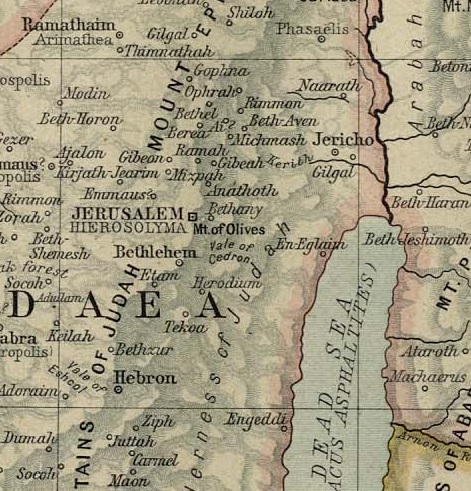
Note the location of Bethany just to the right of Jerusalem. No wonder John the baptist drew theBethany of Judea attention of the Pharisees.

John 1:28 ERV  These things all happened at Bethany on the other side of the Jordan River. This is where John was baptizing people.

In response to John’s assertion, He is the one who is coming later. It would not be that much later, for the Messiah showed up the next day.

John 1:29 TLV  “The next day, John sees Yeshua coming to him and says, “Behold, the Lamb of God who takes away the sin of the world!”

Think about this bold statement made by John, “Behold, the Lamb of God who takes away the sin of the world!”

Where did this come from?

If you have been following our study in the book of John, then you will remember how I pointed out that Elizabeth, his mother, was filled with the Holy Spirit. Therefore, though John leaped in his mother’s womb when she heard the greeting by Mary, this does NOT imply anything about John.

I am bringing these things up because I was bombarded with misinformation as I grew up in church. As I have sat under the teaching of evangelists, pastors, and various teachers, the implications of how the Holy Spirit moves in you and “controls” you.

  • First, the Holy Spirit DOES NOT possess anybody unless that person asks Him to control them.

The example that stands out is Nicky Cruz, the former ‎Mau Maus gang leader, who tormented Pastor David Wilkerson and became the subject of Pastor Wilkerson’s book “The Cross and the Switchblade.” One day, I came home from work, and my wife (at the time) had Trinity Broad Casting on the Television, and they were interviewing now pastor Nicky Cruz. Nicky spoke about his father in Puerto Rico, who had been a Santeria priest. His dad would encourage the “evil spirits” to possess him and make him the best and possibly the most feared Santeria priest in PR. 

Nicky pointed out that the Holy Spirit is a spirit and suggested that we “Christians” invite the Holy Spirit to possess us. I have done that at times, repeatedly.

(If I learned anything from church, I falsely came to believe that I needed to keep putting Jesus back on His throne and that I needed to re-invite the Holy Spirit into my life. These two things are the predominant falsehoods that I fight. Now, I will admit that I do allow distractions to take my mind away from the life and power of the Holy Spirits impact; however, I have also come to understand that it is me and not the power of Jesus Christ or the comforter, that has gone on vacation. )

  • Note how the Baptist declared, “the Lamb of God who takes away the sin of the world!

How would John know this?

Here are a couple of examples to answer this question.

Then Isaac said to Abraham his father, “My father?” Then he said, “Here I am, my son.” He said, “Look. Here’s the fire and the wood. But where’s the lamb for a burnt offering?” Abraham said, “God will provide for Himself a lamb for a burnt offering, my son.” The two of them walked on together.” (Genesis 22:7-8 TLV)

I suggested that Isaiah 53 may have been on John’s mind as he made these statements, which may have startled even John, who, like me, often wondered where those thoughts came from.

We all like sheep have gone astray. Each of us turned to his own way. So Adonai has laid on Him the iniquity of us all. He was oppressed and He was afflicted yet He did not open His mouth. Like a lamb led to the slaughter, like a sheep before its shearers is silent, so He did not open His mouth.”
(Isaiah 53:6-7 TLV)

Clearly, there is a grasp that Jesus, the spotless lamb, had the iniquity of all of us laid upon Him.

Your lamb is to be without blemish, a year old male. You may take it from the sheep or from the goats.”
(Exodus 12:5 TLV)

The example from Exodus 12 continues.

They (God’s people) are to take the blood and put it on the two doorposts and on the crossbeam of the houses where they will eat it.”
(Exodus 12:7 TLV)

Putting the blood on the doorpost is symbolic of our being covered by Jesus’ blood and our protection from the wrath (that for the Egyptians and those among “God’s people” that refused to believe) that was to come.

Also, you are to eat it this way: with your loins girded, your shoes on your feet, and your staff in your hand. You are to eat it in haste. It is Adonai’s Passover. “For I will go through the land of Egypt on that night and strike down every firstborn, both men and animals, and I will execute judgments against all the gods of Egypt. I am Adonai. The blood will be a sign for you on the houses where you are. When I see the blood, I will pass over you. So there will be no plague among you to destroy you when I strike the land of Egypt.”
(Exodus 12:11-13 TLV)

Leviticus also helps to define the removal of and our permanent separation from all sin.

/Aaron should lay both his hands on the head of the live goat and confess over it all the iniquities of Bnei-Yisrael and all their transgressions, all their sins. He should place them on the head of the goat and send it away into the wilderness by the hand of a man who is in readiness. The goat will carry all their iniquities by itself into a solitary land and he is to leave the goat in the wilderness.”
(Leviticus 16:21-22 TLV)

Jesus took all our sins to the cross with Him. Although I have tried to share this information with the various church bodies I have been involved with, I can tell you that some will come back you with vile hatred. I suppose this makes sense to some as they also condemn many to hell.

As a young man, who was shy and withdrawn, we were sent out to the local neighborhood to win the lost to Christ. At this point in time, if you had long hair, you were a hippie, so when we knocked, a hippie came to the door. I had taken a position to the side near the door and leaned against the railing. I do not remember most of what was said, but the man responded with no thanks; I am not interested. To his response, one loud but pretty girl yelled back, then you are going to hell. They all turned and walked away. I just stood there. The man turned to me and said, what do you have to say? All I could say was, I am so sorry, and I merely walked away. That moment changed me, and I told God I would never do this door-to-door garbage or speak to anybody in that manner again.

I am passionate about what I know and refuse to whisper as I sit in a public place talking about Jesus.

Posted in baptize, blood of the Lamb, existed, Forgiveness, Gospel of John, Holy spirit, Jesus, Messiah, testified, the blood, Thoughts on scripture | Tagged , , , , , , , , , , , , , , , , , , , , , , , , , | Leave a comment

Are you Elijah? I am not. Then who are you? John 1:25.


John the Baptist told those who came to question him that he was NOT Elijah, nor was he the Messiah.

They asked him, “If you’re not the Messiah, Elijah, or the Prophet, why then are you immersing?” (John 1:25 TLV)

 It is interesting, primarily because, despite John’s comment that he was NOT Elijah, people will tell you that Elijah came back as John the Baptizer.

I want you to pay attention to what Jesus said to the disciples.

“Six days later, Jesus took with him Peter and the brothers James and John and led them up a high mountain where they were alone. (2) As they looked on, a change came over Jesus: his face was shining like the sun, and his clothes were dazzling white. (3) Then, the three disciples saw Moses and Elijah talking with Jesus. (4) So Peter spoke up and said to Jesus, “Lord, how good it is that we are here! If you wish, I will make three tents here, one for you, one for Moses, and one for Elijah.” (5) While he was talking, a shining cloud came over them, and a voice from the cloud said, “This is my own dear Son, with whom I am pleased—listen to him!” (6) When the disciples heard the voice, they were so terrified that they threw themselves face downward on the ground. (7) Jesus came to them and touched them. “Get up,” he said. “Don’t be afraid!” (8) So they looked up and saw no one there but Jesus. (9) As they came down the mountain, Jesus ordered them, “Don’t tell anyone about this vision you have seen until the Son of Man has been raised from death.” (10) Then the disciples asked Jesus, “Why do the teachers of the Law say that Elijah has to come first?” (11) “Elijah is indeed coming first,” answered Jesus, “and he will get everything ready. (12) But I tell you that Elijah has already come, and people did not recognize him but treated him just as they pleased. In the same way, they will also mistreat the Son of Man.”
(
Matthew 17:1-12 GNB)

  1. No photographs of Moses and Elijah existed, so how did the disciples know who was standing there talking to Jesus?

    The answer lies in the fact that the three were given an instant download of information. That download is the Holy Spirit. If you are that person who loves to argue and is willing to say, “that’s impossible.” I ask you, had the Holy Spirit been restricted from operating on the earth? The answer is NO and if you are prone to argue against that, then prove your thesis. You cannot.

  2. The three disciples started raving about building tabernacles for each “prophet,” talking with Jesus. If they had done this, those structures would have quickly become idolatrous structures, snares, and patterns for other idol worship, which Israel was very adept at.

    So what happens next?

    While they were talking, “a shining cloud came over them, and a voice from the cloud said, “This is my own dear Son, with whom I am pleased—listen to him!” God is trying to snap them out of this human response mode. This voice was much like when God spoke over Jesus at His baptism by John, where those that heard it said it sounded like thunder.

  3. Note the next question.

    Why do the teachers of the Law say that Elijah has to come first?

    That would be confusing, especially if you had just seen Elijah talking with Jesus. As I tried to put my thoughts together about Elijah, I was reminded that he left this earth without dying. The writer of Hebrews tells us that we must die. (Hebrews 9:27.)

    Other witnesses to this assertion that we must die.

    Psalms 103:13-14 NASB Just as a father has compassion on his children, So the LORD has compassion on those who fear Him. (14) For He Himself knows our frame; He is mindful that we are but dust.

    Made in the image of God, a spirit (Genesis 1:26,27.) It was not until Genesis 2:7 that the man was given a body, and this was after the seventh day. We are all built from the earth.

    The author of Ecclesiastes can be attributed to one who identifies as a “son of David,” but this does not necessarily mean it was Solomon. The author, talking about pottery, a created thing that must return to dust, says this.

    Then the dust returns to the ground it came from, and the spirit returns to God who gave it.” (Ecclesiastes 12:7 TLV )

    Since the psalmist had already told us that we are dust, we will return to dust. But there is a small problem – we have a hope of eternal life filled with peace. So these bodies that will be changed must die, an event that happens in that twinkling of an eye. Why? Because it is the body that became corrupted and is the reason that God could NOT use humans to procreate the Son of God. Having a young girl that had never intimately known a man to be a surrogate mother bypassed the genetic brokenness called sin.

When, then, does Elijah return again?

Ah, when God sends the two witnesses to preach in the streets of Jerusalem. By the way, the world is about to see this happen.

Okay, that may cover one of the witnesses; who is the other? 

First, the question is unimportant, as the church will have gone up in the rapture, and we will NOT see any of that. Many think it will be Moses. But, unfortunately, it will not be Moses, and our evidence for that comes from the writings of Jude.

But when Michael the archangel, disputing with the devil, was arguing about the body of Moses, he did not dare to render a judgment against him for slander, but said, “May the Lord rebuke you!” “
(Jude 1:9 TLV)

The devil would not be wasting his time arguing about the body of Moses unless there was a dead body. This would tell us that Moses died and was, therefore, excluded from returning to earth and being subjected to death once again. Even our “so-called” legal system prevents double jeopardy, for crying out loud. 

Having eliminated a “major” player, who is left?

There is only one more player left, and that is Enoch.

Yes, I am aware that most have no clue about Enoch and would never call him a prophet, as though being a prophet is a requirement for God to send you back to earth as a witness to the greatness of God.

A significant piece of evidence about Enoch is these words.

And Enoch continually walked with God…” Genesis 5:24 TLV

Walked is the Hebrew word hālaḵ. The Word Study Dictionary tells us that: “this common word carries with it the basic idea of movementthe flowing of a riverSince the word is also used to describe natural movement, it applies to the descending of floods (Gen_8:3); the crawling of beasts (Lev_11:27); the slithering of snakes (Lev_11:42); the blowing of the wind (Ecc_1:6); the tossing of the sea (Jon_1:13). Since it is usually a person who is moving, it is frequently translated “walk.”” “This word is also used metaphorically to speak of the pathways (i.e., behavior) of one’s life.” And I add one more word from the NASEC dictionary – accompany.

Every description above speaks to me of intimacy, whether it was in an uptime or a down time. The relationship was mutual as Enoch, who was NO MORE spiritual than you or I, accompanied God/elohim in his everyday affairs. Think about the fact that Enoch, a husband, had to eat, till a field, hunt game, feed a family (he was, by the way, the father of Methuselah,) and he had to pass along the verbal understanding of who elohim is. Things I know about the man.

  • Enoch lived 65 years, then fathered Methuselah.

  • Enoch walked with God continually for 300 years after he fathered Methuselah.

  • Enoch fathered other sons and daughters, which we know nothing about.

  • All of Enoch’s days were 365 years.

  • Enoch continually walked with God.

  • Enoch walked with God, and then he was no more because God had taken him away.
    (Gen 5:24 BSB)

I can remember when I read about Enoch, asking myself, where and how did Enoch understand what it was like to have such an intimate relationship?

It would seem that “sin” had stripped that intimacy away, but that was only on our side. I say that because God still came to the couple, respecting their newly found discomfort, and spoke to them in the garden, as He killed some animals for sacrifice and coverings, which He gave them instructions on how to do all that.

I started to do the math and discovered that Adam, a great-grandfather (many times over), was over 600 years old when Enoch was born. All the people on earth were related in some way to the man that walked with God, and none chose to pursue what this God – elohim, was like. The only man that ever walked with Him in the cool of the day was still alive, and Adam described those days with such longing and passion that even now, as I write, I can hardly see through the tears.

I am painfully aware of many people who had the opportunity to God. Consider that Enoch had a son, Methuselah, and other children, but only one stands out, primarily because of his age when he died.

Did you know that Methuselah’s name had meaning and was, therefore, a prophecy? 

His name meant when he dies, it will come.

What was coming?

A flood that would purge the earth of NOT just sin; the flood could not eliminate sin because that “sin” was embedded within the bodies of Noah and his extended family that God saved on that ark. The primary purpose of the flood was to eliminate the effects of fallen angels, sons of god, that were taking any woman they chose and having sexual relations with them. The only purpose behind this was to eliminate the heritage of God on earth. Those children Enoch had that did not get on the ark, descendants of Adam, and Methuselah’s children, aside from Noah, were all killed in the flood because all of them had been genetically altered by the fallen angels. Only Enoch, Methuselah, and Noah’s family, a descendant of Methuselah, escaped this perversion.

One last shot.  Enoch was a prophet.

It was also about these men that Enoch, in the seventh generation from Adam, prophesied, saying, “Behold, the Lord came with many thousands of His holy ones,
(Jude 1:14 NASB)

Posted in Adam, bible study, body, death, Enoch, fallen angels, Genesis, Holy spirit, Nephilim, Sin, twinkling of an eye, wickedness | Tagged , , , , , , , , , , , , , , , , , , , , , | Leave a comment

John didn’t refuse to answer. He told them clearly. John 1:19-23.


I am writing to people who have been taught poorly or were taught falsehoods, and some errors are intentional. I will include myself in this next weakness within the Christian community, and that is that WE do not nor will not pick up the Bible and read it. I can speak bluntly about this because I had to make a hard decision to fix this weakness in myself. In 2007 I started a job with early work hours, so I would give myself an extra hour before work to go to McDonald’s, eat breakfast and read my Bible. So many people whimper about where they should start reading; I have suggestions, but there is a better time or place. I needed to know who God was and what His character was like, so I started with Matthew’s gospel, where I saw His Son, Jesus, and slowly worked my way through the New Testament. Every day brought questions and challenges, and I wrote them down as I asked God my hard questions, all of which got answered.

I never spent a tremendous amount of time focused on John the Baptist.

The NASB entitles this next section, The Testimony of John the Baptist.

We covered a couple of details about John the Baptist in my previous post. In terms of teIn my previous post, we covered some details about John the Baptist. In terms of temperament, and I am imagining here, I perceive a touch of sanguine because he is outgoing and, to a degree, social. The other trait that I see is choleric. I say this because John comes across as short-tempered and irritable, much like the Apostle Paul (who may well be one of those being sent to verbally accost him.) He had, by the way, called them a den of vipers. 

Now apply the personality traits that we can only assume to the following few verses where we see John in action.

This was John’s answer when the Jews sent priests and Levites from Jerusalem to ask him, “Who are you?””
(
John 1:19 GW)

  • The Jews sent priests.”

We are not told who did the sending as even within the priests and council members, there was a hierarchy. I can see leaders sending lower-ranking members to go and challenge the man they obviously perceive as acting as though he is replacing them. However, John may not have felt that way.

If what I said seemed odd to you, think about this incident.

Very early, while it was still night, Yeshua got up, left, and went away to a place in the wilderness; and there He was praying. Then Simon and those with him hunted for Yeshua. And when they found Him, they said to Him, “Everybody’s looking for You.” He said to them, “Let’s go somewhere else, to the neighboring towns, so that I may proclaim the message there also—this is what I came for.” And He went throughout all the Galilee, proclaiming the message in their synagogues and driving out demons. A man suffering from a dreaded skin disease came to Jesus, knelt down, and begged him for help. “If you want to,” he said, “you can make me clean.”(GNB) .” Moved with compassion, Yeshua stretched out His hand and touched him. He said, “I am willing. Be cleansed.”
(
Mark 1:35-41 TLV & GNB)

There was no doubt that Jesus could heal, but to be cleansed was what the priests did, and apparently, religion was corrupt enough to demand payment for the procedure where you were reintroduced back into the community. So this man asked Jesus to heal him and pronounce him cleansed. But, if you follow the narrative, Jesus sternly warned the man to keep his mouth shut about Jesus pronouncing him clean. He knew this was a boundary that would feed into a deadly fight with the Pharisees. Considering that John’s daddy was a priest, they knew who John was.

When Herod was king of Judea, there was a priest named Zechariah, who belonged to the division of priests named after Abijah. Zechariah’s wife Elizabeth was a descendant of Aaron.”
(
Luke 1:5 GW)

Their question had no politeness connected to it. It is more of a challenge, similar to who do you think you are. The other side of this coin is that Jesus’ own disciples, and several of them left John to join Jesus, did not understand that He was the Messiah, as they were looking for a warring messiah that would free them from Roman oppression, etc. This misconception stayed with them until they were filled with the Holy Spirit in the upper room after Jesus left the earth.

John didn’t refuse to answer. He told them clearly, “I’m not the Messiah.”
(
John 1:20 GW)

Adam Clarke wrote: “John renounces himself, that Jesus may be all in all.” Really, at this point, John is enjoying some freedom, but the day is coming after denouncing the actions of Herod.”

For Herod had arrested John, bound him, and put him in prison for the sake of Herodias, the wife of his brother Philip,”
(Matthew 14:3 TLV)

John is close to death, so he sends some of his disciples to Jesus to do what?

Now when John heard in prison about the works of the Messiah, he sent word through his disciples and said to Yeshua, “Are You the Coming One, or do we look for another?”
(Matthew 11:2-3 TLV)

““What then? Are you Elijah?” they asked him. “I am not,” said John. “Are you the Prophet?” “No,” he answered.”
(John 1:21 TLV)

  • Are you Elijah?

    The answer is NO.

  • Are you the prophet?

    Just a touch on the repetitious side. Wasn’t Elijah a prophet? Yes, he was, and NO he never died because God took him, and this piece of evidence sort of mandates that Elijah must physically die. 

John told them straight out, I am not Elijah. Then who is this other prophet? Adam Clarke says this is the prophet spoken of by Moses, Deuteronomy 18:15,18.

Instead, he will send you a prophet like me (Moses) from among your own people, and you are to obey him.”
(Deuteronomy 18:15 GNB)

I had no idea that Moses was a prophet.

I will send them a prophet like you from among their own people; I will tell him what to say, and he will tell the people everything I command.”
(Deuteronomy 18:18 GNB)

This line, I will tell him what to say, and he will tell the people everything I command,” says much about the character of Jesus.

He will speak in my name, and I will punish anyone who refuses to obey him.” (Deuteronomy 18:19 GNB)

Every word that Jesus spoke was focused on the instructions of the Father, no matter how random those words may have seemed.

So they said to him, “Who are you? Give us an answer for those who sent us. What do you say about yourself?”
(John 1:22 TLV)

I am not sure it mattered what the answer was; no matter how ridiculous, it just needed to quell the angst of the Jewish leadership. 

He said, “I am ‘the voice of one crying in the wilderness, “Make straight the way of Adonai,”’ as the prophet Isaiah said.”
(John 1:23 TLV)

The words that stand out in my mind are the same that I chose for my blog.” Why did I choose that? Because I felt, and still feel, like I am sharing God’s voice and no one is listening. Someday soon, they will hear. 

It is never too late to make straight the way of Adonai, as long as you have breath in your lungs.

Posted in baptize, bible study, Gospel of John, Messiah, testified, wilderness | Tagged , , , , , , , , , , , , , , , , , , , , , , , , , , | Leave a comment

Grace and truth were realized through Jesus. John 1:15-18.


 “In Him was life, and the life was the Light of men. The Light shines in the darkness, and the darkness did not comprehend it.” (John 1:4-5 NASB)

Some need to know information.

As I pointed out in a previous post, when you begin reading the gospel of John, you need to keep it straight in your mind who the passage is referring to. In verse four above, John is speaking about Jesus, but we only know that because of the definitions John gives us. In verse 15 below, John, the baptizer, tells people about Him. The Him, in this instance, is Jesus.

If you were to watch the series “The Chosen,” you would notice that it takes liberties with what we understand about Jesus; they have to as they merge several months of Jesus’ three-year ministry into a show that lasts a little over an hour each week.

When Mary came to Elizabeth, John the Baptizer was a four-month-old fetus, and he leaped in her womb. We were told that John received the Holy Spirit at this point, but there is nothing to substantiate that assertion.

“When Elizabeth heard Mary’s greeting, the baby leaped in her womb; and Elizabeth was filled with the Holy Spirit. And she cried out with a loud voice and said, “Blessed are you among women, and blessed is the fruit of your womb! “And how has it happened to me that the mother of my Lord would come to me? “For behold, when the sound of your greeting reached my ears, the baby leaped in my womb for joy.”
(Luke 1:41-44 NASB)

So John is only a few months older than his step-cousin Jesus, and yet John eventually makes this extraordinary declaration about Jesus.

“John told people about him. He said loudly, “This is the one I was talking about when I said, ‘The one who is coming after me is greater than I am because he was living before I was even born.’”
(
John 1:15 ERV)

The NASB used the word “testified” to indicate how John spoke to those who came to hear him. Testify is the Greek word marturéō, meaning to bear witness to the truth of what one has seen, heard, or knows. The series “The Chosen” portrayed John as being rather direct and outspoken. For someone of this character to be loud would not surprise me.

“But when he (John the Baptist) saw many of the Pharisees and Sadducees coming for baptism, he said to them, “You brood of vipers, who warned you to flee from the wrath to come?”
(
Matthew 3:7 NASB)

If these religious rulers were coming to John, submitting to the baptism that he was performing, then they apparently did not see him as a joke or some animated but entertaining radical.

Doesn’t it make you wonder what this baptism represented to them?

It should be because Jesus submitted to John’s baptism, and the oddity of Jesus indicating that he was fulfilling the law. In all my years of warming a seat in church, I never heard of or saw baptisms in the Old Testament.

Then Jesus *arrived from Galilee at the Jordan coming to John, to be baptized by him. But John tried to prevent Him, saying, “I have need to be baptized by You, and do You come to me?” But Jesus answering said to him, “Permit it at this time; for in this way it is fitting for us to fulfill all righteousness.” Then he *permitted Him.”
(
Matthew 3:13-15 NASB)

So, what was Jesus talking about?

It might be best to back up to an explanation of why John was baptizing.

John also was baptizing in Aenon near Salim, because there was much water there; and people were coming and were being baptized–for John had not yet been thrown into prison. Therefore there arose a discussion on the part of John’s disciples with a Jew about purification.” (John 3:23-25 NASB)

The passage tells us that John was baptizing. This is the Greek word baptizo and means to immerse, submerge, or saturate. The first two options tend to indicate that there was a complete submersion. The general idea was that submersion was a rite of purification, a cleansing of the heart from sin. A huge clue comes from John 3:25, where John’s disciples were having a “discussion with a Jew about purification. Why would Luke bring this up, adding this conversation into the context, unless it carries some weight in the discussion?

Purification is the Greek word katharismós, and “it actually refers to the process of purificationthe sacrifice of purification.” (WSD)

Interesting how our life in Christ is based upon faith in Jesus Christ alone. Everything beyond that could potentially fall into the category of works. If I were to try to understand the statement “the process of purification,” I might do well to perceive this as part of the sanctification process. I am always reminded of the thief on the cross. He was afforded no water immersion, nor did he go through some over-embellished sanctification class, and yet what did Jesus reply to the man? This day you will be with me in paradise. Jesus, in those moments, sanctified the man because of the depth of his conversation, which most of us miss.

With the knowledge that Jesus was sinless (He was NOT born of tainted human blood, this is why God had to make a fertilized egg and have a virgin girl carry that egg as a surrogate.) There should have been no reason for Jesus to cleanse himself; He had no sin. (Scripture tells us this;) But, we can see that few understood or believed that He was God, God’s son, so He had to in order to quell the voices of tradition.

Baptism would have to have been pulled from the Torah and, therefore, might be a reference to Ezekiel 36:25. I include verses 24 and 26 as they create a time frame and a context, which I think applies to the Spirit of God.

For I will take you from the nations, gather you from all the lands and bring you into your own land. “Then I will sprinkle clean water on you, and you will be clean; I will cleanse you from all your filthiness and from all your idols. “Moreover, I will give you a new heart and put a new spirit within you; and I will remove the heart of stone from your flesh and give you a heart of flesh.”
(Ezekiel 36:24-26 NASB)

Leviticus gives us several references, but they all pertain to blood, and it is a broad-spectrum cleansing. One in particular, Leviticus 14:5-7, conveys that they were to sprinkle the blood on the “one who is to be cleansed from the leprosy and shall pronounce him clean.” I would not say that this represents why Jesus came to John.

The book of Numbers might provide the reasons Jesus got baptized.

Take the Levites from among the sons of Israel and cleanse them. “Thus you shall do to them, for their cleansing: sprinkle purifying water on them, and let them use a razor over their whole body and wash their clothes, and they will be clean.”
(Numbers 8:6-7 NASB)

In church, we rarely hear that Jesus was of the lineage of Levi, but Luke’s gospel traces Jesus backward and, therefore, shows Him to be a descendant of Levi, one of Aaron’s relatives.

When He began His ministry, Jesus Himself was about thirty years of age, being, as was supposed, the son of Joseph, the son of Eli, the son of Matthat, the son of Levi, the son of Melchi, the son of Jannai, the son of Joseph,”
(Luke 3:23-24 NASB)

The writer of Hebrews tells us that Jesus is our high priest. A few examples of this priesthood.

Hebrews 2:17 “Therefore, He had to be made like His brethren in all things so that He might become a merciful and faithful high priest in things pertaining to God, to make propitiation for the sins of the people.”

Hebrews 3:1 “Therefore, holy brethren, partakers of a heavenly calling, consider Jesus, the Apostle and High Priest of our confession;.”

Hebrews 4:14,15 “Therefore, since we have a great high priest who has passed through the heavens, Jesus the Son of God, let us hold fast our confession. 15)For we do not have a high priest who cannot sympathize with our weaknesses, but One who has been tempted in all things as we are, yet without sin.”

Hebrews 5:10 “…being designated by God as a high priest according to the order of Melchizedek.”

Numbers 19:13 tells us that anyone who touches a corpse.

“… and does not purify himself, defiles the tabernacle of the LORD; and that person shall be cut off from Israel. Because the water for impurity was not sprinkled on him.

So far, I do not see a direct relationship between water baptism and a release from sin, but let’s try one more.

Wash me thoroughly from my iniquity And cleanse me from my sin. For I know my transgressions, And my sin is ever before me. Against You, You only, I have sinned And done what is evil in Your sight, So that You are justified when You speak And blameless when You judge. Behold, I was brought forth in iniquity, And in sin my mother conceived me. Behold, You desire truth in the innermost being, And in the hidden part You will make me know wisdom. Purify me with hyssop, and I shall be clean; Wash me, and I shall be whiter than snow.”
(Psalms 51:2-7 NASB)

Psalms 51:2-7, written by David, helps to make that connection, so it may have been an Old Testament understanding that immersion with water is part of the cleansing of sins. Again, Jesus had NO sin, but the humans He had to deal with did not know that.

A few more verses that pertain to cleansing by water. Leviticus 11:32; Leviticus 12:7-8; Leviticus 13:6.

Moving on with our study of John’s gospel.

John 1:16 GNB)  “Out of the fullness of his grace he has blessed us all, giving us one blessing after another.”

The NASB reads: “For of His fullness we have all received, and grace upon grace.” This makes no sense to me.

Pastor John MacArthur says that John 1:16 “…emphasizes the superabundance of grace that has been displayed by God toward mankind…”

“For the Law was given through Moses; grace and truth were realized through Jesus Christ.” John 1:17 NASB 

  • Consider the phrase, “grace and truth were realized through Jesus Christ.

History tells us that John wrote this gospel between 80 and 90 A.D. That would mean that John’s memories were only 50 to 60 years old. Compare this with “the writings of Plato” (born 428, died 347 BCE) that were written over a thousand years after his death. 

  • “The ‘Clarke Plato’, the oldest manuscript (discounting papyrus fragments) for about half the dialogues of Plato, was written by John the Calligrapher in 895 CE for Arethas the deacon, originally a native of Patras, who later became archbishop of Caesarea in Cappadocia.” https://www.worldhistory.org/image/10818/dialouges-of-plato/

Realized is the Greek word ginomai. The King James concordance indicates 456 occurrences of ginomai; 88 were translated as came, and 63 were translated as done.

Would applying the word came to John 1:17, where it says realized, make sense?

Let’s see. “grace and truth came through Jesus Christ.” It works, especially if you consider all that Jesus did for you. The cross stands out as monumental when you think about Jesus. The word done is not as effective.

If I look up the word ginomai in the Word Study Dictionary, there is an extensive listing. 

  • To come into existence;

  • to be created, to be born,

  • producedgrow, to arise, come on,

  • occur, as the phenomena of nature,

  • to be appointedconstitutedestablished,

  • to come to oneself, to recover from a trance or surprise.

The first entry in this list stands out to me, not because there was no grace in the Old Testament, but because it certainly wasn’t as notable. Paul’s writings on grace were the game changer, but you have to remember that Paul only had the Old Testament – and that was by what he retained in the synagogue and a direct revelation from Jesus that came to him on the road to Damascus or the years that he spent at the base of Mount Sinai.

grace and truth came into existence through Jesus Christ.”

I could take this literally and say there was NO grace until the death and resurrection of Jesus Christ.

Let’s finish this dive into John’s gospel with verse 18.

No one has ever seen God; but the one and only God, in the Father’s embrace, has made Him known.” (John 1:18 TLV)

The God’s Word translation says it this way.

No one has ever seen God. God’s only Son, the one who is closest to the Father’s heart, has made him known.”

Known or explained, as the NASB conveys, is the Greek word exēgéomaiMounce Concise Greek-English Dictionary tells us that it means to be a leader; to detail, to set forth in language; to tell, narrate, recountLuk_24:35Act_10:8to make known, revealJoh_1:18Act_15:12Act_15:14Act_21:19.

The substitutionary word or phrase that best fits in John 1:18 as it tells us that Jesus has revealed the Father to us is to make known.

but the one and only God, in the Father’s embrace, has made Him known.”

Jesus said, when you have seen me, you have seen the Father. Having been raised to believe that God was an angry God, just waiting to punish me severely for my sins. Thank you, Jesus, for taking all our sins to the cross with Him, and I want to thank the producers of the Chosen as they have shown us a Jesus that can laugh, dance, and cry; because of this, I have been able to see the Father as one that can, at least, laugh and cry.

Posted in baptize, bible study, existed, explained, fullness, God's character, Gospel of John, grace, grace, higher rank, Jesus, realized, testified, The Word was God, Thoughts | Tagged , , , , , , , , , , , , , , , , , , , , , , , | Leave a comment

Passages that speak to the rapture of the Church.


In a recent conversation, I was told by a person who also spent a tremendous amount of time attending church, as I did, that they can see very little in scripture that tells us of a rapture of the church. They said that if there is a rapture, they don’t expect it to happen for another fifty years. What makes this even worse is that I had a brother in Christ and a pastor tell me to relax as they could not see Jesus returning for His bride anytime soon.

I responded to the rather one-sided conversation by saying every prophetic event, up to this point, has been fulfilled, and all the events needed to make these things happen have exploded on the scene so quickly that there will be no stopping or slowing this process down. And we have a group called the World Economic Forum, run by Klaus Schwab and many rich, powerful, demonically motivated egomaniacs who desire to eliminate commoners. You are blinded by the enemy if you cannot see this in the scriptures.

Even as this person was talking to me, my head and heart were telling me that I needed to gather the information that validates that the church will be caught up to meet Jesus in the air and forever be with Him; and that the Bible is filled with passages that affirm that He is coming back for us, which has a secondary benefit as we are removed from the wrath that will quickly hit the earth. On that note, I did NOT include Noah and his family, who were told to get into the ark, and then scripture tells us that God closed the door. The other example or type is Lot and the fiery destruction of Sodom, Gomorrah, and several other cities. At one point in that narrative, the angels had to grab Lot and his family because they could do NOTHING until Lot was moved to safety – just as we, the church, will be.

With that, let’s dive in, starting with Daniel, as he wrote extensively about the time we have been experiencing.

“But you, Daniel, keep this message a secret. You must close the book and keep this secret until the time of the end. Many people will go here and there looking for true knowledge, and the true knowledge will increase.” (Daniel 12:4 ERV)

The question you should be asking is, is this speaking of when the church gets snatched away, or is it meant for the moment, seven years later, when Jesus comes back as the warring Messiah?

If it is intended to convey the moment Jesus returns on the white horse in Revelation 19, you have to ask, what has been going on up to this point? The time of wrath has been a non-stop onslaught of death at the hands of humans, weather changes that kill the plant life, death by starvation, death by plagues – both natural and lab-made, sky-born objects poisoning the rivers and oceans– making the waters undrinkable and fish life die.

Here in Revelation 3, the moment when the wrath is unleashed is called “the hour of testing” and does not exclude the other descriptives, such as day or week = 7 years.

Revelation 3:10 NASB) “‘Because you have kept the word of My perseverance, I also will keep you from the hour of testingthat hour which is about to come upon the whole world, to test those who dwell on the earth.”

Matthew 24 alerts those looking for Jesus to return for His bride that a multitude of signs will take place. Well, all those things have taken place; seeing Israel as the fig tree is one of those.

(Matthew 24:32-35 MKJV) “Now learn a parable of the fig tree. When its branch is still tender and puts out leaves, you know that summer is near. So you, likewise, when you see all these things, shall know that it is near, at the doors. Truly I say to you, This generation shall not pass until all these things are fulfilled.”

Another of those alerts tells us that “This generation shall not pass until all these thing are fulfilled.” The NASB conveys it this way “this generation will not pass away until all these things take place.”

1 Thessalonians 5 points out that we (believers) are not in the dark and therefore have an awareness of what is coming and approximately when.

(1 Thessalonians 5:1-5 MKJV) But of the times and the seasons, brothers, you have no need that I write to you. For you, yourselves, know accurately that the day of the Lord comes like a thief in the night. For when they shall say, Peace and safety! Then sudden destruction comes on them, as travail upon a woman with child. And they shall not escape. But you, brothers, are not in darkness, that the Day should overtake you like a thief. You are all the sons of light and the sons of the day. We are not of the night or of darkness.

The day will come like a thief in the night. How does the thief in the night function?

By sneaking around in the darkness, undetected. But Christ’s return for His church is NOT like a thief, nor will those who are looking for Him be caught off guard. Why? Because we ARE NOT in the darkness, because the light became a part of who we are.

When I try to convey that we should be able to tell when Jesus is coming back, I am met with the “out-of-context” garbage that says, “no man knows the day or the hour.” This was said to Jews in a language that was completely knowable to them and had everything to do with seeing the moon, which indicated the new month. Even though there had to be witnesses, cloud cover could obscure the sighting to the point that an arbitrary announcement would have to be declared. Can’t you see that even this has variables involved in it, just picking the winners of the World Series of baseball or how many games they will play?

Matthew 13:10- 13 MKJV) And the disciples said to Him, Why do You speak to them in parables? He answered and said to them, Because it is given to you to know the mysteries of the kingdom of Heaven, but it is not given to them. For whoever has, to him shall be given, and he shall have more abundance. But whoever does not have, from him shall be taken away even that which he has. Therefore I speak to them in parables because seeing they see not, and hearing they hear not; nor do they understand.

There is no doubt that Jesus was here and returned to the Father. His promise to us is John 14:1-3.

John 14:1-3 (KJV) Let not your heart be troubled: ye believe in God, believe also in me. 2)  In my Father’s house are many mansions: if it were not so, I would have told you. I go to prepare a place for you. 3)  And if I go and prepare a place for you, I will come again, and receive you unto myself; that where I am, there ye may be also

1 Corinthians 1:7 tells us that we are waiting for Christ to come again. For us, He will meet us in the air.

This proves that what we told you about Christ is true. Now you have every gift from God while you wait for our Lord Jesus Christ to come again. He will keep you strong until the end so that on the day when our Lord Jesus Christ comes, you will be free from all blame.”
(1 Corinthians 1:6-8 ERV)

Raised incorruptible, we shall be changed.

I’m telling you a mystery. Not all of us will die, but we will all be changed. It will happen in an instant, in a split second at the sound of the last trumpet. Indeed, that trumpet will sound, and then the dead will come back to life. They will be changed so that they can live forever.”
(1 Corinthians 15:51-52 GW)

In his letter to the church at Philippi, Paul writes.

There are many who live like enemies of the cross of Christ. I have often told you about them. And it makes me cry to tell you about them now. The way they live is leading them to destruction. They have replaced God with their own desires. They do shameful things, and they are proud of what they do. They think only about earthly things. But the government that rules us is in heaven. We are waiting for our Savior, the Lord Jesus Christ, to come from there. He will change our humble bodies and make them like his own glorious body. Christ can do this by his power, with which he is able to rule everything.” (Philippians 3:18-21 ERV)

To the church at Colossae, he wrote.

Yes, Christ is now your life, and when he comes again, you will share in his glory.” (Colossians 3:4 ERV)

1 Thessalonians tells us about Jesus coming to save us from God’s wrath.

People everywhere are already telling the story about the good way you accepted us when we were there with you. They tell about how you stopped worshiping idols and changed to serve the living and true God. And you began waiting for God’s Son to come from heaven—the Son God raised from death. He is Jesus, who saves us from God’s angry judgment that is coming.” (1 Thessalonians 1:9-10 ERV)

We are the prize set forth by those who have gone before that will fill the heavens with joy when we see Christ at His return.

Who is our hope, joy, or prize that we can brag about in the presence of our Lord Jesus when he comes? Isn’t it you? You are our glory and joy!” (1 Thessalonians 2:19-20 GW)

1 Thessalonians 4:14-18 ends with, “And so we shall ever be with the Lord, Therefore comfort one another with these words.” This is our hope. I, based upon God’s promises, place my hope in the fact that the rapture is coming quickly. Because of the proximity of further deadly actions against humanity and the church, I personally think we are down to mere months of survivability. There are several reasons I feel so strongly about our coming demise, and all of them are based on common sense and the fulfillment of prophecy.

There is NO hope in fear, and the Apostle Paul wrote his second letter to the church in Thessaloniki to bolster the information he had already given them and to encourage them to hold on to faith and the hope that he had informed them of. The reality of that church body is that they all died and are already in heaven with the Father. The point is that WE never give up hope.

Brothers and sisters, we don’t want you to be ignorant about those who have died. We don’t want you to grieve like other people who have no hope. We believe that Jesus died and came back to life. We also believe that, through Jesus, God will bring back those who have died. They will come back with Jesus. We are telling you what the Lord taught. We who are still alive when the Lord comes will not go ⌞into his kingdom⌟ ahead of those who have already died. The Lord will come from heaven with a command, with the voice of the archangel, and with the trumpet ⌞call⌟ of God. First, the dead who believed in Christ will come back to life. Then, together with them, we who are still alive will be taken in the clouds to meet the Lord in the air. In this way, we will always be with the Lord. So then, comfort each other with these words! (1 Thessalonians 4:13-18 GW)

It is wrath that is coming.

For God has not destined us for wrath, but for obtaining salvation through our Lord Jesus Christ, who died for us, so that whether we are awake or asleep, we will live together with Him.”
(1 Thessalonians 5:9-10 NASB)

2 Thessalonians chapter 2 has several paragraphs committed to our departure and the onslaught of the antichrist once we are gone. Unfortunately, very few translations use the word departure, as the Geneva Bible does. The state church of England got involved over 100 years after the publication of the Geneva Bible, as people were leaving the Catholic church. For this reason, the Catholic church ordered the King James Version to be changed to reflect their anger and dismay over people turning their backs on God and the church. Therefore, the terminology was changed from departure to apostasy to manipulate people into repentance.

Let no man deceive you by any means: for that day shall not come, except there come a departing first, and that that man of sin be disclosed, even the son of perdition,” (2 Thessalonians 2:3 Geneva)

That departure is our being called back to Jesus, and the thing that is coming is the antichrist. The church has to be removed before he will be disclosed. We will never see him.

I charge you in the presence of God, who gives life to all things, and of Christ Jesus, who testified the good confession before Pontius Pilate, that you keep the commandment without stain or reproach until the appearing of our Lord Jesus Christ,” (1 Timothy 6:13-14 NASB)

2 Timothy 4 speaks of that day.

I solemnly charge you in the presence of God and of Christ Jesus, who is to judge the living and the dead, and by His appearing and His kingdom:” (2 Timothy 4:1 NASB)

This crown of righteousness only happens at the Bema seat, and that seems to be integrated into that day.

in the future there is laid up for me the crown of righteousness, which the Lord, the righteous Judge, will award to me on that day; and not only to me, but also to all who have loved His appearing.”
(2 Timothy 4:8 NASB)

Titus speaks of the day.

instructing us to deny ungodliness and worldly desires and to live sensibly, righteously and godly in the present age, looking for the blessed hope and the appearing of the glory of our great God and Savior, Christ Jesus,” (Titus 2:12-13 NASB)

He is coming for those who eagerly await Him.

so Christ also, having been offered once to bear the sins of many, will appear a second time for salvation without reference to sin, to those who eagerly await Him.” (Hebrews 9:28 NASB)

Be patient as you await.

Therefore be patient, brethren, until the coming of the Lord. The farmer waits for the precious produce of the soil, being patient about it, until it gets the early and late rains.” (James 5:7 NASB)

Your faith will be found tested on that day.

In this you greatly rejoice, even though now for a little while, if necessary, you have been distressed by various trials, so that the proof of your faith, being more precious than gold which is perishable, even though tested by fire, may be found to result in praise and glory and honor at the revelation of Jesus Christ;.”
(1 Peter 1:6-7 NASB)

When He appears, you are to have confidence.

As for you, the anointing which you received from Him abides in you, and you have no need for anyone to teach you; but as His anointing teaches you about all things, and is true and is not a lie, and just as it has taught you, you abide in Him. Now, little children, abide in Him, so that when He appears, we may have confidence and not shrink away from Him in shame at His coming.” (1 John 2:27-28 NASB)

And I will end with this.

Nevertheless what you have, hold fast until I come.” (Revelation 2:25 NASB)

The word caught is the Greek word harpazo and means to be snatched up or seized upon with force. The other word, and origin of the terminology rapture, is rapio. Revelation 12:5 uses the terminology harpazo (caught up). This clause gives the basis for belief in the Rapture (from the Latin rapio) of the living saints. The Rapture is clearly Pretribulational, for Paul’s purpose is to comfort the Thessalonians by calling attention to this glorious prospect and blessed hope.  (1 Thessalonians 4:18) (The Ultimate Cross-Reference Treasury)

Time is short; you need to come to Jesus and give Him your life.

Posted in 2 Thessalonians, antichrist, apostasy, Apostle Paul, bible study, departure, Our being caught up, Prophetic, rapture, rescue, sons of light, Thoughts, Thoughts on scripture | Tagged , , , , , , , , , , , , , , , , , , , , , , , , , | 1 Comment

There came a man from God. John 1:6-14.


 Consider something, if all humanity carries the brokenness called sin, is it possible that it is a genetic issue that has been passed down through Adam and Eve would have been passed through Mary, the virgin? 

Well, of course, it was, so God was excluded from using the egg or sperm of anyone human. 

Now, what is God supposed to do? 

If we are talking about the God who spoke the worlds into existence, creating all things, including Adam, then it is not beyond Him to make His own fertilized egg and to ask a young virgin girl to be a surrogate mother for that child. I might add, having attended a Catholic memorial service recently, where the priest stated that Mary was without sin; in my mind, I could hear the squeal of brakes as my head screamed out excuse me! From the days of Adam and Eve in the Garden, humanity has been born under the influence of sin. Mary was NOT excluded from this curse. Therefore, any child created through human intercourse would have been born into sin. However, Jesus was NOT made through human intercourse and was, therefore, sin-free. 

Did Jesus have free will to sin? 

Yes, but fortunately for us, He did not. He never sinned. Now apply that understanding to the time Jesus purposefully made a scourge of ropes and drove the money changers and sellers from the temple’s outer courts. I cannot read that detail without seeing the fury in His eyes, but that does not mean it was there. I can’t explain how this moment happened without rage; I just know I would have been motivated by rage/sin. 

In scripture, we are NOT given all the reasons that Mary and Joseph could not find a place to stay in Joseph’s hometown of Bethlehem, where his relatives lived. They could not even find a place at the Inn. Although here in America, we have a hotel chain called Motel 6, they used to be an inexpensive place for a “not so rich” family to shower and get a little bit of sleep. Multi-level, with relatively clean floors and beds, is NOT what we are talking about, as the typical house had livestock living within what would be the first level of the house. Yes, you slept with the smells. 

Whether the news about their marriage, how she is pregnant, and Joseph is not the child’s father traveled ahead of them is unknown. But you must agree that it is hard to hide nine months of pregnancy, and the couple have no reasonable explanations aside from repeating that He is the Son of God. All the problems accompanying their legitimate statements of understanding and faith were suddenly solved once the wise men came with their expensive gifts, which the couple apparently sold. We know this because the child is approximately two years old, and the family is living in their own home in Bethlehem when the wise men located them. It is mere days later when an angel tells them to escape to Egypt until the threat upon Jesus’ life through Herod passes. 

We have little to tell us how long they stayed in Egypt, but at some point, the family is given the green light to come back home because Herod is dead; home is no longer in Bethlehem but in Nazareth. Since Jerusalem is closer than Nazareth and it was a festival week, it may have been practical to make the stop there, where Jesus found his way into the temple and began having deep discussions about the Law and the Prophets.

Scripture tells us that Joseph was a good man, but this matter of who the Father of Jesus is may have been a struggle. The internet series “The Chosen,” in introducing the context of a third season episode, has Joseph alluding to potential problems if they linger much longer in the vicinity after finding Jesus in the temple. 

Why is Jesus being in the temple a problem?  

Because Joseph apparently had a visit from the same angel that visited Mary. From that point forward, Joseph protected Mary from prodding neighbors who were more than willing to call her a whore, potentially killing Mary and giving Jesus nothing less than the abuse the son of a whore deserved. The terminology for illegitimate children is mumzer, and the Torah told them that no illegitimate child would be allowed in the temple or receive official religious training. So, keeping a low profile and moving to towns where you are NOT known is beneficial to your survival.

Apparently, the simple phrase “a good man” included the idea that Joseph was adept with the scriptures and may well have taught young Jesus himself. We can assume that Joseph made it back to Nazareth, but what transpires during this time is a mystery, for the next thing we see in scripture is a reference to John the Baptist, baptizing in the Jordan river, and Jesus is about 30, and there is no more mention of Joseph.

With that, we pick up our study with John 1:6-14.

There came a man sent from God, whose name was John. (7) He came as a witness to testify about the Light, so that all might believe through him. (8) He was not the Light, but he came to testify about the Light. (9) There was the true Light which, coming into the world, enlightens every man. (10) He was in the world, and the world was made through Him, and the world did not know Him. (11) He came to His own, and those who were His own did not receive Him. (12) But as many as received Him, to them He gave the right to become children of God, even to those who believe in His name, (13) who were born, not of blood nor of the will of the flesh nor of the will of man, but of God. (14) And the Word became flesh, and dwelt among us, and we saw His glory, glory as of the only begotten from the Father, full of grace and truth.”
(John 1:6-14 NASB)

Verse six opens with “There came a man sent from God.” The verse expresses to us that John the Baptizer is the subject, but what if you lacked that information. 

What would be your guess as to who the Holy Spirit is referring to?

The prophet Malachi, using similar wording, also spells out that this man is John. 

“Behold, I am going to send My messenger, and he will clear the way before Me…”
(Malachi 3:1 NASB)

In a cloaked manner, Isaiah declared that this voice was John, speaking about the Lord – Jesus.

“A voice is calling, “Clear the way for the LORD in the wilderness; Make smooth in the desert a highway for our God. “Let every valley be lifted up, And every mountain and hill be made low; And let the rough ground become a plain, And the rugged terrain a broad valley; Then the glory of the LORD will be revealed, And all flesh will see it together; For the mouth of the LORD has spoken.”
(Isaiah 40:3-5 NASB)

John 1:9-13 shifts subjects and defines Jesus.

“There was the true Light which, coming into the world, enlightens every man. (10) He was in the world, and the world was made through Him, and the world did not know Him. (11) He came to His own, and those who were His own did not receive Him. (12) But as many as received Him, to them He gave the right to become children of God, even to those who believe in His name, (13) who were born, not of blood nor of the will of the flesh nor of the will of man, but of God.”

John 1:8 explains –

“John was not the light. But he came to tell people about the light.” (John 1:8 ERV)

John 1:10,11 tells us –

“He (Jesus) was in the world, and the world was made through Him, and the world did not know Him. He came to His own, and those who were His own (Who are His own? The Jewish nation, of course. But for me, it also speaks of the disciples and of us.) did not receive Him.” (NASB)

As a side note, despite the harsh criticism the series has received, I watch The Chosen series and enjoy it immensely. One of the apparent things is how little the disciples understood Jesus’ mission. Dallas Jenkins, the producer, director, and one of the writers, has done an excellent job of portraying many of the Biblical aspects of Jesus’ ministry. Try to watch it without crying.

“And the Word became flesh, and dwelt among us, and we saw His glory, glory as of the only begotten from the Father, full of grace and truth.”
(John 1:14 NASB)

Jump back to verses one through three.

“In the beginning was the Word, and the Word was with God, and the Word was God. He was in the beginning with God. All things came into being through Him, and apart from Him nothing came into being that has come into being.”
(John 1:1-3 NASB)

Keep in mind that we can read this opening as “In beginning” to indicate a process that had an initiation point.

Previously, I asked when and where Jesus decided to fulfill the Father’s will and become flesh?

The answer goes back to a time, possibly before the creation. I say this because we see an angelic person under the guise of the angel of the Lord, interacting with humanity in many of the details of the Old Testament; these interactions give us every reason to believe that Jesus has been around for a long time. 

I have no reason to think that Jesus was not the one who walked in the cool of the garden calling out to Adam and Eve. I would NOT for a second suggest that once Adam brought all humanity under Satan’s subjection, the Father, Son, and Holy Spirit, had to go into emergency repair mode. No, this plan of redemption (the mystery) was well thought out long before Satan’s revolt and man’s treason.

Why is a comment such as “the only begotten from the Father,” important?

First, was anyone born again at the time of John the Baptist? The answer is NO that came after the cross, but many demonstrated faith in Jesus Christ, and that, according to the Apostle Paul, is the only way through Christ, to the Father.

“nevertheless knowing that a man is not justified by the works of the Law but through faith in Christ Jesus, even we have believed in Christ Jesus, so that we may be justified by faith in Christ and not by the works of the Law; since by the works of the Law no flesh will be justified.” (Galatians 2:16 NASB)

The Word became flesh and made his dwelling among us.”

Another version of this verse reads like this “The Word became a man and lived among us.”

Isaiah chapter seven tells us.

“So the Lord himself will give you this sign: A virgin will become pregnant and give birth to a son, and she will name him Immanuel [God Is With Us].”
(Isaiah 7:14 GW)

The path that God used to bring His Son into the world is through this young virgin.

Isaiah chapter nine gives us His names.

“A child will be born for us. A son will be given to us. The government will rest on his shoulders. He will be named: Wonderful Counselor, Mighty God, Everlasting Father, Prince of Peace.”
(Isaiah 9:6 GW)

The probability that Jesus, the Word of God that created the heavens and the earth, was a man when all this took place is good.

It is NOT impossible for God to place that Son into an egg and have a young virgin carry that Son.

It is NOT improbable that the Father had His Son fostered by a young girl named Mary, and the older man – a good man, hold the place of a Father that would see to it that Jesus was taught appropriately in the Law and nature of God, a representation that is exhibited in the action and words of the Son.

Posted in Adam, beginning, bible study, children, creation, Creation, Gospel of John, grace, Jesus, mystery, The Word was God | Tagged , , , , , , , , , , , , , , , , , , , | Leave a comment

In Him, there was life. A study in the gospel of John 1:4,5.


In my previous post, I “only” covered John 1:1. I had the blinders on and only chose to focus on that one verse. However, verses two and three also speak to the beginning of all things and Jesus’ role in creation.

Before the world began, the Word was there. The Word was with God, and the Word was God. He was there with God in the beginning. Everything was made through him, and nothing was made without him.”
(John 1:1-3 ERV)

Before the world began, the Word was there. John used the Greek word logos – a word spoken, to express what he was trying to say. So the spoken word conveys the will and nature of God while also detailing His Son. Some strong clues that back this peculiar statement up are: “The Word was with God;” the Word was God;” and, Everything was made through him (the Word), and NOTHING was made without him.”

Who is the Word?

  • Jesus

  • God

  • and yes, the Holy Spirit.

They are three, but they are one and the same. And yes, the written Word is an integrated aspect of the Father, the Son, and the Holy Spirit. Those Words you find in your Bible are filled with life, power, and promise.

I don’t do high theology; I write to be understood. If you can’t understand that Jesus spoke the worlds into existence because He and the Father are one, then perhaps that is because you have a veil over your eyes and cannot see. Paul tells us that the veil is lifted when a person asks Jesus to come into their lives and take control. (2 Corinthians 3:14)

Ooh, that taking control part sounds scary, almost as if I am giving up the right to make decisions about my own life. First, I would like to ask you, how have your efforts to control your life been working out for you?

So what we are doing is voluntarily submitting ourselves to Jesus, who voluntarily laid down His life so that you could have life once again. Ah, but this does NOT mean that every negative circumstance around you will simply fall away. No, you will probably, in time, have to separate yourself from people and places that will harm you (either mentally or physically.)

Since it is on my mind. We ALL sin – in other words, we all miss the mark. Yes, the word sin is an old English archery term that indicates you did anything but hit the bullseye (the bullseye is that small, usually colored circle, about an inch wide, that gets remarkably small the further away it gets.) The human/religious and, therefore, traditional implications are that you MUST hit the bullseye on every attempt. Seriously, we occasionally hit it as we make amends, an aspect of confessing our sins.

What am I trying to say?

We are forgiven because Jesus went to the cross and rose again, but that forgiveness did not integrate itself into our being until we accepted Jesus Christ into our lives. At the moment you received Jesus, the Holy Spirit of God, the one who had been prodding you to give your life to Him, came into you and permanently, made His home, and began to change you from the inside to the outside.

Now that we have that understanding, we shall move on.

In him there was life, and that life was a light for the people of the world. The light shines in the darkness, and the darkness has not defeated it.”
(John 1:4-5 ERV)

  • In him there was life.”

    Ah, but what does it mean to have life?

    Life, according to the Word Study Dictionary, is the Greek word zōḗ and conveys the general idea of physical life and existence as opposed to death and nonexistence. In other Manuscripts, it is presented as psuchḗ zōḗs, the soul of life means every living soul (Septuagint.: Gen_2:7Gen_25:7). Of life or existence after rising from the dead, only of Christ (Rom_5:102Co_4:10-12). Metaphorically of the Jewish people (Rom_11:15).

    Then the LORD God took dust from the ground and made a man. He breathed the breath of life into the man’s nose, and the man became a living thing.” (Genesis 2:7 ERV)

    The usage of life in Gen 2:7. chayyim (313a); from H2421a; life: — alive, life, life-giving, lifetime, live, sustenance.

    SUSTENANCE, n. Support; maintenance; That which supports life.

    Romans 5:10 expresses a similar meaning.

    For if while we were enemies we were reconciled to God through the death of His Son, much more, having been reconciled, we shall be saved by His life.”
    (Romans 5:10 NASB)

    Here is what I hear screaming in my head.

    I am already alive, so what does giving myself to Jesus offer me that I do not already have?

    I suppose that the fact that you are breathing and living in a manner that you prefer is what you are talking about. The Apostle Paul said something strange that speaks to your definition of life.

    If our hope in Christ is good for this life only and no more, then we deserve more pity than anyone else in all the world.” (1 Corinthians 15:19 GNB)

    Obviously, life does NOT apply to how you can live in your journeys on this earth; there is something more, and in expressing that we have hope in Christ, he has explained to whom we turn to gain this life.

    Webster’s dictionary gives 26 points in which they attempt to define life. A few of those will make our case.

      1. In a general sense, that state of animals and plants, or of an organized being, in which its natural functions and motions are performed, or in which its organs are capable of performing their functions.

        (So you are breathing and feeling; we, for the most part, all do that. And clearly, there is something more.)

      2. The present state of existence; the time from birth to death.

        (For the person, through no fault of their own, who is now a quadriplegic, their existence is rather limited. Again, this is hardly what we are talking about, and these people can have  hope in Christ, and you might never know that.)

      3. Manner of living; conduct; deportment, in regard to morals.

        (For some, they believe this is acquired with their excessive amounts of money and controlled by their tainted morals, which could be guided by that money.)

      4. “Blood the supposed vehicle of animation.”

        (This is one of the basest definitions, and we are all subject to death.)

And I will cut this off with one last definition.

      1. Eternal happiness in heaven. Rom 5.

        Webster did not expound on what motivated him to write Romans 5, but verse 10 speaks of being saved by His life.

        For if, while we were yet enemies, we were reconciled to God through the death of His Son, how much more, having been reconciled, shall we be saved by His life.” (Romans 5:10 TLV)

        Sin made us enemies, but Christ’s death and resurrection brought us back into the family through our acceptance of the cross.

        Outside of the breath you breathe, there is no life without Jesus in your life.

Maybe I should explain that because we are made in the image of God, we all have eternal spirits; this also means that you, being in the image of God, are a hated target of Satan’s wrath. Some will respond to this statement by saying, I am doing my best to live for Satan. The problem with that logic is that he doesn’t need you, nor does he care for you. At the moment, because of your putrid allegiance, you are, for the time being, taken out of the way and NOT a threat to him. Whoopee. None of this means a thing to the unbeliever, although many of them may be trying to live forever through AI.

Since you will live forever through the aid of an operating system being installed in you, the question then becomes where you will live, preserved in a bottle of formaldehyde?

At this point, the next question thrown at you is, how could a good God send people to hell?

Hell, was made for Satan and the fallen angels. We have freedom of choice and can choose to follow Jesus Christ, or you can follow Satan. Those are the ONLY two choices. Following Christ gives you a life with the Father in eternity, while following Satan only gives you a fiery hell with him for perpetuity. So, it is not that God is sending you to hell; you are merely following your leader. You will NOT have the freedom to say, I did not know, because you are choosing, even now, to NOT believe and, therefore, not receive Jesus into your life.

If Christ gives you a life with the Father, is that happening now, or do you have to wait for something to come?

The life in Him begins immediately. Unfortunately, we live in a broken creation. But the day is coming in which it will be changed. This comes in two phases: the 1000 years, where there will be peace. Oh sure, the earth will still have people living on it with their freedom of choice. The second phase comes after the 1000 years when all sin is purged, the dead will be judged, and Satan and sinners will be gone. At this point in time, we will be with the Father, with all the other saints – free from the damage of sin, and we will have clear minds. The migration to the 1000-year reign is about to take place, and I look for it every day.

    • and that life was a light for the people of the world.”

      Not just the Jews, but you and I.

    • The light shines in the darkness,

      I don’t care how dark it seems; the light is still shining.

    • and the darkness has not defeated it.

      And the most important part of all. Know and understand that the darkness (in whatever form it takes) has not and will not defeat the light of the gospel of Jesus Christ and the Father.

Posted in bible study, creation, Creation, darkness, enemies, forgiven, Forgiveness, Gospel of John, Hope, Jesus, saved, The Word was God, Thoughts, Thoughts on scripture | Tagged , , , , , , , , , , , , , , , , , , , , , , , , | Leave a comment

A study in the Gospel of John (John 1:1)


 “In the beginning, was the Word, and the Word was with God, and the Word was God.”         (John 1:1 NASB)

The Strong’s numbers for John 1:1

“In the beginningG746 was R2the WordG3056, and the WordG3056 was R3with GodG2316, and R4the WordG3056 was GodG2316.”

In the beginning,” The single Gk word is archē; It denotes an order, time, place, or rank, and an act, in this case, the beginning. It can also indicate a cause, as in Col_1:18; 

A comparative verse is Genesis 1:1 from the OT. 

Genesis 1:1 NASB “In the beginning, God created the heavens and the earth.”

Much like the Apostle John’s gospel, this one Hebrew word, rê’shı̂yth, conveys the phrase “In the beginning.” It, too, carries the meaning of the first, in place, time, order, or rank.

Likewise, Colossians 1:17 tells us that “He is before all things.”  Interesting how the definitions include the idea that things were happening in order. We see a comparable assertion when we consider Genesis 1:1.

Since John’s gospel defines the context as Jesus, we could walk away, shake the dust off our feet, and call it done. But the terminology “He” also applies to GodPaul’s letter to the church in Colossae also conveys the idea that Jesus’ Words hold all things together, and if you were honest, you would admit that you, too, think of God as He.

What evidence do we have that confirms this relationship between God and Jesus?  

“In the beginning the Word already existed; the Word was with God, and the Word was God.” (John 1:1 GNB)

This Good News Bible is quite simplistic, but it opens with a telling statement, when this all began, the Word already existed, and it seems He was standing next to Abba when He spoke the universe into existence. 

This opens the door to another mystery.

Had Jesus, knowing how things would turn out, already submitted Himself to take on the form of a man? 

One piece of evidence that fuels such a thought comes from the many pre-incarnate appearances of Jesus Christ throughout the Old Testament. If the Messiah created with a human inclination, then you would think he would have done so with a concern for the beauty of nature, which we humans are so enamored with, as it would have become a part of His thinking. Although I am getting ahead of myself, John 1:14 clearly tells us that the Word became flesh.

And the Word became flesh, and dwelt among us, and we saw His glory, glory as of the only begotten from the Father, full of grace and truth.”
(John 1:14 NASB)

The word became is the Greek word ginomai. The Word Study Dictionary gives us the meaning: to begin to be, to come into existence or into any state, or simply to be.

1 John 1:1 NASB “What was from the beginning, what we have heard, what we have seen with our eyes, what we have looked at and touched with our hands, concerning the Word of Life–”

John and many other disciples unashamedly testified to some essential things that many feel comfortable denying or ignoring.

  • We heard. Many events have sounds and memorable sayings associated with them. 
  • We have seen with our eyes. We saw people’s lives change because of the miracles.
  • And, we touched with our hands. While touching has some wide latitude, it could be taken to mean they touched the Son of God.

In a translation such as the LITV, the word “the” is italicized, indicating that it was added for clarity.

 “In the beginning, was the Word, and the Word was with God, and the Word was God.” (John 1:1 LITV)

I could read this, “In beginning.” A read like this applies no parameters to how this should be understood. The Septuagint, where it reads “en arche,” conveys the idea of a point of commencement, simply to begin, or it is indicative of a process.

Since John seems to lean heavily upon Genesis 1:1 as a prophetic witness, you would think that we would see the same treatment of the word “the” in the Genesis record. However, a proper study of the Genesis account proves that it could be read in the same manner but through the usage of a singular Hebrew word, rê’shı̂yth.

Now let’s ponder the phrase “the Word” for a moment.

The phrase is simple enough. It is (as Strong’s dictionary points out) “The masculine, feminine (second) and neuter (third) forms, in all their inflections; the definite article.” In other words, it is pointed to one thing, the person of Jesus in all His forms

I already pointed out how John 1:14 tells us that the Word became flesh, and yet, suddenly, I find my thoughts a little cloudy, and here is why. Here we are in January 2023, and lately, one of the current trends is to ask some artificial intelligence application to provide an image of God. Some results are effeminate, homogeneous, ethereal beings with a single eye where the forehead should be.

When people try to play the race card and say that “we” have created a white God, I point out that there is the possibility that God is nuclear energy. I say that because Moses was NOT allowed to look at the face of God, as it would kill the man. Instead, Moses was allowed a fleeting glimpse of the backside of God as He moved away. As a result of that moment, Moses glowed for quite a while, so much so that the people asked him to cover his head.

It came about when Moses was coming down from Mount Sinai (and the two tablets of the testimony were in Moses’ hand as he was coming down from the mountain) that Moses did not know that the skin of his face shone because of his speaking with Him.” (Exodus 34:29 NASB)

We know that Moses was on that mountain for 40 days and nights, longer than a human can live without water and food, but we have no chronological timeline of when specific things occurred. So the point here is we do not know how long Moses glowed.

And yet, when the Pharisees demanded that Jesus show them the Father, He merely responded by saying, if you have seen me, you have seen the Father. Today, we see Jesus primarily through the Word of God – the Bible. 

Posted in 1 John, beginning, bible study, Creation, Genesis, Gospel of John, Heaven | Tagged , , , , , , , , , , , , , , , , , , , , , , | Leave a comment