God’s call.


God decides what he wants to do with our lives; we often refer to that as God’s call upon our lives. Having heard this terminology all my life, I still struggle to understand it. You see, the problem is our massive brains think that the path we are on (hopefully a good one) was all our doing. How wrong we are.

As I start to write an image of the bumbling television spy, Maxwell Smart, popped into my head. America was involved in the “cold war” and what we perceived, as Communisms push to take over the world. Each week Maxwell Smart, otherwise known as Agent 86, would save the world, at least until the next episode, but only by accident. You could count on 86 having to call the office by using his shoe phone at least once each episode. He had to pull off the sole of shoe to expose a rotary dial, an earpiece, and he flips down the heel of the shoe to talk. I cannot imagine that any of us thought that something like this would become an everyday occurrence.

The Apostle Paul too had a calling upon his life, but the call came in a much more dramatic way. While riding into town, with the intent of persecuting Christians, just as Islam is doing today, God knocked Saul off his horse with a bright light. Try wrapping your head around that for a moment. Saul, now lying on the ground, unable to see, begins to hear God’s voice talking to him. When Saul asked, who are you? The voice answered with, I am Christ, the one you are persecuting. Just moments before, Saul actually thought his calling was to persecute those who seemed to be in opposition to the “Jewish” faith.

Saul went about persecuting any of “the way”; he did much more than persecute people. I say that because our general understanding of persecute is to harass. Bullies that go about harassing people, fulfilling some sick internal pleasure, can eventually kill you. For the most part, they try to cripple you with words, but some heartlessly leave bruises and vicious scars on their victims. Somehow, Saul, the religious bully, thought he was doing the right thing.

We find it recorded in Matthew 24: 5-10 when Jesus, speaking to a Jewish crowd, warned that there will be deceptive and harmful people coming, and they think they are doing the right thing.

“For many will come in My name, saying, I am Christ, and will deceive many. And you will hear of wars and rumors of wars. See that you are not troubled, for all these things must occur; but the end is not yet. For nation will rise against nation, and kingdom against kingdom. And there will be famines and pestilences and earthquakes in different places. All these are the beginning of sorrows. Then they will deliver you up to be afflicted and will kill you. And you will be hated of all nations for My name’s sake. And then many will be offended, and will betray one another, and will hate one another.” (MKJV)

Not even the Modern King James translation does this passage justice. Having looked at many translations, I do not believe that any of them do. However, here is one that is close, and yet it misses it.

Matthew 24:5 GNB Many men, claiming to speak for me, will come and say, ‘I am the Messiah!’ and they will fool many people.

The King James version puts it this way: “For many shall come in my name” Our assumption is that Jesus (Yashua) is telling them that those coming will represent themselves as Christ, using that name (the reality is that many have done just that. The result of an in-depth relationship with these people has typically ended in a violent death for the followers.) If you are a student of the bible, then you should know that Yashua was a common name, and the Greek version of Joshua.

If you look up the Greek for the word name, as it is used in Matthew 24:5, you get onoma, and it merely means – a name, or authority figure. To say, “a name”, implies that the name itself carries weight, much like a president with the backing of a nation or military force. Our assumptions have misdirected us and caused us to look for incorrect definitions of end time’s events.

Since we are trying to comprehend what is being said, the next thing I want to look at is the idea of these people saying, –

“I am Christ;”

Yes, the Greek word is Christos, and it is the word used to define Jesus as the anointed one. Why then am I having a problem with it? The meaning of the word Christos is anointed (presumably with oil); by implication to consecrate to an office or religious service. Webster’s dictionary defines anointed as one set apart. Well, that is exactly how Islam feels about it. You can add Boko Haran to that list as well. They believe they have a calling or mandate from the Qur’an to carry out Allah’s plans with violence.

If I do a rewrite of Matthew 24:5, using the definitions and origins of the wording, we get this: Many, claiming to speak as god’s authority figures, will make bold statements like, I am the anointed or chosen, and will cause many to roam from safety and truth. (Me)

This suddenly causes a shift from religious tradition, and allows us to consider looking at Islam as the ones that most closely fit this prophetic word; for they commit brutal acts while claiming that they are surrogates for a god, Allah. The Qur’an teaches them that they have the favor and blessing of Allah, as they wantonly slaughter people merely because they are not Muslims.

Saul, turned Paul, now finds himself standing before the same Jewish council he once worked for as an enforcer. Trying to defend himself he said, “Brothers, I have lived my life before God in all good conscience up to this day.” Paul admitted that in his role as a ranking Pharisee, that he stood there, not only approving, but holding the cloaks of those who threw the stones at Stephen. This would not be something you brag about, unless you were a fool, trying to impress fools. No, he was trying to make this Jewish council understand something deeper.

By the time, we get to Acts 26, Paul has appealed up to king Agrippa, a man who understood Jewish tradition and ways. He had asked to be here. In contrast to killing Christians, this was definitely an aspect of God’s calling, for he is not only defending himself against the Pharisees, who were falsely accusing him, but he showing them that Jesus is the fulfillment of the law.

Questioned now by governors and a king, Paul responds:

Acts 26:8 GNB Why do you who are here find it impossible to believe that God raises the dead?

Had Paul come to understanding that he had been the dead man? The only dead man mentioned, several chapters earlier, had been Stephen. No, Paul is talking about himself, and, by logical conclusion, every other believer.

What does it mean to be dead? Paul used the Greek word nekros – a corpse. Therefore, Paul now understood the true condition of his life before Christ, to be dead.

An aspect of the discussion at Monday morning’s bible study, had one of the men saying; “I know I am a sinner”. In reality, this sin is an aspect of our broken lives, but brokenness does not equate to dead. Having spent some time in recovery, I have come to realize that this brokenness is an aspect of our life and unavoidable. That old, dead man, riddled with sin that kept us separated from God, was replaced the day we accepted the life of Christ within us. What a strange irony, because the world thinks accepting Jesus strips all the enjoyment of life out of you;  The reality is, Jesus Christ brings you life. While Jesus can and does heal the brokenness, in reality it is more of a process over time. What we look for as healing is more like you replacing your broken behaviors with Christ like qualities.

Paul, in his letter to the Roman church, wrote:

“as Scripture says: “I have made you a father of many nations.” Abraham believed when he stood in the presence of the God who gives life to dead people and calls into existence things that don’t even exist.” (Romans 4:17 GW)

You can attest to the fact that you are breathing, and yet without Christ in your life, you are dead – spiritually. The sin and disobedience kills you. Again, Paul writes, but this time to the church in Ephesus. In this letter, he defines what he means.

In the past you were spiritually dead because of your disobedience and sins. At that time you followed the world’s evil way; you obeyed the ruler of the spiritual powers in space, the spirit who now controls the people who disobey God.” (Ephesians 2:1-2 GNB)

He goes on to explain how you gain life back. (A clue, it has everything to do with having Christ in your life.)

“Actually all of us were like them and lived according to our natural desires, doing whatever suited the wishes of our own bodies and minds. In our natural condition we, like everyone else, were destined to suffer God’s anger. But God’s mercy is so abundant, and his love for us is so great, that while we were spiritually dead in our disobedience he brought us to life with Christ. It is by God’s grace that you have been saved. In our union with Christ Jesus he raised us up with him to rule with him in the heavenly world.” (Ephesians 2:3-6 GNB)

Let us take this back to the origin of man’s death.

“Therefore, even as through one man sin entered into the world, and death by sin, and so death passed on all men inasmuch as all sinned:” (Romans 5:12 MKJV)

There is hardly a person in the civilized world that does not have a comprehension about the Garden narrative. Having been told not to eat from “the tree”, Adam stands there watching as the serpent tempts his woman, and there are no replacements, as far we know. He just stood there, saying nothing in rebuttal, as a multitude of thoughts raced through his mind.

Knowing what God said, I cannot even imagine what he was thinking as she sunk her teeth into that fruit. You cannot almost feel him tense up, holding his breath, waiting for her to drop dead at his feet, but that did not happen.

What does he do in response when she extends her hand with the fruit in it; he takes a bite. That is when he feels it, a sudden surge of strange new emotions: feelings of fear, separation and inadequacy. He had never experienced these things before, because was made in the image of God, untainted. He had been the dominant ruler.

For untold years, he had an intimate closeness with the Creator of the universe, and now he feels anything but close. Oh sure, the death of the body was a part of the deal, but for Adam, it took 900 years. It was far worse than that, the serpent had killed the man from the inside out, exactly what he had wanted. It was almost as though in that one moment of time, Satan had affected the man’s DNA, because Adam passed it along to every one of us.

Keep this in mind as you ponder what happened that day. Man partook of a tree called the knowledge of good and evil. While the choice of man in general, was to pursue the evil, there is no doubt that the good is still evidenced occasionally. Sadly, God had spelled out the result of man’s bad choice, and it was death – or should I say, a separation from God.

There you have it, much like a massive Tsunami, and all because of Adam’s actions. Mankind, from that day forward, was born into sin, and death. That seems like an extensive, all-encompassing effect, and it is. Now how does this equate to God’s plan? This makes plain the problem we humans have, but we are not God, and we do not see things as God sees them.

However, there is hope.

“But from the time of Adam to the time of Moses, death ruled over all human beings, even over those who did not sin in the same way that Adam did when he disobeyed God’s command. Adam was a figure of the one who was to come. But the two are not the same, because God’s free gift is not like Adam’s sin. It is true that many people died because of the sin of that one man. But God’s grace is much greater, and so is his free gift to so many people through the grace of the one man, Jesus Christ. And there is a difference between God’s gift and the sin of one man. After the one sin, came the judgment of “Guilty”; but after so many sins, comes the undeserved gift of “Not guilty!” It is true that through the sin of one man death began to rule because of that one man. But how much greater is the result of what was done by the one man, Jesus Christ! All who receive God’s abundant grace and are freely put right with him will rule in life through Christ.” (Romans 5:14-17 GNB)

I do not know how that hits you, but for one man’s actions to essentially affect every human, down to a genetic level, from that day forward, is huge. Yet, Paul tells us that the action of Jesus Christ on the cross is even greater yet. This is understandable as I read the passage above, and yet I know that some can and will stumble over it. The key words are “All who receive”.

Allow me to reveal a little secret to you. It may allow you to see how much greater and freeing Jesus actions were. It is not known with certainty who wrote the book of Hebrews. However, what I do know is that the writer understood some of the same concepts as Paul. Here is one:

“. we are sanctified through the offering of the body of Jesus Christ once for all.” (Hebrews 10:10 KJV)

Christ put himself on that cross. By putting himself there, he paid the price, purchasing us out of the bondage to the penalty for that sin we carry. Moreover, Jesus never has to do it again. According to Hebrews 10:10, we were made clean through a purification process that only the priest could do. Jesus was that priest. This has everything to do with that sin-damaged chromosome we all carry. He covered the price demanded and we do not have to pay the sin tax anymore.

You are not free and clear yet; but you clearly do not have to stand before God, trying to make up excuses for a nature that wants to break away from God. You are however, responsible for what you do with Jesus Christ. That becomes a problem doesn’t it?

Paul and the Father want you to know what your calling is. Scripture tells us that the Holy Spirit leads us and guides us into all truth, and shows us things to come. Perhaps some of those truths are your calling.

In the letter to the Christians gathered at Ephesus, Paul wrote:

“I do not cease to give thanks for you, remembering you in my prayers, that the God of our Lord Jesus Christ, the Father of glory, may give you the Spirit of wisdom and of revelation in the knowledge of him, having the eyes of your hearts enlightened, that you may know what is the hope to which he has called you, what are the riches of his glorious inheritance in the saints, and what is the immeasurable greatness of his power toward us who believe, according to the working of his great might that he worked in Christ when he raised him from the dead and seated him at his right hand in the heavenly places, far above all rule and authority and power and dominion, and above every name that is named, not only in this age but also in the one to come.” (Ephesians 1:16-21 ESV)

If I based my search for a definition of my calling on what this says, this letter would have me believe that it is all about hope. Sure, hope will motivate to move forward, but does little to define the plans I have for my life. I gave you much more than you required, only because you needed to know that Paul, a man dearly loved by God, was praying for this body of believers to understand their calling. Paul’s actions demonstrate God’s heart toward you.

What do we see in the passage above?

  • An understanding of the riches of our inheritance,
  • A working knowledge of the immeasurable greatness of his power, which he imparts in and toward us who believe.
  • All this works because of the great might that he fashioned in Christ, when he raised him from the dead. (You are aware of that correct.)
  • God, seated His Son at his right hand in the heavenly places. (While Christ remains our great high priest, making intercession for us daily, he is done. He is done fighting with the enemy because he defeated him. I know that is hard to swallow because we still struggle, but he has handed all that authority over to us who believe, and what do we do with it? Argue with him, as to why he is not fixing things.)
  • That heavenly place where he sits is: “far above all rule and authority and power and dominion, and above every name that is named, not only in this age but also in the one to come.” (He did not go on a well-earned vacation. Can you begin to understand why the world seeks power?)

In the seventh chapter of Paul’s first letter to the church at Corinth, Paul is continuing a theme by talking about the choice to be married, how to treat each other in marriage, and the pitfalls of abusing this trust relationship you have been called to. Paul, a man who should have been married (I say that because it would have been traditional for a man who held his position as a Pharisee.) However, Paul is either not married at all, or because of his becoming a follower of Christ, his wife divorced him. This is not defined for us, at all.)

While we tend to perceive marriage as just a course of life, it is apparently a calling. Paul goes on to talk about circumcision. While it falls under the law and not necessary, it is still found as calling.  Slavery is mentioned in the same breath with calling. How one would volunteer to be a slave as an aspect of God’s directive I do not know, but allowing my mind to think about the conditions in India, where a caste system would exclude you from having an education or significant job, might force you sale yourself. Perhaps, you are a lucky one, and the owner treats you fairly; then by all means, live your calling as unto God.

I had always understood God’s calling to be one that directs you to go do mission work, or something along those lines and that may be the case.

What if we just saw needs and tried to meet them? Filled with all that power, what if we just followed Jesus example and healed the sick, etc?

Posted in Hope, In Christ, Thoughts on scripture | Tagged , , , , , , , , | 1 Comment

I am on a journey


Well, I am on a journey; I have been for some time. We all are, most of us do not realize it. Now that I am sixty-one years old, and missed what I think are life’s best opportunities to take advantage of these phases life throws at us, what am I supposed to do?

I think I am fortunate, in that several years ago one of our men at church stumbled upon the writings of John Eldredge. He pitched his excitement to the men’s ministry leader about the changes that he began to see in his own life, and is now one of the driving forces for change in the hearts of men in our church.

I have been through several of these book studies and I can tell you that change does not happen overnight; it is a process, and I can see changes in me since this aspect of the journey began. We just started the next session of small groups, and mine is reading Fathered by God. Allegedly, we are not supposed to read ahead, but it was recommended that we obtain the free download of the study guide. The immediate admonition in the study guide is to read or reread the first chapter. That makes sense; for how do you answer a question, about which you have no comprehension? I suspect I may have been the only one that did that based on the depth and direction of the conversation at the end of the meeting, as most seemed to focus on how the woman affects their lives and how we need to understand them. This did not even rear its ugly head as I read the first chapter, except that Eldredge points out that we men mistakenly go to the woman to answer the question. In this case, the question seems to be, do I have what it takes.

What I came to realize, once again, was how painfully damaged I am. Every page brought about painful visualizations of childhood interactions, or the lack thereof, that formed me. This is not new information to me, but I have never had a good grasp of how to deal with the damage life has thrown at me.

I recently spoke to the man who leads the mental health ministry in my church. He is a licensed therapist, and I told him about a couple of things that I had recently become aware of in my life. He responded surprisingly fast, saying, you need to get trauma counseling. We are talking damage on the level of PTSD as he described it, and I have never been involved in combat, unless paintball counts. I do not say that to discount PTSD, but I saw a side of myself playing paintball that I never wanted to see again. Thankfully, they were only paint balls. Think about those letters for a moment – Post (after the fact) Traumatic (that can come in so many forms) Stress (the physical and emotional way we react to an experience. Sadly some stresses can be sustained over years for many people) Disorder (I suppose that is a polite way of saying you are messed up. I think I knew that, some people do not. Denial is our worst enemy, but we think it is our friend). This is precisely why I put myself in Celebrate Recovery. I realized I was out of control.

I hate admitting this, but as I read the first chapter, I felt hopeless. I am just saying! I have to believe that being honest and owning who I am or how I feel, is that smartest thing I can do right now. I have heard all the religious garbage I can stand. I understand that God is on my side; not only is He on my side but Jesus is living inside of me, and some day, in the twinkling of an eye, I will be changed as he calls us home. I can hardly wait, for in that moment I will know what sane feels like, finally freed of self-doubts, monetary worries, and the pains of failed relationships.

Next week, chapter two.

Posted in Hope, In Christ, Thoughts | Tagged , , , , , , , , | Leave a comment

On winning the lost


 Senior bible study is still on the theme of winning the lost. They should be asking my dad, he would put Pastor Greg Laurie to shame, and he seems to have a come back for everything. What they do not seem to understand is that it is not mandatory, nor necessary to lay guilt trips on people. Jesus never did, unless they were spewing religious garbage at him. Religious folk are more than willing to not only spew, but also validate their feckless lives by tradition.

For weeks now it seems that we are being asked the question, how do we win the lost? I can tell you what does not work:

  • Pounding on a table or nearby object only seems to intimidate and irritate people, me included.
  • Leaning upon religious tradition is ineffective for most. Religious tradition restrains more people than it leads to life.
  • Screaming at them only conveys an angry God, and misrepresents Him. Considering that God sent his son because he loved the world, and that includes you, should make some sort difference in what you say and how you say it.

Salvation is only found in Christ.

Because of my faith in Christ, I no longer have to rely on the law for my righteousness (tradition often gets substituted for law – do not go there). Do not allow yourselves to think that this was exclusive to the Jews. Every church is filled with bylaws and demands. To this day, some churches will not allow women inside the church building without their heads covered. Christ came to set us free, free to live for him and to the Father.

Romans 10:4 ESV For Christ is the end of the law for righteousness to everyone who believes.

There is a catch to it though, this freedom only applies to the believer, and if I were pitching salvation to you, you would not be there yet.

All right then, get me there.

John 3:36 ESV Who ever believes in the Son has eternal life; whoever does not obey the Son shall not see life, but the wrath of God remains on him.

In effect, I am trying to sell life to you. That may seem like an odd way to put it, but it is true. The opposite of life is death, but we all have eternal spirits, which scripture tells us are more real than the physical world around us. What is death then if I live eternally? Adam had the same dilemma, for God had told him (Adam then passed that info along to Eve) that eating from that one particular tree would bring death. Satan’s ploy then, and play on words, was meant to get around that logic. Really, did he really mean that? They had no reason to not believe God, and yet standing there, hearing the arguments of the serpent, and then watching his woman bite into the fruit and not drop dead instantly opened the door to doubts.

Adam would not have been aware of the difference until he bit into the fruit, and he did. Instantly the realization of his separation from God hits; he may have said, I have never felt this before, as a rush of emotions and fears wash over him. It took over nine hundred years for his body to die, but the separation from God was immediate.

This separation was one-sided. The creator of life and knowledge was very much aware of where they were in the garden, and yet he does something brilliant, he calls out to the man who has hid himself in the bushes because of the shame he now feels. God treated his creation with respect. Do you now realize that the death we carry, an aspect of God’s wrath, has everything to do with separation?

Do you need me to tell you that everything around you is dying? I think your wise enough to know that. The problem is that you are comfortable in your hot tub. Look around you, and then look at yourself. Everything is going downhill fast. There is a day coming, sooner than you wish to believe, in which Christ will come back for believers. For those that chose not to follow Jesus, the time that follows will be a living nightmare.

One of the guys sitting there said, “John 3:36 only has one demand.” Is that the case? It does say that who ever believes in the Son has eternal life. Now you really have to start asking questions.

What does believe mean?

Believe – To credit upon the authority or testimony of another; to be persuaded of the truth of something upon the declaration of another, or upon evidence furnished by reasons, arguments, and deductions of the mind, or by other circumstances, than personal knowledge. When we believe upon the authority of another, we always put confidence in his veracity.

So the answer is no! This is not a simple, one-part agreement. You are persuaded by the truth of something. When Jesus said this, he had spoken, and acted out what the Father had shown him. He had shown them life and the life emanated from the Father.

The people hearing him say this understood what he meant. It was no secret, no mystery.

Jesus it seems was intentional about giving evidence. Things meant to convince them and move them toward belief. If you have read the Old Testament, where it talks about the early days of God’s relationship with Abraham, God knowing that Abram was just a man, demonstrated His commitment to Abram with “as for me” statements. God then proceeds to do what he said. This increases the validity of a man, making him believable.

Apparently, the Jews had standards for believability, and Jesus fulfilled them all. This begins to come clear as you look at Matthew 8:2.

Matthew 8:2 And behold, a leper came to him and knelt before him, saying, “Lord, if you will, you can make me clean.”

The Jewish New Testament Commentary states:

By the first century, Judaism had developed a list of major signs the true Messiah could be expected to give as proof of his identity (see Matthew_16:1-4). Healing a leper was one of them. Another was casting out a deaf, dumb and blind demon (Matthew_12:22-23). Other Messianic signs and references to them are found at Matthew 11:2-6 and John_6:25-33, John_9:1-41, John_11:1-52. The comments for Matthew 16:1 are: Sign from Heaven. A triple wordplay: (1) the appearance of the sky (heaven), which foretells the weather; (2) a sign from God (Heaven); and (3) “signs of the times” (Matthew_16:3), where “times” evokes both weather seasons and where we stand in the flow of history. See Matthew_3:2.

John the baptizer, sitting in prison at this point, wants to know if Jesus is the Messiah they are looking for.

The JNTC continues with: Having instructed the Twelve and sent them away, Yeshua continues his itinerant healing and preaching; the narrative joins up with Matthew_9:36. The disciples of Yochanan the Immerser come to Yeshua with a message “in code,” which he also answers in code (Matthew_11:2-6).

Here is how Matthew’s gospel describes the exchange.

Matthew 11:2-6 NASB Now when John, while imprisoned, heard of the works of Christ, he sent word by his disciples and said to Him, “Are You the Expected One, or shall we look for someone else?” Jesus answered and said to them, “Go and report to John what you hear and see: the BLIND RECEIVE SIGHT and the lame walk, the lepers are cleansed and the deaf hear, the dead are raised up, and the POOR HAVE THE GOSPEL PREACHED TO THEM. “And blessed is he who does not take offense at Me.”

If they were looking for signs that Jesus was the Messiah, he did not miss one of them. He verbally lays out the menu for John’s disciples. You have to know that others saw this as well, especially the religious folk, as they were looking for evidence to have him killed.

In response to the adamant way in which the “teacher” laid this out for us, one of the men, an older, contentious, marine said, “why should I waste my time with Romans 10: 9-10? It demands I do two things. I am sticking with John 3:36, it only has one requirement.” I believe I covered the word belief of John 3:36, but perhaps I am missing something.

Romans 10:9-10 gives a bold contrast to John 3:36, or does it?

Romans 10:9-10 NASB that if you confess with your mouth Jesus as Lord, and believe in your heart that God raised Him from the dead, you will be saved;   (10) for with the heart a person believes, resulting in righteousness, and with the mouth he confesses, resulting in salvation.

“. if you confess with your mouth Jesus as Lord, and believe in your heart that God raised Him from the dead, you will be saved” It seems like two parts are necessary.

Confess – To own, acknowledge or avow, as a crime, a fault, a charge, a debt, or something that is against one’s interest, or reputation.

Taking this at face value, we simply acknowledge the Lordship of Jesus over our lives.

Wait a minute here. Standing on the street corner, trying to save some person from the pull of hell, before the next bus comes, did I fail to mention the commitment involved in this decision?

If I think in terms of restraint, then a yoke would certainly do that, but restriction seems to be the general idea people have when you begin to present Jesus to them. However, Jesus told us his yoke was easy. I cannot say that I have not felt it, but it has never occurred to me that it was ever a burden. I do believe that most of the burden ensued by putting on this yolk, has more to do with constraints religion places on us. Jesus was the freest man I ever met. Certainly, he fulfilled the law, but he constantly broke it. I so wish I could dance before the Lord without restraint. I did it a couple of times when I was sure there was no one watching and it was so liberating.

Just the idea of someone being lord over our lives infers subservience, and our broken nature fights the idea of submitting. Did Jesus ever convey dismay at being God’s Son? No, there was a pride and knowledge that he was representative of the Father’s authority and power. The Greek word for Lord is kurios and undeniably conveys someone supreme in authority. If I am going to confess Jesus as my Lord, then I am clearly giving him a supremacy over me. That may be something that needs to be understood in the course of time.

Is it possible to confess without belief?

I suspect we did it all the time as children. Remember when, as children, we said the pledge of allegiance to the flag. Seriously, a flag, how about some strong moral conviction or goal, but we were just kids and did what we were told. To be honest, there was an implied punishment for non-compliance.

To believe also carries the definition: to expect or hope with confidence. How do you get to that place without some deeper explanation? It is not the mere pronouncement of eternal judgment for those outside of Christ that moves people toward God. Again, my mind goes back to Abraham. How effectively would God have promoted the life he had in store for us, if he started his pitch talking about the fiery damnation that awaits those who reject him? I might have responded affirmatively, merely to escape some future pain and not have a stitch of sincerity about me.

Have you ever noticed that eternal condemnation comes upon them that “take the mark, AND worship the beast?” Children are the most susceptible to tactics like this because their hearts are tender and do not want to see a family member beheaded because they did not give the right answer. Here in America, we opened our borders and if nothing else allowed some hideous diseases back into the country that had not been seen for over 30 years. How do we do handle those diseases now? We excoriate doctors and parents who refuse to comply with voluntary inoculations. Did you catch that, voluntary? So ask yourself, how many people will be coerced into taking a mark and then suddenly realize that the next step is the selling of your soul?

We should be able to see that there really is no difference between what Jesus said in John’s gospel, and what Paul wrote to the Romans. They both imply a conviction, based in hope, which moves you to follow the one who gave his life and then rose from the dead so that you could live with Him. I do not have to concern myself over the judgment that is to come upon the earth against those that have rejected Christ, for that does not apply to me (We mistakenly call this period of judgment or wrath, the great tribulation. While there is great tribulation associated with the judgment, that time of tribulation is specific to the last half of that judgmental period, and is so great that Jesus stated, that no one would survive if God did not stop it.) What does apply to the life of every believer, is tribulation; for it is the thing, that Jesus said you would have plenty of. For many Mid Eastern Christians recently, it has been deadly.

Posted in Thoughts on scripture | Tagged , , , , , , , , , , | Leave a comment

On the subject of false teachers


I am currently not working . That may turn into a permanent situation soon, but until then, I try to make the best use of my time. That means that I am involved with several bible studies during the week, and I hang out with some of those same guys for coffee. Lately the subject keeps coming back to false teachers.

By myself, in a calm atmosphere, I want to see if I can sort this out and understand how to decide if someone is a false teacher.

According to my acquaintances’, the point of origin is 2 Peter 2:1. A quick read on the background of Peter’s letters gives you an understanding of the church to which he is writing. These churches are all Mediterranean and he calls them aliens. In 2Peter 3:2 he tells them to remember the words of the holy prophets. When we consider that God tried to get Peter to, not only accept the Gentiles, but go to them also (Picture the whole Cornelius incident), and how we do not see that happening beyond that, these must have been primarily Jewish believers. That for me brings no condemnation, but an understanding. A Jew, steeped in learning and tradition would have knowledge of characters like Balaam, or the sons of Eli. It also implies a basis for understanding and a solid foundation of traditional learning – the law.

One of my acquaintances repeatedly stresses the importance of teaching the “foundational doctrines”. I suppose they are like a return to the law for him. That is easy to assume, as he is more of a legalist, often setting aside grace. Each time he rants about doctrine, I find myself thinking, I am not even sure what those are. In essence, these are the “We believe” statements of the church. It is really our living apologetic, the basis of what and why we have a hope, the promised eternity with the Father (The one who first loved me). My lack of understanding prompted me to look up doctrines. There are many and few agree, but I get it. This is foundational stuff – the bread and butter of our faith. How do I come to Jesus Christ, in faith, and receive what he is offering, if I do not know what he is offering? I suppose many do, but shortly afterwards, someone should be teaching them the basics. I tend to see it as the cement upon which the large building is supported.

Assuming I know the basics, I should then be able to spot a false teacher. Have you seen any those doctored photos that has a wolf covered in sheepskin, standing among the sheep. Much depends on how good the person was with the photo-editing program, because in one case the wolf is covered in a ragged, hanging sheepskin. There is no doubt he is a wolf waiting for a free lunch. However, some blend the fur so well that you have to study the facial features to convince yourself that this is a wolf standing there. The second example scares me the most. In either case, my reaction is, someone is going to be eaten. Maybe that is Peter’s concern. I am not terribly concerned if the wolf is feeble and has no teeth, but just that it is standing there tells me that it is on the hunt. Consider this though, if a sheep were eaten, though they cease to be on earth, do they cease to be a sheep? Even in our reference to them in the past tense, we still call them a sheep. There is a point to this. Jesus told us, and John’s gospel recorded it, I lose none of them. Is a consumed sheep then lost? It does not sound like it. Now what we do not know is if that was really a sheep? You see we all have the same clothing on (skin), but none look-alike, and I cannot see into your heart, only God can do that. The only thing I have that tells me you are a sheep is your consistent conversation and the fruit you bear; chew on that for a moment.

2 Peter 2:1 KJV But there were false prophets also among the people, even as there shall be false teachers among you, who privily shall bring in damnable heresies, even denying the Lord that bought them, and bring upon themselves swift destruction.

The word false is the Greek word pseudodidaskalos and means: a spurious teacher, that is, propagator of erroneous Christian doctrine: – false teacher.

See how that works. I try to figure one thing out and I am forced to momentarily pursue another. What does spurious mean?

SPURIOUS, a. [L.] 1. Not genuine; not proceeding from the true source or from the source pretended;

Therefore, the 100,000-dollar question is what is the basis for truth. I am not an apologist, but I have listened to people who are, and they have discussed the idea of truth in-depth. Essentially God is truth. He is the basis for all that exists and all things were formed by his word. God’s word is truth.

John 17:17 Jesus praying said, “Sanctify them through thy truth: thy word is truth.”

In John 18:37 Jesus answering Pilate stated, “for this cause I came into the world, that I should bear witness unto the truth.” If that was not enough, he added, “Every one that is of the truth hears my voice.” However, this was Jesus testifying about himself, so what else do we have.

Luke’s gospel tells us of Peter, and others, seeing Jesus on the mount with Moses and Elijah, and hearing God’s voice testify of his Son.

Luke 9:32-36 NASB Now Peter and his companions had been overcome with sleep; but when they were fully awake, they saw His glory and the two men standing with Him. (33) And as these were leaving Him, Peter said to Jesus, “Master, it is good for us to be here; let us make three tabernacles: one for You, and one for Moses, and one for Elijah”–not realizing what he was saying. (34)   While he was saying this, a cloud formed and began to overshadow them; and they were afraid as they entered the cloud. (35) Then a voice came out of the cloud, saying, “This is My Son, My Chosen One; listen to Him!” (36) And when the voice had spoken, Jesus was found alone. And they kept silent, and reported to no one in those days any of the things which they had seen.

This was not the first time God had acknowledged Jesus publicly, but this time the witnesses could understand what was being said. That was not the case when Jesus was baptized in the Jordan.

If you know the story behind Balaam, then you may understand when I use the word absurd to define him as a witness. He would not be described as righteous man, or a defender of the faith. We assume that the word prophet and God were synonymous; apparently, that was not the case, as Balaam was a hired gun – a prophet for hire. Because Balaam’s motivation is other than religious, I perceive his testimony to be a little more credible. Here is a portion of what happened and what God said to him.

Numbers 23:16-20 NASB Then the LORD met Balaam and put a word in his mouth and said, “Return to Balak, and thus you shall speak.” (17) He came to him, and behold, he was standing beside his burnt offering, and the leaders of Moab with him. And Balak said to him, “What has the LORD spoken?”   (18) Then he took up his discourse and said, “Arise, O Balak, and hear; Give ear to me, O son of Zippor! (19) “God is not a man, that He should lie, Nor a son of man, that He should repent; Has He said, and will He not do it? Or has He spoken, and will He not make it good? (20) “Behold, I have received a command to bless; When He has blessed, then I cannot revoke it.

Now, if there were an example of a false prophet, it would be Balaam. He was definitely spurious. Although the excerpt makes it sound like he is a noble guy, he is not. Balaam ignored God’s warnings, went after money and gave the enemies of Israel intelligence that allowed them to be destroyed from the inside out. A clear defiance of God’s will. Notice that Balaam understood the serious nature of what was said to him. You see this in, “Behold, I have received a command to bless; When He has blessed, then I cannot revoke it.”

God defined his character to Abram.

Genesis 17:4-5 NASB “As for Me, behold, My covenant is with you, And you will be the father of a multitude of nations. (5) “No longer shall your name be called Abram, But your name shall be Abraham; For I have made you the father of a multitude of nations.

This was not the first time he had done this. Abram could not reciprocate with an irreproachable nature; he had none. God made his statements, and then he backed them with action. God followed through; this dominates any study you might do about God.

Jonah might be one of those that people will read and then say, this proves that God lies and changes his mind. Do not be so narrow-minded and foolish. Even Jonah understood the character of God for he said you are going to relent. Why is that important to the story, because Jonah hated these people, the Assyrians/Ninevehites, and wanted them dead. God relented when they repented (I had to do that), but make no mistake, their sins did catch up with them and the remains of that metropolis was discovered in mounds outside of Mosul, Iraq. Therefore, God followed through.

Now, since we understand that God is believable, we should have a foundation of belief. How then does this wolf approach us and with what do they deceive?

John McArthur says, “The greatest sin of Christ-rejecters and the most damning work of Satan is misrepresentation of the truth.”

Misrepresentations may end up being big stuff if they go on long enough, but it is typically subtle and small in the beginning. Those same guys that squawk so loudly about false teachers have introduced things of late that really irritated me. One example: a guy pulls an article out of his pocket, that he printed about “that boy” that went to heaven, and has since told his story, and got a book published. He and the family, are now recanting his epic tale. Ironically, the family name in this article is Malarkey. I attempted a challenge because you cannot merely say, “that boy” as it is misrepresentation. You have to distinguish between this Malarkey and Colton Burpo, whom I happened to value.

It is not the information on the paper that is bad, and could easily have been used to make his point about false teachers, but it was his adamant, overbearing, one-sided delivery. Coming from the mouth of a trusted teacher, he is going to be listened too. However, the manner in which he  delivers it creates a false understanding about God.

Come on now, what are you trying to say when you say, a false understanding about God. Because, those same doctrines, which my friend rants about, tell me that there is a hope of an eternity with the Father. Jesus declared these things repeatedly – I will come back and take you to the Father, with me. Why would he have to say this so many times, because we are rock heads and easily swayed I suppose. Perhaps we are not so quick at recognizing the well-cloaked wolf among us.

My other friend leads a bible study. That fact alone should show some skills and knowledge that I wish I had. Recently, in an effort to define grace, he sets up a quick visual in front of him. If you are operating on the truth that Christ died once for all, and that sin is covered by his blood, then you can probably agree that God, looking down upon us (that means everyone, even your Muslim neighbors) sees nothing but forgiven people. The visual display represented that, as he acted as if his hand was God and he was looking through a bottle of water (Jesus blood) at the bell on the table, which represented people. All well and good to this point, but then he added a twist, which befuddled me and pushed us back into having to work for our salvation. He essentially said that this forgiveness is not yours until you come out and ask God to forgive you. Now which is it? Did Christ die for no reason and all this is a lie, or is God’s word true. This is an in-depth discussion and is precisely what Paul talked about in his letter to the Romans. (This discussion goes far beyond bread and butter does it not, and yet it seems to be essential. It demands that you get your understanding clear, which lessens your ability to be deceived.) God is not judging the world for sins any more. He is judging based upon what you did with Jesus. It is that simple. Allow me a simple example from the mouth of Jesus:

John 12:47 ESV If anyone hears my words and does not keep them, I do not judge him; for I did not come to judge the world but to save the world.

Therefore, what that bible study leader did was a misrepresentation of the truth, and, he was loud, and adamant about it. He was even challenged about some of the things he said and seemed unwilling to yield to the truth, and, I can tell you from first hand experience that this happens repeatedly. Is it deliberate? I will say no, but what is it when you have the potential to understand the truth and yet refuse it because it does not fit within your doctrinal scheme?

Most of us know about the blatant ones, the false teachers that have their own television shows. One in particular has apparently stated the he is a motivational speaker. Those tend to be easy to spot. When the studio set is lined with gold, you should know that you are about to be fleeced.

One of the techniques for studying scripture is to let the scripture define itself. I just went through pages of what some might call a rant. I admit I am put off by false teachers, but at the same I need to watch myself so that I do not fall into that same trap. Many will read this and do what I do, build a false image about the person doing the writing, for I may come off as having all the answers. That is not the case at all. I struggle with a bad memory and self-esteem issues all the time. It makes me think of Paul as he spoke about his perceived presence in one of his letters,  compared with the reality of how he actually presented himself and looked. I, because of my internal bad image, would put on the persona of an angry bear. It seemed good at the time because I thought it kept me safe. I was wrong; it kept me lonely. I have to fight that desire and imagery all the time. I think about a song done by the group Mercy Me, which states, “the last thing I need is to be heard, and the funny thing is, that’s okay.” I believe it the Holy Spirit keeping me in check because I know me. If I could have pulled an array of scriptures out of my memory, against the recent misrepresentations, I would have used them like a club, and God does not want that from me. It misrepresents him.

I am compelled to give you one more example of misrepresentation. Moses was told to speak to “the rock” because the people were whining for water. Now they may have needed water and God noticed that, but it seems that God wanted the people to see the  loving, caring side of him, so he tells Moses to speak to the rock. Moses is mad, no doubt about it, and he slams his staff against the rock. Yes, water came out. Thankfully, we have a merciful God, but Moses paid for his disobedience, which misrepresented God, and he was not allowed to enter the Promised Land; what a drag that would have been.

As I looked at Second Peter, it became obvious that this explanation of false teachers and prophets is intertwined all through the chapter. Again, I run long, sorry.

But false prophets also arose among the people, just as there will be false teachers among you, who will secretly bring in destructive heresies, even denying the Master who bought them, bringing upon themselves swift destruction. (2 Peter 2:1 ESV)

 And many will follow their sensuality, and because of them the way of truth will be blasphemed. (2 Peter 2:2 ESV)

Jesus defines blasphemy for us nicely. It is the attribution of the things of God to the devil.

 And in their greed they will exploit you with false words. Their condemnation from long ago is not idle, and their destruction is not asleep. For if God did not spare angels when they sinned, but cast them into hell and committed them to chains of gloomy darkness to be kept until the judgment; if he did not spare the ancient world, but preserved Noah, a herald of righteousness, with seven others, when he brought a flood upon the world of the ungodly; if by turning the cities of Sodom and Gomorrah to ashes he condemned them to extinction, making them an example of what is going to happen to the ungodly (2 Peter 2:3-6 ESV)

 and if he rescued righteous Lot, greatly distressed by the sensual conduct of the wicked (2 Peter 2:7 ESV)

This is vague because you may not see what God saw.

 (for as that righteous man lived among them day after day, he was tormenting his righteous soul over their lawless deeds that he saw and heard);  then the Lord knows how to rescue the godly from trials, and to keep the unrighteous under punishment until the day of judgment, (2 Peter 2:8,9 ESV)

This verse brings hope for the believer surrounded by wolves, and condemns the false teacher, which he labels the unrighteous.

 and especially those who indulge in the lust of defiling passion and despise authority. Bold and willful, they do not tremble as they blaspheme the glorious ones, (2 Peter 2:10 ESV)

“Bold and willful, they do not tremble as they blaspheme” What do you suppose that means?

 whereas angels, though greater in might and power, do not pronounce a blasphemous judgment against them before the Lord.  But these, like irrational animals, creatures of instinct, born to be caught and destroyed, blaspheming about matters of which they are ignorant, will also be destroyed in their destruction, (2 Peter 2:11,12 ESV)

This is a bit overwhelming. I do not see much of what is done as being so intentional. Maybe there is more to people like this. I am thinking about Paul telling the church body to turn so and so over to Satan for the destruction of his flesh so that his spirit might be saved. The more I think about things like this, the more I am glad that I am not the judge.

 suffering wrong as the wage for their wrongdoing. They count it pleasure to revel in the daytime. They are blots and blemishes, reveling in their deceptions, while they feast with you. (2 Peter 2:13 ESV)

There are more of them intertwined among us. I suspect that this is the tares Jesus spoke of.

 They have eyes full of adultery, insatiable for sin. They entice unsteady souls. They have hearts trained in greed. Accursed children! (2 Peter 2:14 ESV)

Wow!

Forsaking the right way, they have gone astray. They have followed the way of Balaam, the son of Beor, who loved gain from wrongdoing, (2 Peter 2:15 ESV)

“They have followed the way of Balaam” Remember that name? I brought him up earlier.

but was rebuked for his own transgression; a speechless donkey spoke with human voice and restrained the prophet’s madness. (2 Peter 2:16 ESV)

The day will come when they will be rebuked. It may not be so pretty. Sadly, Balaam only paid a minimal amount of attention.

 These are waterless springs and mists driven by a storm. For them the gloom of utter darkness has been reserved. For, speaking loud boasts of folly, they entice by sensual passions of the flesh those who are barely escaping from those who live in error.   They promise them freedom, but they themselves are slaves of corruption. For whatever overcomes a person, to that he is enslaved. (2 Peter 2:18,19 ESV)

We use this passage in Recovery. The emphasis for recovery is “whatever overcomes a person, to that he is enslaved”, and so many are enslaved. I am not sure that I can recall any freedom that was set forth in the teachings of my acquaintances.

 For if, after they have escaped the defilements of the world through the knowledge of our Lord and Savior Jesus Christ, they are again entangled in them and overcome, the last state has become worse for them than the first.   (2 Peter 2:20 ESV)

Who is the “they” here, the believer. In recovery that is what you hope to see, escape from defilements of the world. However, the misrepresentations did not bring freedom, they become more entangled.

 For it would have been better for them never to have known the way of righteousness than after knowing it to turn back from the holy commandment delivered to them. (2 Peter 2:21 ESV)

How is that possible? A statement that says it was better to never know Jesus, the way of righteousness, all because of misrepresentations. Do you realize how destructive this is.

 What the true proverb says has happened to them: “The dog returns to its own vomit, and the sow, after washing herself, returns to wallow in the mire.” (2 Peter 2:22 ESV)

 I reading the John Eldredge book, Beautiful Outlaw, he points out that too many of us, go to church, but only allow Jesus/God to work within our limits. Really? Was it misrepresentation that created this in us?


Posted in Apostasy, Deception, Thoughts, Thoughts on scripture | Tagged , , , , , , , , , , | 1 Comment

Wearing out the saints. Daniel 7:23-26.


This phrase, wearing out the saints,” came up in conversation one day, and based upon that conversation, it is clear to me that it begs an explanation and answers.

Depending on what version of the bible you are using, to wear out is also translated as: 

Exhaust, crush, hurt, and consume. 

It is the Chaldean word belâ, meaning: 

To afflictand it is only used once in the bible

The terms wear out and to afflict mean two entirely different things to me.

  1. To wear out makes me think of the damage I used to do to my jeans during the summers as a child, as we climbed and slid across every rock we could find. Mental pressure could certainly do that to you. 

  2. Afflict, however, has a sizable range of violence attached to it. I remember the knuckle to the head in grade school, but it can also mean beheadings

The phrase wearing out the saints needs some clarity, doesn’t it?

I was asked,

  • When does this take place?

  • Is it possible that we are in it now?

  • Does it imply a continuous action, or could it be for a specific time? 

  • Is it indicating typical life issues or a constant threat of death?

Note: What I see here in America as typical is nothing compared to life in Africa or the current conditions in Ukraine. 

Let’s attack this one point at a time.

When does this “wearing out of the saints” take place?

While we understand that Satan is the perpetual enemy of the believer, scripture tells us that there is a specific time range for this to occur. Unfortunately, this wearing out of the saints falls during an extended, nondescript period called the time of the fourth beast. 

The specific reference is found in Daniel’s book of prophecies.

Thus he said, The fourth beast shall be the fourth kingdom upon earth, which shall be diverse from all kingdoms, and shall devour the whole earth, and shall tread it down, and break it in pieces. And the ten horns out of this kingdom are ten kings that shall arise: and another shall rise after them; and he shall be diverse from the first, and he shall subdue three kings. And he shall speak great words against the most High, and shall wear out the saints of the most High, and think to change times and laws: and they shall be given into his hand until a time and times and the dividing of time. But the judgment shall sit, and they shall take away his dominion, to consume and to destroy it unto the end.”
Daniel 7:23-26 KJV

As you can see, the problem with determining a time frame has much to do with this fourth beast.

In the book of Revelation, the beast(s) are associated with the multi-headed dragon (See Revelation 13).

Have you seen many of those multi-headed dragons lately?

Neither have I, so the association that the astute picks up on is that these heads are kingdoms 

As we see in Daniel, there are three identified and distinct kingdoms. (Therefore, I felt safe calling the time of the fourth beast vast and nondescript because we have well-defined clarity on the identity of the first three kingdoms and not the fourth.)

The last of the three, the Grecian Empire, started with Alexander and continued through the Seleucid and Ptolemaic Empires. As far as most are concerned, the Seleucid and Ptolemaic empires were still Grecian.

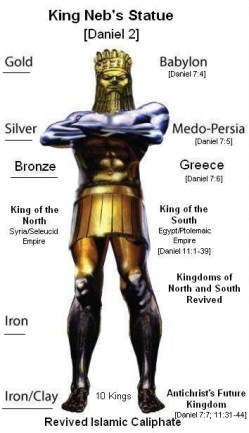
If what I am saying matches the dream statue of Nebuchadnezzar, then you really have to ask yourself – what about those feet?

We emphatically speculate that the fourth empire is the Roman Empire; speculation is all these “teachers” are doing when they assign the Roman empire to this fourth empire. They need to pay more attention to the fact that the fourth empire is not detailed as the others were.

The typical approach used in this skewed assignment of this empire, and therefore where the Antichrist comes from, is derived from Daniel 9:26.

 “And after threescore and two weeks shall Messiah be cut off, but not for himself: and the people of the prince that shall come shall destroy the city and the sanctuary; and the end thereof shall be with a flood, and unto the end of the war desolations are determined.”
Daniel 9:26 KJV

The mediocre teachers assert that since the Roman troops, supposedly under orders from Titus, destroyed the temple, the Roman Empire will be revived, and that is where the Antichrist will come from. 

Do your research, and you will find evidence that leans toward a Middle Eastern people group known as the Assyrians, not Romans/Italians. 

Here are some excerpts from the historian Josephus:

The Wars of the Jews – Book 5, chapter 13

… “Moreover, do the Arabians and Syrians now, first of all, begin to govern themselves as they please, and to indulge their appetites in a foreign war, and then, out of their barbarity in murdering men, and out of their hatred to the Jews, get it ascribed to the Romans?”

In The Wars of the Jews book 6, chapter 4, Josephus states that:

… So he (Titus) commanded that the chosen men that were taken out of the cohorts should make their way through the ruins, and quench the fire.

“…the soldiers, without staying for any orders, and without any concern or dread … snatched somewhat out of the materials that were on fire, and being lifted up by another soldier, he set fire to a golden window, …”

Notice the reaction of Titus and ask yourself, does Titus’ actions give you the impression of someone bent on the complete destruction of the temple?

“And now a certain person came running to Titus, and told him of this fire, as he was resting himself in his tent after the last battle; whereupon he rose up in great haste, and, as he was, ran to the holy house, in order to have a stop put to the fire; … Then did Caesar, both by calling to the soldiers that were fighting, with a loud voice, and by giving a signal to them with his right hand, order them to quench the fire. …. But as for the legions that came running thither, neither any persuasions nor any threatening could restrain their violence, but each one’s own passion was his commander at this time;.”

These Assyrian and Arabian troops were out of control.

This statement is the most telling of them all, and it was said by Titus.

Moreover, do the Arabians and Syrians now first of all begin to govern themselves as they please, and to indulge their appetites in a foreign war, and then, out of their barbarity in murdering men, and out of their hatred to the Jews, get it ascribed to the Romans?”

Even Titus feared that the barbarity of these men would be ascribed to the Romans, and that is precisely what we do when we declare the fourth empire to be a revived Roman empire

Can you not see that ascribing Rome to the fourth empire also takes our eyes off what could be the true evil of the last days, Islam?

While I cover the vagueness of the time frame for “When does this take place?” Let’s find some decisive factors that can help us determine when this will occur. 

“As for me, Daniel, my spirit was distressed, and the visions of my mind were alarming me. (16) I approached one of those standing nearby and asked him about the meaning of all this. So he spoke with me and revealed to me the interpretation of the vision: (17) ‘These large beasts, which are four in number, represent four kings who will arise from the earth.”
Daniel 7:15-17 NET.

Almost as if it is a side note, Daniel is told something that I never understood until this moment.

the holy ones of the Most High will receive the kingdom and will take possession of the kingdom forever and ever.” Daniel 7:18 NET.

The “holy ones” is representative of the church. So the fact that this is inserted here is not only a part of our answer as to when this will take place, but it is another of those validations that the church will NOT be a part of the horrendous violence that is going to happen during the time of wrath.

If I tried to make an assertion as to when this wearing out of the saints will occur, then I could say, based upon Daniel 7:18, that it primarily takes place after the catching away of the church.

Daniel, too, wanted to know the specifics of a beast he would never experience.

“Then I wanted to know the meaning of the fourth beast, which was different from all the others. It was very dreadful, with two rows of iron teeth and bronze claws, and it devoured, crushed, and trampled anything that was left with its feet.”
Daniel 7:19 NET.

Pay attention to several critical words in verse 19,  bronze and iron. 4Beast Comparative Chart

These are not just random descriptions; the Holy Spirit is trying to point out something. 

Bronze represented the Grecian empire under the leadership of Alexander, but in time, he died, and eventually, two out of four generals retained leadership over a divided Grecian empire. 

The second term verse 19 gives us is iron teeth. There is no difference between the effects of these two materials; therefore, it forces the discerning to ask how and why the legs change from bronze to iron. 

Because there is an assimilation, not described in Daniel 7:19into the remaining two ruling aspects of the Grecian empire that cause dramatic changes. 

These dramatic changes are integral to why this beast differs from all the others.

All this occurs after the Grecian empire’s demise and before the Roman empire, which Josephus elaborates on. The Grecian empire extended South into Egypt and Northern Africa through Ptolemy and North under the leadership of Seleucid. Both the Grecian and the Roman empires assimilated conscript troops from conquered countries, and the primary parties involved were Assyrians

Take note also of the feet. We have to jump back to Daniel 2 for the following explanation. 

“In that you saw the feet and toes, partly of potter’s clay and partly of iron, it will be a divided kingdom; but it will have in it the toughness of iron, inasmuch as you saw the iron mixed with common clay. (42) “As the toes of the feet were partly of iron and partly of pottery, so some of the kingdom will be strong, and part of it will be brittle. (43) “And in that you saw the iron mixed with common clay, they will combine with one another in the seed of men; but they will not adhere to one another, even as iron does not combine with pottery.”
Daniel 2:41-43 NASB

Almost immediately, we see that this fourth kingdom is NOT a unified kingdom as the Grecian or Roman empire was. 

To understand this, ask, how many sects of Islam are there? 

The answer is many. We commonly hear of Shi’i, Sunni, and Wahhabi. The first two are constantly at war against each other, and the third, which interacts occasionally, is primarily in the region of the Saudis. 

When you look up the simplistic word mixed, you find the word ‛ărab; this word means mixed or co-mingled. 

So what does Daniel 2:43 say? 

“ they will combine with one another in the seed of men; but they will not adhere to one another, even as iron does not combine with pottery.

Scripture helps to define their hostility toward each other when it talks about Ishmael.

 “The angel of the LORD said to her further, “Behold, you are with child, And you will bear a son, And you shall call his name Ishmael Because the LORD has given heed to your affliction. (12) “He will be a wild donkey of a man, His hand will be against everyone, And everyone’s hand will be against him; And he will live to the east of all his brothers.”
Genesis 16:11-12 NASB

In short, a generalization that applies today is that Muslims still do not adhere to each other.

If you are a student of the Bible, then you understand that the destruction of the temple has two fulfillments. One came under the rule of the Roman general Titus in 70 AD. However, there is another fulfillment coming in these last days. 

And he shall enter into a strong and firm covenant with the many for one week [seven years]. And in the midst of the week he shall cause the sacrifice and offering to cease [for the remaining three and one-half years]; and upon the wing or pinnacle of abominations [shall come] one who makes desolate, until the full determined end is poured out on the desolator.”
Daniel 9:27 AMP

Part two.

In recent years, I held the position that “the saints” were only those martyred during the seven-year period of God’s wrath, which we so foolishly call the tribulation. I did the very thing I despise, spewing out concepts as fact without checking my Bible adequately. Paul used the term saints throughout his writings, and that tends to dispel the idea that the saints are exclusive to the years of wrath. Several examples are Ephesians 1:1; Philippians 1:1; Ephesians 6:8, and numerous others.

The terminology saint immediately takes me to Revelation, where we see things like 

the woman, drunken with the blood of the saints (Revelation 17:6). 

It does not take a rocket scientist to figure out
the most significant implication here is the martyred saints

However, there is something notable about John’s writings. He never used the term saints in reference to the church outside of Revelation; most of the time, he calls them little children and brethren. The feeling is one of association and an understanding of the heart and character of God. Considering John’s beginnings compared to the end, it only makes sense that he would have God’s heart as he unfolds the Revelation, a time of nightmarish destruction and judgment. This time is not directed at “my little children.”

I realize that I initiated this conversation with a portion of Daniel, not John, yet they talk about the same thing. This demonstrates the leading and direction of the Holy Spirit. We cannot discount that John’s recollection of Daniel’s prophecies may have played a role in John’s terminology.

When you look at end times prophecy, there are only three people groups to consider: the Jews, the nations, and the church. While there can and will be some crossing over between the Jews and the church, as followers of Christ are considered a part of the church.

Some will say that God gave up on the Jews. I do not think so. He has engraved their names and faces in the palms of his hands. You do not give up something that precious, especially after showing that level of commitment. God plans to drive the heart of the Jew, his chosen, back to himself. Unfortunately, there is much pain and suffering involved with that journey.

In general, the Jews have rejected Jesus, the Messiah, and therefore subjected themselves to the coming wrath.

And when he was come near, he beheld the city, and wept over it, Saying, If thou had known, even thou, at least in this thy day, the things which belong unto thy peace! but now they are hid from thine eyes. For the days shall come upon thee, that thine enemies shall cast a trench about thee, and compass thee round, and keep thee in on every side, And shall lay thee even with the ground, and thy children within thee; and they shall not leave in thee one stone upon another; because thou knew not the time of thy visitation.”
(
Luke 19:41-44 KJV)

The rejection of God by Israel is a common theme. An example of this is seen in the selection of Saul as king.

And the LORD said unto Samuel, Hearken unto the voice of the people in all that they say unto thee: for they have not rejected thee, but they have rejected me, that I should not reign over them.”
(
1 Samuel 8:7 KJV)

The nations could also be referred to as the gentiles. Daniel referred to them as the people of the prince that shall come. Jesus, talking about the days of vengeance, said,

And they shall fall by the edge of the sword, and shall be led away captive into all nations: and Jerusalem shall be trodden down of the Gentiles, until the times of the Gentiles be fulfilled.
(
Luke 21:24 KJV)

The church is the entire collection of believers comprising the body of Christ.

“And hath put all things under his feet, and gave him to be the head over all things to the church, Which is his body, the fullness of him that fills all in all.” (Ephesians 1:22-23 KJV)

Who is the image of the invisible God, the firstborn of every creature: For by him were all things created, that are in heaven, and that are in earth, visible and invisible, whether they be thrones, or dominions, or principalities, or powers: all things were created by him, and for him: And he is before all things, and by him all things consist. And he is the head of the body, the church: who is the beginning, the firstborn from the dead; that in all things he might have the preeminence.”
(
Colossians 1:15-18 KJV)

In general, the Jews have rejected Jesus, the Messiah, and therefore subjected themselves to the coming wrath.

But God proves his love for us by this (James Moffatt), in that, while we were yet sinners, Christ died for us. Much more then, being now justified by his blood, we shall be saved from wrath through him.”
(Romans 5:8-9 KJV)

. you turned to God from idols, to serve a living and a real God and to wait for the coming of his Son from heaven — the Son whom he raised from the dead, Jesus who rescues us from the Wrath to come.”
(
1 Thessalonians 1:9-10 Moffatt NT)

The church likes to hold itself in exclusivity, thinking we are protected from tribulation. Jesus guaranteed us three things:

  1. In this world, you will have tribulation.

  2. You will be hated by all men, for my name’s sake.

  3. I will come again for you.

Tribulation and wrath/vengeance are two different things. Tribulation is non-stop and comes in many forms. It has nothing to do with your inability to buy a new propeller for the family ski boat. Get real; people in parts of the world with a heavy Muslim influence are killed daily.

If you lived under a constant threat of death, do you think you would feel you were being worn down?

Perhaps the Bible in Basic English translates it more appropriately. Daniel 7:25 (a) BBE 

And he will say words against the Most High, attempting to put an end to the saints of the Most High;” It is clear that the intent is to kill the saints.

And he shall speak words against the Most High, and he shall wear out the saints of the Most High. And he intends to change times and law. And they shall be given into his hand until a time and times and one half time.”
(
Daniel 7:25 LITV)

Daniel 7:23 Declares what was to come, the fourth beast. If the fourth beast is Islam, then that was initiated by Muhammad over 600 years after Christ’s death.

“He gave me this explanation: ‘The fourth beast is a fourth kingdom that will appear on earth. It will be different from all the other kingdoms and will devour the whole earth, trampling it down and crushing it.
(Daniel 7:23 NIV)

What follows is several bits of historical information about the beginnings of Islam.

Born approximately in 570 CE in the Arabian city of Mecca,[9][10] Muhammad was orphaned at an early age; he was raised under the care of his paternal uncle Abu Talib. After his childhood, Muhammad primarily worked as a merchant.[11] Occasionally he would retreat to a cave in the mountains for several nights of seclusion and prayer; later, at age 40, he reported at this spot,[9][12] that he was visited by Gabriel and received his first revelation from God. Three years after this event, Muhammad started preaching these revelations publicly, proclaiming that “God is One,” that complete “surrender” (lit. islām) to Him is the only way (dīn)[n 3] acceptable to God, and that he was a prophet and messenger of God, similar to other Islamic prophets.[13][14][15] (From Wikipedia.)

Islam has operated under various caliphates since the death of Muhammad in 632 AD (BCE). While all of them caused the Middle Eastern world grief, the largest and most powerful was the Ottoman Caliphate.

Ottoman Caliphate (1453/1517–1924)

At the end of October 1922, the Allies invited the nationalist and Ottoman governments to a conference at Lausanne, Switzerland, but Atatürk was determined that the nationalist government should be Turkey’s sole representative. In November 1922, the Grand National Assembly separated the offices of the sultan and caliph and abolished the former. The assembly further stated that the Ottoman regime had ceased to be the government of Turkey when the Allies seized the capital in 1920, in effect abolishing the Ottoman Empire. Excerpt from the Ottomans.org

Is it possible that believers have been under attack for eighteen hundred years? No doubt.

Pay attention to another aspect of Islam.

The Muslim Brotherhood was founded in Ismailia, Egypt by Hassan al-Banna in March 1928 as an Islamist religious, political, and social movement.[1][2] The group spread to other Muslim countries but has its largest, or one of its largest, organizations in Egypt, where for many years it has been the largest, best-organized, and most disciplined political opposition force,[3][4][5] despite a succession of government crackdowns in 1948, 1954, 1965 after plots, or alleged plots, of assassination and overthrow were uncovered. Following the 2011 Revolution the group was legalized,[5] and in April 2011 it launched a civic political party called the Freedom and Justice Party (Egypt) to contest elections.” (Wikipedia)

Note that this is two years after the Caliphate was disbanded.

Links to the Nazis began during the 1930s and were close during the Second World War, involving agitation against the British, espionage and sabotage, as well as support for terrorist activities orchestrated by Haj Amin el-Hussaini in British Mandate Palestine, as a wide range of declassified documents from the British, American and Nazi German governmental archives, as well as from personal accounts and memoirs from that period, confirm.[7] Reflecting this connection, the Muslim Brotherhood also disseminated Hitler’s Mein Kampf and The Protocols of the Elders of Zion widely in Arab translations, helping to deepen and extend already existing hostile views about Jews and Western societies generally.[8] (Wikipedia)

The point is that Islam has been a destructive thorn in the flesh of those who do not comply for over 1800 years. Have they been a global threat throughout their history? No, but it took a global response to subdue them in 1922. I think we can agree that they are global now and a more significant threat than ever before. Aside from that, their prime directive is to kill the people of the book, which would be the Jews and the Christians. 

Have you noticed that they are making a serious dent in their goals?

If you have watched the news in the last couple of years, you are aware of Christians being slaughtered in the mid-East and African nations. Perhaps you have also noticed that attacks against any group outside of Islam are fair game to them. Buddhists, Catholics, you name it. They even fight each other as though there is a competition to see who can follow the Qur’an most precisely. Unfortunately, for the outsider, while the Qur’an does have passages devoted to peace, they are superseded by newer passages that demand strict and violent compliance.

It is currently November 2022 as I am writing, and things have changed drastically since I first posted this study on Wearing out the Saints in January 2015.

  • Many of us have a watchful eye on Bill Gates as he pushes through the goals of his Bill and Melinda Gates Foundation, and that’s to have the whole world vaccinated. Klaus Schwab and his sidekick Professor Yuval Noah Harari, are the men currently taking the lead in this New World Order. 

  • Currently, we have what some refer to as the deep state. You can find these people in almost every nation, calling the action plays as they crush global economies, create a reign of fear, and promote a global, universal marking system to allegedly indicate that we have been vaccinated against COVID-19 when the reality is that they are trying to tag us all with a quantum chip that is a part of this regimentation; this then would give them the ability to control if and when we can eat. 

  • It would seem that the reality of the mark of the beast is upon us.

I do not feel that Bill Gates is the Antichrist, as I have felt for several years that this person would have to be a Muslim. But, besides all that, the Muslims have already been marking those who wish to comply with the terms of their invasion by submitting to heavy taxation and wearing a scarf as a sign of submission, somewhat comparable to what the Jews in Poland had to submit with the yellow star, during WW2.

This declaration of peace that we see the Antichrist making might be supported by Israel, but the majority of the Middle Eastern world, even at this moment, is rejecting any possibility of peace with Israel and will continue to do so if peace is represented by anyone other than a Muslim; and, if you did not notice, Israel is not mentioned as part of this peace treaty. 

I think it is obvious that there is affliction directed at Christians in certain parts of the world.

Not to be left out of this violence against Christians are China and North Korea.

I suppose the question is, how long until this level of violence comes to the Americas and afflicts us as well?

Do not think that your non-belief will protect you.

In general, they feel that any American is a Christ follower and worthy of death. Scripture tells me that you may have a chance to reject God and accept Allah as your God of choice, bowing before him in worship. 

Perhaps that will save your neck for the moment. I am aware that they cut a man’s head off anyway, perhaps because they felt he was a coward with no backbone. I suspect it will not be as easy as that, and they may not have the time to await your decision. Of course, giving into this cuts you off from any hope of a relationship with God. In other words, there is no turning back from this decision.

If you do not know this Jesus Christ, you can.

Ask him into your life, turn yourself over to him and accept his forgiveness. Allow him to run it. You do not have to work for your salvation, as it is free and paid for; you merely have to receive this life and salvation. You will experience a peace that you have never known before and a promise that he will come for you so that you can live with him in glory.

Posted in End times, In Christ, Prophetic, Thoughts, Thoughts on scripture | Tagged , , , , , , , , , , , , | 3 Comments

Matthew chapter 3. Still looking for the character of Jesus.


Matthew 3

Chapter 2 ends with the family and the child, Jesus, moving back to Nazareth. Suddenly we are fast-forwarded to John the Baptist (He is only six months older that his cousin, Jesus,) baptizing in the Jordan River.

In those days John the Baptist came preaching in the wilderness of Judea, “Repent, for the kingdom of heaven is at hand.” For this is he who was spoken of by the prophet Isaiah when he said, “The voice of one crying in the wilderness: ‘Prepare the way of the Lord; make his paths straight.'” Now John wore a garment of camel’s hair and a leather belt around his waist, and his food was locusts and wild honey. Then Jerusalem, all Judea, and all the region about the Jordan were going out to him, and they were baptized by him in the river Jordan, confessing their sins. But when he saw many of the Pharisees and Sadducees coming to his baptism, he said to them, “You brood of vipers! Who warned you to flee from the wrath to come? (Matthew 3:1-7 ESV)

Quite the greeting; apparently John says what he thinks. I noticed something else about this passage, how about you?

Matthew tells us that he asked them, Who warned you to flee from the wrath to come?” This prompts some comments and questions in me, such as:

He, like a skilled Rabbi, is quoting scripture. No, there were no chapters and verses, and yet anyone with knowledge of the law and the prophets would have understood what he meant. If Jesus were treated as an illegitimate child then he would have been excluded from the proper training that John would have obtained. This opens some odd doors about how and where Jesus got his skill sets. I know we like to think that God merely input it all into his brain, or he was just born with it, but that tends to circumvent the idea of God voluntarily becoming a man and being born. No child is born talking. In addition, none of them can play the piano by eighteen months. No, he had to be taught. What we do know is that Joseph was a good man. The King James version uses the word just. The Greek word is – dikaios and means righteous, observing divine laws. If he observed the law, then he knew and understood the law. Therefore, it is possible that Joseph home-schooled Jesus.

What wrath is John the Baptist talking about?

Still under a brutal Roman rule, this could mean something entirely different.

The Greek word that Matthew used was orge, and means – (by analogy) violent passion (ire, or [justifiable] abhorrence); by implication punishment:anger, indignation, vengeance, and wrath. The word orge is used 36 times in the New Testament. Thirty-one of those times, it is translated wrath. Revelation 14:10 translated the word orge to his cup of indignation. However, the Pharisees and Sadducees did not have the advantage of a New Testament; neither would they have accepted it. Paul, before his conversion proved that.

What they did have was this:

But who may abide the day of his coming? and who shall stand when he appeareth? for he is like a refiner’s fire, and like fullers’ soap: And he shall sit as a refiner and purifier of silver: and he shall purify the sons of Levi, and purge them as gold and silver, that they may offer unto the LORD an offering in righteousness. (Malachi 3:2-3 KJV)

“And what cause soever shall come to you of your brethren that dwell in their cities, between blood and blood, between law and commandment, statutes and judgments, ye shall even warn them that they trespass not against the LORD, and so wrath come upon you, and upon your brethren: this do, and ye shall not trespass.” 2 Chronicles 19:10 KJV

Did they understand what “the wrath” meant, absolutely.

The Jews that came to John had an understanding of Hebrew and Aramaic, and yet spoke Greek as well due to the Roman influence. Yes, they knew the law and the prophets, but consider that John would not have said something that had no meaning to them.

The prophet Isaiah spoke of the cup of his fury. (Isaiah 51:17)

A passage that easily answers the question is Isaiah 13:9 KJV – Behold, the day of the LORD cometh, cruel both with wrath and fierce anger, to lay the land desolate: and he shall destroy the sinners thereof out of it.

The hearer immediately realized that this implied a punishment upon the world, and yet, quickly dismissed God pouring his wrath upon them for their rejection. They never seemed to get it.

What should this mean to us?

If you are a student of the Bible, and you should be, then you should also be a student of end times and have some familiarity with the terminology surrounding God’s wrath.

It seems best to bring you up to speed by starting in Revelation. The foremost thing that you need to understand about this book is that this is a Revelation of Jesus Christ. One of the questions I repeatedly hear is, where is the church during the horrors described here. Chapter 3 ends with, “He who has an ear, let him hear what the Spirit says to the churches.” Chapter 4 opens with, “Come up here, and I will show you what must take place after this.” Thus ends the church age, and initiates the wrath of God being poured out upon the earth, the nations, and those that have rejected him by serving idols and other gods. Sadly, two-thirds of Israel will be killed during this time.

I could say the short answer to where the church is, can be found explained very simply in – For God has not destined us for wrath, but to obtain salvation through our Lord Jesus Christ, (1 Thessalonians 5:9 ESV). That is of course a somewhat open-ended statement, in that it gives no definition of how to obtain this salvation in Christ.

Since Christ died upon the cross, rose again, offered the same sacrifices as a high priest does upon the heavenly altar, then all debt for sins was paid. That means you have freedom from the payment of sins. Then why will you be judged since you are theoretically sin free, good question.

The Apostle Paul, a man who had a firm knowledge of the law, and knew both sin and acceptance, wrote to the church body in Rome:

That is why his faith was “counted to him as righteousness.” But the words “it was counted to him” were not written for his sake alone, but for ours also. It will be counted to us who believe in him who raised from the dead Jesus our Lord, who was delivered up for our trespasses and raised for our justification. (Romans 4:22-25 ESV)

In plain English – if I understand that Jesus paid the price for my life by: being beaten, hung on a cross to die, rose from the dead, and now sits enthroned in heaven with the Father so that I can now live. Accepting that, because I received him, he now lives in me. I have received his life and righteousness; the guarantee of a life with Him in heaven.

All of this anticipates a rescue at some point from tribulations and wrath down here on earth. I cannot guarantee that you can or will escape tribulation while you live. Many die daily. However, there is a time of wrath (God’s punishment) that is to be poured out upon the earth, some of which will be distributed at the hands of man.

Living testimonies

While I suppose it is ultimately, what God thinks about us that matters, it is clear to me that we are to be living testimonies of his life in us.

I have to do jury duty soon. Having had that experience, I understand the process. The only thing that we, as jurors, are supposed to consider is the testimony and evidence that comes from the witness stand. There are exceptions of course. In a sense, we are on the witness stand all throughout life. No one seems to care or notice as long as you are not making waves and moving with the flow. Suddenly, you changed course, repented of your sins, and really turned your back to them. This is as if some massive sea cliff breaks off into the ocean causing an immense tidal wave; now you are noticed, generally based upon irritation alone. The only thing we truly have going for us, is what we show to people. That tends to boil down to your actions and words.

After accosting the Pharisees and Sadducees (He called them snakes and vipers) that came to him to be baptized, John told them to go and:

Matthew 3:8 ESV Bear fruit in keeping with repentance.

Let your life prove what you claim you now believe – easier said than done. This next verse reeks of self-righteous arrogance and assumed privilege. John knew them better than they thought.

And think not to say within yourselves, We have Abraham to our father: for I say unto you, that God is able of these stones to raise up children unto Abraham. (Matthew 3:9 KJV)

This verse causes me angst, not just because I am not clear on it’s meaning, but because it tells me two more things, and one of them speaks directly to me. You do not gain advantage because your mommy was a praying woman. This is a personal relationship. If God is able to raise up stones for children, what does that say about us?

Matthew 3:10 KJV And now also the axe is laid unto the root of the trees: therefore every tree which brings not forth good fruit is hewn down, and cast into the fire.

This is a good time for a commentary. John MacArthur declares: “Irreversible judgment is imminent.” This can mean so many things in my thinking, but if this speaks to us as well, then it is not right.

Just the fact that Jesus was here on earth, active in the role he was made for, might be implied, but we cannot decisively say that John knew that. Another possible implication could be that John, speaking prophetically (This is highly possible as Jesus implied that John came in the spirit of Elijah) knew that God’s end times countdown clock was now running. Was this intended to convey that God was cutting off Israel from the inheritance; not a chance, but with a consistent record of idolatry, judgment was coming. (An aspect of that judgment came in 70 AD with the destruction of the temple.

Ezek 15:1-8, (ESV) And the word of the LORD came to me: “Son of man, how does the wood of the vine surpass any wood, the vine branch that is among the trees of the forest? Is wood taken from it to make anything? Do people take a peg from it to hang any vessel on it? Behold, it is given to the fire for fuel. When the fire has consumed both ends of it, and the middle of it is charred, is it useful for anything? Behold, when it was whole, it was used for nothing. How much less, when the fire has consumed it and it is charred, can it ever be used for anything! Therefore thus says the Lord GOD: Like the wood of the vine among the trees of the forest, which I have given to the fire for fuel, so have I given up the inhabitants of Jerusalem. And I will set my face against them. Though they escape from the fire, the fire shall yet consume them, and you will know that I am the LORD, when I set my face against them. And I will make the land desolate, because they have acted faithlessly, declares the Lord GOD.”

This merely adds to my confusion about axing the roots. Having a background in Horticultural science, I can tell you that most anyone, cutting a tree down to its roots kills it. In so doing you have cut off all hope of a life source feeding its limbs and fruit.

I do not care what Hendrik “Hank” Hanegraaff has to say, he lost my respect years ago, but having listened to him and his followers, I know what they will say about this, because I have already heard it. I admire Beth Moore. I love her style of teaching. Truthfully, I have only had the influence of her study on Daniel. It was in this study that Beth emphasized that God has not replaced Israel (any student of the bible is aware of that fact), but he did put them on hold.

I have the Holy Ghost, so where is the fire? This is what I long for, and I do not even care if it has a negative potential.

I indeed baptize you with water unto repentance: but he that cometh after me is mightier than I, whose shoes I am not worthy to bear: he shall baptize you with the Holy Ghost, and with fire: (Matthew 3:11 KJV)

There seems to be two distinct baptisms spoken of here. Jesus accepted John’s baptism as fulfilling the Law. That might be a stretch to find the reference for it. Hang on for here comes the exciting part. “he shall baptize you with the Holy Ghost, and with fire:”

The leader of a bible study I attend did it again. He said, we do not need to wallow in teachings about the end times they just confuse everyone. We need to teach doctrine! How funny that is because even John the Baptist spoke about the end times.

Matthew 3:12 NET. His winnowing fork is in his hand, and he will clean out his threshing floor and will gather his wheat into the storehouse, but the chaff he will burn up with inextinguishable fire.”

This should strike a familiar chord because Jesus, in a parable, talked about a gathering of the wheat, and at that time, the tares would be separated out. We find this in Matthew 13.

Matthew 13:30 KJV Let both grow together until the harvest: and in the time of harvest I will say to the reapers, Gather ye together first the tares, and bind them in bundles to burn them: but gather the wheat into my barn.

Now Jesus comes to the Jordan to be baptized

(Matthew 3:13 AMP) Then Jesus came from Galilee to the Jordan to John to be baptized by him.

John – What kind of man was he? Referring to Elijah, Jesus asked, “What did you go out into the wilderness to see?”

(2 Kings 1:7,8 AMP) The king asked, What was the man like who came to meet you saying these things? They answered; He was a hairy man with a girdle of leather about his loins. And he said, It is Elijah the Tishbite.

John is said to have come in the spirit of Elijah. Elijah was honored and respected. Perhaps another way to say that is – he was feared. John the disciple may have patterned his life after John the Baptist. It is possible that many followed Elijah’s example.

Zechariah 13:4 … in that day every prophet will be ashamed of his vision when he prophecies; they will not wear a robe of coarse hair to deceive.

But false prophets also arose among the people, just as there will be false teachers among you, who will secretly bring in destructive heresies, even denying the Master who bought them, bringing upon themselves swift destruction. And many will follow their sensuality, and because of them the way of truth will be blasphemed. And in their greed they will exploit you with false words. Their condemnation from long ago is not idle, and their destruction is not asleep. (2 Peter 2:1-3 ESV)

What is it about wearing a robe of course hair that would cause deception? Perhaps people would perceive the hairy garments in the same light that they saw Elijah, evoking a false following. The Apostle Peter pointed out the greed of the false teacher, this is not the image we get when we think of John.

(Matthew 3:14 ESV) John would have prevented him, saying, “I need to be baptized by you, and do you come to me?”

Based upon this statement we learn that John knew him. That would make all the sense in the world, as they were cousins. Keep in mind that John’s family did not have to flee to Egypt and Jesus’ family were the outcasts. Jesus would have been considered an illegitimate child in Nazareth, and the ostracism would have been against the entire family. Jewish law alone would have prevented him from been allowed in the temple, let alone be taught by anyone other than his immediate family. No, just being a cousin did not mean that they grew up close, or in close proximity. I believe that John knew him as a man and carpenter, but John had been filled with the Holy Spirit of God from his mother’s womb, and surely heard God’s voice.

John seemed to know that Jesus carried God’s authority. If that is the case, how do we explain John’s question from prison, for we see John, while in prison, sending messengers asking Jesus if he is the one that they have looked for. Jesus response is interesting. Tell him what you see and hear. Fruit is a good example of what kind of tree you have.

The disciples of John reported all these things to him. And John, calling two of his disciples to him, sent them to the Lord, saying, “Are you the one who is to come, or shall we look for another?” (Luke 7:18-19 ESV)

Notice how Jesus responded. At first he says nothing; he goes into action.

Luke 7:21-23 ESV In that hour he healed many people of diseases and plagues and evil spirits, and on many who were blind he bestowed sight. (22) And he answered them, “Go and tell John what you have seen and heard: the blind receive their sight, the lame walk, lepers are cleansed, and the deaf hear, the dead are raised up, the poor have good news preached to them. (23) And blessed is the one who is not offended by me.”

and behold, the heavens were opened to him

(Matthew 3:16 ESV) And when Jesus was baptized, immediately he went up from the water, and behold, the heavens were opened to him, and he saw the Spirit of God descending like a dove and coming to rest on him;

The Spirit of God – See Matthew 3:11. This was the third person of the Trinity, descending upon him in the form of a dove, Luke 3:22. The dove, among the Jews, was the symbol of purity of heart, harmlessness, and gentleness,

heavens – the Greek word ouranos, meaning

1) the vaulted expanse of the sky with all things visible in it

1a) the universe, the world

1b) the aerial heavens or sky, the region where the clouds and the tempests gather, and where thunder and lightning are produced

I cannot imagine what this must have looked like. I know I have watched too much television and they have created images in my head, and I sometimes think it was like that. It may have been as simple as the clouds parting and something that looked like a dove came down through the opening. I imagine everyone has had one of those moments where the clouds parted on a dark, rainy day, and the sun shone like a beam through that hole in the clouds.

were opened unto him, – anoigo – to open up (literally or figuratively)

The KJV version says the heavens were opened unto Him. That conveys some exclusivity. Did others see it? That is not clear, but if God wanted to make a point, and bring His Son Jesus into the limelight, a dramatic act would be the way to go.

and he saw the Spirit of God descending like a dove and coming to rest on him;

The sky opens and He sees this happening. What if no one else saw it? Then we would be entirely reliant on Jesus telling us the story. That becomes very farcical at that point. It only seems logical that everybody there knew that something unusual was happening. They may not have seen it as clearly as Jesus did, but they saw something. None of this seemed to give Jesus any more credence than if he had just stepped off the bus. His word and His actions had to speak for Him. Once again, the tree’s fruit seemed to define where the tree came from. The Pharisee Nicodemus came to Jesus and said, we know that you are come from God, because no one can do the things you do without Him or his approval.

 (Matthew 3:17 AMP) And behold, a voice from heaven said, This is My Son, My Beloved, in Whom I delight

And behold, a voice

voice phōnē

1) a sound, a tone

1a) of inanimate things, as musical instruments

Here is a little food for thought. In Revelation 1:10 John the beloved, saw into heaven, and had this to say about it. “I was in the Spirit on the Lord’s day, and heard behind me a great voice, as of a trumpet,” The people standing around, watching Jesus get baptized, heard a sound. Jesus heard a voice, but not them. This is probably the same thing that John the beloved heard, a voice as of a trumpet. We are waiting for a sound to herald the return of our King. Perhaps we have been waiting for the wrong sound and yet not; for his voice is like that of a trumpet.

Students of the bible know that there is a day in which Jesus will return for his church, and it will be preceded by what Israel called a trumpet blast. It is actually a Shofar and has a very distinct sound, probably comparable to a bull moose in pursuit of a female. On that day, our hope will be fulfilled and we will get to spend eternity with the one that loved us first. If this speaks to you and you do not have this hope, you can. Just ask Jesus into your life, turn from your destructive ways (that is what it means to repent). Know that in so doing he comes in and gives you his righteousness. Your life becomes his and he will receive you into his waiting arms on that day.

Posted in Thoughts on scripture | Tagged , , , , , , , , , | 1 Comment

Is talking about the rapture relevant or necessary?


This, as with everything I write, started with a conversation. In this case, a conversation that turned out one-sided and ended with the other person telling me that discussions about the rapture are filled with fallacies, and comparable to eating a cupcake, nutritionally pointless.


Let us try to avoid the fallacies and see what scripture admonishes us to teach.


I want to begin with Paul’s first letter to the Thessalonians.

It seems Paul’s purpose in writing was meant to strengthen their faith and give them an assurance of Christ’s return. Throughout the letter to the Thessalonians we gain clues that will support why we need to have an enthusiasm for the “rapture”. Most of Paul’s letters had a doctrinal section and a practical section. The practical lends itself to chapter four, and that is where I am headed.


Background and Setting

“Thessalonica (modern Salonika) lies near the ancient site of Therma on the Thermaic Gulf at the northern reaches of the Aegean Sea. It may have been a vacation attraction because of the thermal springs. This city became the capital of Macedonia (c. 168 B.C.) and enjoyed the status of a “free city” which was ruled by its own citizenry under the Roman Empire.” (The MacArthur Bible Commentary, Copyright © 2005 by John MacArthur). Sometime during the early centuries of the spread of Christianity, Thessalonica came to be nicknamed “the orthodox city” because of its Christian character (Dean Farrar, The Life and Work of St. Paul, New York: Cassell and Company, Limited, 1904, p. 364). Salonika is still an important city in Greece. Because of the Jewish dispersion it is estimated that one-third of the population was Jewish. The Jews brought with them their ethical, monotheistic faith, quite the contrast to the Greeks and Romans they were living with.


Situation

While preaching Jesus as Messiah (the Jewish king) in Thessalonica, Paul had been accused of preaching another king besides Caesar (Act_17:7). The very young Thessalonian church continued to experience persecution after Paul’s departure, but he encourages them with the promise of a future hope, which applies even to those who have already died (1Th_4:13-18). (The IVP Bible Background Commentary: New Testament, Copyright © 1993 by Craig S. Keener)


Paul’s entrance and exit from Thessalonica are recorded in Acts chapter 17. It did not go well and noble men escorted Paul and Silas to safety where they traveled on to Berea.

Now when they had traveled through Amphipolis and Apollonia, they came to Thessalonica, where there was a synagogue of the Jews. And according to Paul’s custom, he went to them, and for three Sabbaths reasoned with them from the Scriptures, explaining and giving evidence that the Christ had to suffer and rise again from the dead, and saying, “This Jesus whom I am proclaiming to you is the Christ.” And some of them were persuaded and joined Paul and Silas, along with a large number of the God-fearing Greeks and a number of the leading women. But the Jews, becoming jealous and taking along some wicked men from the market place, formed a mob and set the city in an uproar; and attacking the house of Jason, they were seeking to bring them out to the people. When they did not find them, they began dragging Jason and some brethren before the city authorities, shouting, “These men who have upset the world have come here also; and Jason has welcomed them, and they all act contrary to the decrees of Caesar, saying that there is another king, Jesus.” They stirred up the crowd and the city authorities who heard these things. And when they had received a pledge from Jason and the others, they released them. The brethren immediately sent Paul and Silas away by night to Berea, and when they arrived, they went into the synagogue of the Jews. Now these were more noble-minded than those in Thessalonica, for they received the word with great eagerness, examining the Scriptures daily to see whether these things were so. Therefore many of them believed, along with a number of prominent Greek women and men. But when the Jews of Thessalonica found out that the word of God had been proclaimed by Paul in Berea also, they came there as well, agitating and stirring up the crowds. Then immediately the brethren sent Paul out to go as far as the sea; and Silas and Timothy remained there. (Acts 17:1-14 NASB)

Because of the nature of the letter, and the soundness of the biblical doctrines, I tend to make several assumptions. First, I presumed that Paul had a reasonable amount of time with them. Secondly, I assumed that he had established some elders in this church and that might have happened. The third thing dominant in my thinking is the depth of conversation about the things of God he was able to have with them. Most people will struggle for months over the concept of eternal salvation, and yet in Christ this is well-defined. A simple example of this is found in: (John 10:28 NASB) and I give eternal life to them, and they will never perish; and no one will snatch them out of My hand.


Paul reasoned with them for three Sabbaths.

I cannot imagine that he took non-Sabbath days off. Three weeks might not have been enough time for him to set up his tent making operations, making a couple of dollars to buy groceries, but you can certainly make a huge impact on receptive ears in three weeks. Nonetheless, in three weeks he gave them a solid foundation and a bit more.

What I have to remind myself is that Paul’s first stops were always to the Synagogues. Here you should find people who are well established in the law and the prophets due to oral tradition. The truth the Holy Spirit built into Paul was based in the Law and the Prophets, so he does have a common ground. In recovery, I have found that the greatest testimony of Christ’s work in me has everything to do with what I personally know and have experienced – freedom and hope. This is what Paul found and this is the message he spread.

Jewish ways and tradition run deep, but then history proves that so does the affinity for idolatry, but we will ignore that for the moment seeing as we all struggle with that one. Within three weeks, many are ready to kill Paul, or at minimum run him out-of-town. It may have been a free city and not under the heavy hand of Rome, but insurrections were put down swiftly. Regardless, Paul and Silas are now gone.

Due to a bible study I attended, my focus lately has been on the later half of chapter four, beginning with this: 1 Thessalonians 4:13 NASB (13) But we do not want you to be uninformed, brethren, about those who are asleep, so that you will not grieve as do the rest who have no hope.

I think it is brilliant how the Holy Spirit, open so much truth just in one sentence. Paul used the word for uninformed, not because he had left it out of his three-week crash course, but because someone had muddied up the water of truth; probably by bringing in external circumstances into the picture. You know how some people are so good at pointing out the obvious to you, for the express purpose of keeping you founded in sound doctrine. I suspect they mean well, but their delivery has no intent other than pointing out your fallacy, and how improperly discipled you apparently are, while making, themselves look better.

Another aspect of this verse is the ramification of being asleep. No, I am not talking about falling asleep in church; I do it all the time. Besides, I am often tired by the time I get there, and the setting is perfect for sleeping. Asleep should mean dead, sort of, if it were not for the fact, our soul never dies. Ah, come on now, even atheists believe in ghosts. Why would Paul have to have a conversation about them grieving over some that have died? No one is saying that it is not okay to grieve your loss of a loved one. However, if I have hope, another aspect of Paul’s conversation, then I should understand that because they too had a relationship with Jesus Christ, I would see them again. This one verse carries the idea of our being with Jesus; due to something we like to call the rapture, written all over it.

The same guy that shut down our morning conversation, because he alone felt that the mention of the rapture deserved the brunt of his displeasure, feels strongly that we should only focus on the doctrines of the church. Really, what does that mean, because those can be different depending on what denomination you are. Doctrines, in general, are the basics that establish our relationship with God. An example might be found in the Apostles creed:

I believe

In God the Father.. Maker of heaven and earth;

And in Jesus Christ, His only Son, our Lord

Who was conceived by the Holy Ghost, born of the Virgin Mary.

He suffered under Pontius Pilate, was crucified, dead, and buried;

He descended into Hades; the third day he rose from the dead;

I believe in the Holy Ghost;

The holy catholic Church; the communion of saints;

The forgiveness of sins;

The resurrection of the body;

And the life everlasting.

There are at least five other versions of the creed, none wholly in agreement with the other. So, which doctrines are we to preach to people? While there are only four words in here that give me grief, the overall is impact is YES, this is what I believe. These things validate our hope. Moreover, if my argumentative friend were to read them again, he might realize that they include the concept of the rapture.

It is clear that Paul believed whole-heartedly in the harpazo, or snatching away of the church. My friend had to let me know that “the rapture did not exist until the 1800’s.” Moments like this make me wish my brain worked better. How dare you accuse me of dispensing fallacies when you make an uneducated statement such as he did. While it may be true that the terminology “rapture” did not become popular until the 1800’s, does not make it a meaningless term. The word rapture is a derivative of the Latin word rapiemur and is found in the Latin Vulgate. It effectively means a snatching away.

From Wikipedia:

The Latin Vulgate translates the Greek ἁρπαγησόμεθα as rapiemur,[21] from the verb rapio meaning “to catch up” or “take away”.[22]

21   1 Thessalonians 4:17. deinde nos qui vivimus qui relinquimur simul rapiemur cum illis in nubibus obviam Domino in aera et sic semper cum Domino erimus (Latin Vulgate).

22 Clouse, R.G. (1984). Elwell, Walter A., ed. Evangelical Dictionary of Theology. Grand Rapids, MI: Baker Books. p. 908. ISBN 0-8010-3413-2.

Let us get something straight now. Jesus only guaranteed us a few things:

  1. In this world, you will have tribulation.

What does that mean? It means that the potential of things going extremely hard and you being killed are a harsh reality

  1. You, as a follower of Christ, will be hated by all men.

That includes religious folk.

  1. Jesus said, I will not leave you, nor forsake you. I will come back for you.

Tribulation ≠ Wrath. Tribulation is a way of life, and NO, God is not terribly interested in whether you drive the newest Mercedes-Benz.

  1. There is a valid hope, and it includes a life with the Father in a land of peace.

Some of the questions you have to ask yourself, if you are trying to make a decision as to whether the rapture is relevant or not, is:

    • Are there two or three witnesses?

I recently looked this up. Of the books of the New Testament, there are only two in which I cannot see any reference to end times and the rapture.

    • Who spoke about it and can we trust them?

This one scares me because it is so pathetic. Paul never left the subject untouched, whether he called it our hope or our gathering to Him.

Jesus spoke about it. John’s gospel is one the largest collection of references to the concept.

John 14:3 ASV And if I go and prepare a place for you, I come again, and will receive you unto myself; that where I am, there ye may be also.

John 14:18 KJV I will not leave you comfortless: I will come to you.

  • Is it possible that there are other terms being used and I am missing this?

Absolutely! It is called:

  1. (Coming) 2 Peter 3:3-4 KJV Knowing this first, that there shall come in the last days scoffers, walking after their own lusts, (4) And saying, Where is the promise of his coming? for since the fathers fell asleep, all things continue as they were from the beginning of the creation.
  1. 2 Thessalonians 2:1 KJV   (1) Now we beseech you, brethren, by the coming of our Lord Jesus Christ, and by our gathering together unto him,
  2. Mark 14:62 KJV And Jesus said, I am: and ye shall see the Son of man sitting on the right hand of power, and coming in the clouds of heaven.
  3. 2 Corinthians 1:14 MKJV (14) even as you have recognized us in part, that we are your rejoicing, even as you also are ours in the day of the Lord Jesus.

You should get the idea by now.

1 Thessalonians 4 may answer any questions we have, if we give it a chance.

1 Thessalonians 4:14 MKJV (14) For if we believe that Jesus died and rose again, even so God will also bring with Him all those who have fallen asleep through Jesus.

“For if we believe that Jesus died and rose again” This is one of those things that define us; it is essential, doctrinal, and foundational truth for every believer.

“..even so God will also bring with Him all those who have fallen asleep through Jesus.” I can apply this statement to two things. First, since the dead in Christ will rise first, they will be with him and possibly be considered to be brought with Him. The second is at the end of the seven-year period, the time of God’s wrath upon the earth.

Zechariah 14:5 KJV And ye shall flee to the valley of the mountains; for the valley of the mountains shall reach unto Azal: yea, ye shall flee, like as ye fled from before the earthquake in the days of Uzziah king of Judah: and the LORD my God shall come, and all the saints with thee.

Here is the passage that tends to trouble me.

1 Thessalonians 4:15 KJV (15)   For this we say unto you by the word of the Lord, that we which are alive and remain unto the coming of the Lord shall not prevent them which are asleep.

“For this we say unto you by the word of the Lord” If Paul has to reestablish where his inspiration is coming from, that tends to tell me that these people had really had their boat rocked.

Speaking from experience, I came to the Lord at perhaps age 12. I tend to cling to that age as a reference point. In reality, evangelistic preachers would come about every six months. I, like so many others, would go down front to repent and be born again; why, because I never had an assurance of my salvation. Mom did not help much with that, as she would emphasize that some minor stupidity we pulled as kids needed to be repented of, or God just might bypass us and we would end up in hell. Needless to say, most of my childhood involved fear.

“, that we which are alive and remain unto the coming of the Lord shall not prevent them which are asleep.” This tells me that one of two things have affected them. Someone has come behind Paul and preached a message that confuses or contradicts what Paul had taught, or tribulation, a perceived evidence of the seven-year period after the rapture, has come in their minds.

I do not know when this started, but I can tell you that we have done this to ourselves. The seven-year period is called the time of God’s wrath upon the earth. Jesus indicated that it would be a time of such great tribulation, that no one would survive unless God shortens time. It is a time of judgment. If I were Paul and I only had three weeks to bring you up to speed, establishing that you are no longer under condemnation for sins would be high on my list of points to make. Just because we are forgiven, purchased out from under the debt we owed, does not give us that full access we see; acceptance of Jesus Christ as the one that paid that price does.

I do not understand for the life of me, why God needs these old bodies, but he seems to want to have them attached to the souls they belong with.

This next verse is the snatching away for which we long. We, out of habit, call it the rapture.

1 Thessalonians 4:16-17 KJV (16) For the Lord himself shall descend from heaven with a shout, with the voice of the archangel, and with the trump of God: and the dead in Christ shall rise first: (17) Then we which are alive and remain shall be caught up together with them in the clouds, to meet the Lord in the air: and so shall we ever be with the Lord.

For me, the key argument about why I should understand, believe, and preach the coming of Jesus Christ, something I happen to believe is imminent, comes in the next verse. It also happens to be the last verse of chapter 4.

1 Thessalonians 4:18 KJV (18) Wherefore comfort one another with these words.

Placement is everything. Since Paul had encouraged and admonished the church already, then it makes sense to say, use these words to comfort one another. If he had placed this sentence else where in the text, then I would have to wonder what kind of documents to they have to refer to, to gain this encouragement. You do realize, that all they had was the Holy Spirit and their memories to hold them together.

I believe, especially now, that we were meant to understand and preach this message. I believe it is even more relevant today because many around us have seen these prophecies happen before their eyes. Israel becoming a nation is one of them.

No the subject is not new, even Daniel ends with this hope.

Daniel 12:1-4 KJV And at that time shall Michael stand up, the great prince which stands for the children of thy people: and there shall be a time of trouble, such as never was since there was a nation even to that same time: and at that time thy people shall be delivered, every one that shall be found written in the book.   (2) And many of them that sleep in the dust of the earth shall awake, some to everlasting life, and some to shame and everlasting contempt.   (3) And they that be wise shall shine as the brightness of the firmament; and they that turn many to righteousness as the stars for ever and ever.   (4) But thou, O Daniel, shut up the words, and seal the book, even to the time of the end: many shall run to and fro, and knowledge shall be increased.


Posted in End times, Hope, Prophetic, Thoughts on scripture | Tagged , , , , , , , , , | 1 Comment

Our lead in to Matthew 2


What an interesting transition. Our lead-in to Matthew 2 tells us: That Joseph was a good man. Mary was probably in trouble, though she had done nothing wrong. Joseph took her into his home before the usual time, disregarding the pressure that may have come at him as well.

Suddenly I realize that am not aware of where they came from. Sadly, I have never been aware of where they were living when all this started. Nazareth, as we learn from Luke’s gospel, was not Joseph’s hometown. I assumed that Bethlehem was where Mary was from as well. This is one of those reasons that we should compare notes with the other gospels when we are trying to get the bigger picture.

Luke’s gospel tells us that they came from Nazareth, and went to Bethlehem. Here is why:

“Now in those days an order was published by Caesar Augustus that the whole world should be registered. This was the first registration taken while Quirinius was governor of Syria. So all the people went to their hometowns to be registered. Joseph, too, went up from the city of Nazareth in Galilee to Judea, to the city of David called Bethlehem, because he was a descendant of the household and family of David. He went there to be registered with Mary, who had been promised to him in marriage and was pregnant.” (Luke 2:1-5 ISV)

So all my rants and perceptions about them being outcasts have more to do with Joseph’s family rejecting the two of them, as they tried to find a place to stay in Bethlehem. Perhaps I am wrong in assuming that common courtesy and hospitality existed in this period of history. Maybe Joseph has been gone so long that he is barely remembered. Who knows? Even here in Bethlehem, if challenges came up, how easy would it be to say, this is my wife and she is with child. Who would question that?

It is clear that Mary and Joseph did not go around announcing that this was the coming Messiah. If they had done that Herod would have had been no need to question the wise men, or the religious Jews about where this Messiah and rightful heir to the throne was.

I do not think that most people would have paid attention if they had declared that this coming baby was the Messiah. All of Israel expected some grand entrance associated with a warrior king, not some poverty-stricken family, with a baby coming.

Matthew 2:1-2 NET.

After Jesus was born in Bethlehem in Judea, in the time of King Herod, wise men from the East came to Jerusalem saying, “Where is the one who is born king of the Jews? For we saw his star when it rose and have come to worship him.”

Wise men?

They were Magi: A magus, the name given by the Babylonians (Chaldeans), Medes, Persians, and others, to the wise men, teachers, priests, physicians, astrologers, seers, interpreters of dreams, augers, soothsayers, sorcerers etc. (Thayer’s definitions)

These wise men were men that had emerged from Daniel’s tutelage of the Magi.

Daniel 4:9 LITV O Belteshazzar(Daniel), master of the magicians(astrologers), because I know that the spirit of the holy gods is in you, and no secret troubles you, tell me the visions of my dream that I have seen, and its meaning.

Did it ever occur to you that there could have, and should have been others that understood and paid attention?

Certainly, the shepherds were wise enough to come. Around Christmas of every year you see the sentence, “Wise men still seek him” and that is certainly true. However, this is very telling of the Jewish people; they knew by oral tradition, based in the Law and the prophets that the Messiah was coming.

Many have decided, after having read the bible, that it borders on impossible to figure out when future events should occur. We are even told, concerning the coming our Lord, that no man knows the precise time. Nevertheless, Daniel was able to figure out that the end of Israel’s captivity in Babylon was near. Did that mean freedom was immediate? Daniel sought the Lord for an answer.

Daniel 9:2-3 KJV “In the first year of his reign I Daniel understood by books the number of the years, whereof the word of the LORD came to Jeremiah the prophet, that he would accomplish seventy years in the desolations of Jerusalem. (3) And I set my face unto the Lord God, to seek by prayer and supplications, with fasting, and sackcloth, and ashes:”

God’s response spelled out: Israel’s release from captivity; the death of the Messiah; the destruction of the temple in 70 AD; Antichrists covenant with Israel for seven years, and his breaking of that covenant at the mid-point; the abomination of the final temple, and the desolation of Israel. Once it starts, this time will continue until the end of those seven years.

Why then, if Daniel can figure things out, no one else can? Ah, but they could, and several did. The religious Jews, when brought before Herod, were able to tell Herod that Jesus was to be born in Bethlehem. Apparently, they knew.  What we see is an intentional refusal of the Messiah.

Matthew 2:3 NET. When King Herod heard this he was alarmed, and all Jerusalem with him.

Herod was an insecure man. You can rest assured that his lookouts saw the wise men coming. The Magi had done their homework, and were looking for the sign of His arrival. Having found it they began their journey. I can understand Herod’s fear, but why is all of Jerusalem afraid, unless, they fear the repercussions of a bipolar king.

Josephus can well understand the meaning of these words. Herod in his rage over his family rivalries and jealousies put to death the two sons of Mariamne (Aristobulus and Alexander), Mariamne herself, and Antipater, another son and once his heir, besides the brother and mother of Mariamne (Aristobulus, Alexandra) and her grandfather John Hyrcanus. He had made will after will and was now in a fatal illness and fury over the question of the Magi. He showed his excitement and the whole city was upset because the people knew only too well what he could do when in a rage over the disturbance of his plans.” (RWP)

Having Herod perceive this as an attempt at an uprising, and the repercussions of that, may well be the basis of Jerusalem’s fear. It will only be days before Herod tries to kill off this young contender for the throne.

Matthew 2:4-6 KJV “And when he had gathered all the chief priests and scribes of the people together, he demanded of them where Christ should be born. And they said unto him, In Bethlehem of Judaea: for thus it is written by the prophet, And thou Bethlehem, in the land of Juda, art not the least among the princes of Juda: for out of thee shall come a Governor, that shall rule my people Israel.”

Herod quickly gathered all the chief priests and scribes of the people together. He demanded an answer, and they gave him what they knew. However, you find these same men denying the deity and veracity of Jesus, even though they knew that his birth fulfilled prophecy. Their hypocrisy screams in the face of God.

Now Herod knows that he has a potential threat. A young boy should be an easy target. Perhaps these wise men have a more precise location, seeing as they are interested in going there; a blatant and notable difference from the religious Jews.

Allow me to insert a break here.

While the general population of religious Jews is in denial about the Messiah, some are not. We are aware of the shepherds and the wise men, but who else has been paying attention?

I want you to look at Luke chapter two with me.

Luke 2:15-17 DRB “And it came to pass, after the angels departed from them into heaven, the shepherds said one to another: Let us go over to Bethlehem and let us see this word that is come to pass, which the Lord hath shewed to us. And they came with haste: and they found Mary and Joseph, and the infant lying in the manger. And seeing, they understood of the word that had been spoken to them concerning this child.”

Luke 2:21-33 DRB “And after eight days were accomplished, that the child should be circumcised, his name was called JESUS, which was called by the angel before he was conceived in the womb. And after the days of her purification, according to the law of Moses, were accomplished, they carried him to Jerusalem, to present him to the Lord: As it is written in the law of the Lord: Every male opening the womb shall be called holy to the Lord: And to offer a sacrifice, according as it is written in the law of the Lord, a pair of turtledoves or two young pigeons: And behold there was a man in Jerusalem named Simeon: and this man was just and devout, waiting for the consolation of Israel. And the Holy Ghost was in him. And he had received an answer from the Holy Ghost, that he should not see death before he had seen the Christ of the Lord. And he came by the Spirit into the temple. And when his parents brought in the child Jesus, to do for him according to the custom of the law, He also took him into his arms and blessed God and said Now thou dost dismiss thy servant, O Lord, according to thy word in peace: Because my eyes have seen thy salvation, Which thou hast prepared before the face of all peoples: A light to the revelation of the Gentiles and the glory of thy people Israel. And his father and mother were wondering at those things which were spoken concerning him.”

The Message version describes Simeon like this:

Luke 2:25 MSG  “In Jerusalem at the time, there was a man, Simeon by name, a good man, a man who lived in the prayerful expectancy of help for Israel. And the Holy Spirit was on him.”

Then there was Anna. She was very old, but she understood.

Luke 2:36-38 ISV “Now Anna, a prophetess, was also there. She was a descendant of Phanuel from the tribe of Asher. She was very old, having lived with her husband for seven years after her marriage, and then as a widow for 84 years. She never left the Temple, but continued to worship there night and day with times of fasting and prayer. Just then she came forward and began to thank God and to speak about Jesus to everyone who was waiting for the redemption of Jerusalem.”

No, not everyone was blind to his birth.

Matthew 2:7-10 ISV “Then Herod secretly called together the wise men, found out from them the time the star had appeared, and sent them to Bethlehem. He told them, “As you go, search carefully for the child. When you find him, tell me so that I, too, may go and worship him.” After listening to the king, they set out, and the star they had seen in the east went ahead of them until it came and stopped over the place where the child was. When they saw the star, they were ecstatic with joy.”

The wise men understood that Herod had an alternative motive and they were going to have no part of it. Notice when they relocated the star that they were ecstatic with joy.

Here comes the part where you get your traditional Christmas manger scene destroyed.

Matthew 2:11 ISV “After they went into the house and saw the child with his mother Mary, they fell down and worshiped him. Then they opened their treasure sacks and offered him gifts of gold, frankincense, and myrrh.”

Nope, He is no longer in a manger. In addition, notice that there is nothing said about how many wise men are here, or the quantity of treasure containers. This is another of those things in scripture about which we have made assumptions.

Matthew 2:12 ISV Having been warned in a dream not to go back to Herod, they left for their own country by a different road.”

God cared about wise men, and warned them in a dream that they should take another way home. I can see this serving two purposes: One, it keeps Herod from killing them since they are no longer useful, and two, God has a plan, and it does not include having His only son killed prematurely.

Matthew 2:13 ERV “After the wise men left, an angel from the Lord came to Joseph in a dream. The angel said, “Get up! Take the child with his mother and escape to Egypt. Herod wants to kill the child and will soon start looking for him. Stay in Egypt until I tell you to come back.””

How old is Jesus at this point? Our evidence is really based upon Herod’s assessment. He had questioned the wise men, because his intent was to kill the child. They apparently told Herod that it had been two years since they had seen His star in the East. Since the star appeared at His birth, then all male children, two and under would be killed.

I think I have always wondered what became of the gifts the wise men brought. I think it is safe to say that these gifts financed, not only the trip, but their lives while in Egypt.

Matthew 2:16 KJV “Then Herod, when he saw that he was mocked of the wise men, was exceeding wroth, and sent forth, and slew all the children that were in Bethlehem, and in all the coasts thereof, from two years old and under, according to the time which he had diligently enquired of the wise men.”

What horrors as so many children were innocently slaughtered.

Matthew 2:17-18 ESV “Then was fulfilled what was spoken by the prophet Jeremiah: (18) “A voice was heard in Ramah, weeping and loud lamentation, Rachel weeping for her children; she refused to be comforted, because they are no more.””

Jeremiah 31: 15 is what they pulled from. Rachel is now symbolic and gains it fulfillment with the deaths of these children. However, this is yet to be fulfilled in the destruction of Israel during the years of wrath.

“But when Herod died, behold, an angel of the Lord appeared in a dream to Joseph in Egypt, saying, “Rise, take the child and his mother and go to the land of Israel, for those who sought the child’s life are dead.” And he rose and took the child and his mother and went to the land of Israel. But when he heard that Archelaus was reigning over Judea in place of his father Herod, he was afraid to go there, and being warned in a dream he withdrew to the district of Galilee. And he went and lived in a city called Nazareth, so that what was spoken by the prophets might be fulfilled, that he would be called a Nazarene.” (Matthew 2:19-23 ESV)

Most people fear the prophetic. Maybe they mostly fear prophetic people. I suppose that is understandable considering the television representations we get to watch. At this point in history, God had been silent for four hundred years. Suddenly he shows up in dreams. It was not unusual for God to talk to his people in this way. That made Mary’s story a little easier to handle.

Given the green light to go back home, with the disclaimer, “all who seek the death of Jesus are dead” you might think Joseph would be comfortable going back to Bethlehem. Life had worked out okay there. But when he learned that Archelaus was ruling Joseph goes around Judea and back to Nazareth. Matthew writes this as though Nazareth is a new and unfamiliar experience for them. They have been gone for a few years but comments made toward Jesus, as far south as Jerusalem, show that his birthing reputation was well-known.

Matthew 2:23 ESV And he went and lived in a city called Nazareth, so that what was spoken by the prophets might be fulfilled, that he would be called a Nazarene.

I have looked in scripture for the prophet that spoke these words but cannot find him. In reading the notes in my Dakes’ bible, he says, these words were spoken but not recorded. Considering that so much of what we read is passed on through oral history and learning, it makes sense.

             Everything was going according to God’s plan.

Posted in Things I have never noticed before, Thoughts on scripture | Tagged , , , , , , , , , , , | Leave a comment

Let’s talk about prophecy for a moment.


You need to understand something; prophecy is not something that must be feared unless you are the one in error. There are exceptions to everything and there is no denying that The Revelation (of Jesus), that John saw, is filled with some scary aspects. However, in most cases the prophetic word is meant to turn your life toward safety and hope. Now should the one in error not respond appropriately, then they are subject to the parameters that God pronounces.

God’s methods of operation at not dark secrets, and God declared his plans and intentions throughout his Word. Jesus the Messiah is that Word, and how did God handle his coming? He used prophets. Men that heard his voice and were brave enough to give it to the people.

Many are afraid of the prophet, while others have no respect for them. For me, the prophets Samuel and Elisha are two that would have given me some concern had they showed up at my door. Samuel hacked king Agag to pieces, while Elisha called bears down upon some young men that were mocking him.

Some, say prophets are no longer necessary and do not exist. I do not know how you ignore those that truly move in that realm. The problem for the believer is how do you sort out the quacks from someone who is real; more on that shortly.

I get emails and posts on Facebook with the new and fresh prophetic words. These words are brought by highly acclaimed, airbrushed, portfolio faces, which in many cases make their living speaking at prophetic conferences. I flat-out ignore most of them. Why would I do that? Because in the midst of obvious, impending chaos, they declare that God is bringing us into a time of roses to smell and fields of clover to roll in. If they were talking about heaven that might make sense, but it does not help me now, and if Heaven was the subject then their public word needs to be more focused.

Look around you; do really see good things coming? Neither do I, and yet when I tell people, that all these things are signs of His imminent coming for those that await him, they respond with, that’s impossible for not all the lost have heard the gospel, and people like you have said that for two thousand years. The responses only prove that most of the church has their head buried in the sand.

How do we define the true prophet?

Initially it can be difficult, for one of the things we have to look for is: do their words come true.

Deuteronomy 18:22 (AMP) When a prophet speaks in the name of the Lord, if the word does not come to pass or prove true, that is a word which the Lord has not spoken. The prophet has spoken it presumptuously; you shall not be afraid of him.

In the Old Testament, they were told to judge the prophets harshly if they were false. You could get yourself stoned to death, a less than glamorous ending.

Deuteronomy 18:20 (KJV) But the prophet, which shall presume to speak a word in my name, which I have not commanded him to speak, or that shall speak in the name of other gods, even that prophet shall die.

This, fortunately, is not what we see anymore. This should however have a tremendous influence on how you make your delivery. I know it concerns me. I try to steer away from the, “thus saith the Lord” statements. Besides that, he has never spoken to me in Elizabethan English. I have prefaced some of my statements with, I hear this in my spirit, or does this mean anything to you.

Strangely, Moses spoke to the people and said:

Deuteronomy 18:9-15 (AMP) When you come into the land which the Lord your God gives you, you shall not learn to follow the abominable practices of these nations. There shall not be found among you anyone who makes his son or daughter pass through the fire, or who uses divination, or is a soothsayer, or an augur, or a sorcerer, or a charmer, or a medium, or a wizard, or a necromancer. For all who do these things are an abomination to the Lord, and it is because of these abominable practices that the Lord your God is driving them out before you. You shall be blameless [and absolutely true] to the Lord your God. For these nations whom you shall dispossess listen to soothsayers and diviners. But as for you, the Lord your God has not allowed you to do so.   The Lord your God will raise up for you a prophet (Prophet) from the midst of your brethren like me [Moses]; to him you shall listen.

Therefore, instead of Israel following after the abominations of the land, God was going to bring them prophets to guide them. We find these ruling the people in the days before they had to have a king like the other nations around them.

The prophets included:

Ahab saw Elijah as an enemy because Elijah always brought bad news.

Elisha was Elijah’s replacement, and operated under a greater anointing than his teacher Elijah.

Samuel was placed under the care teaching of the priest Eli. Unfortunately, Eli did not control his sons and Samuel had to call him down for it. Samuel went on to anoint two of Israel’s first kings.

Deborah the prophet fit her situation perfectly. She had the leadership skills a challenged Israel needed, and she had a remarkable relationship with God

There were many other prophets and some had a direct impact on the decisions of kings, while others warned the nation of its sin and consequences.

Many of the prophets, while not false (it would take years in some cases for the word to come to pass) were beaten, imprisoned and in some cases killed, primarily by religious leadership. It was not a highly desired job.

In looking for the definitions of a prophet, the first is found in the Old Testament.

Numbers 12:6-7 (KJV) And he said, Hear now my words: If there be a prophet among you, I the LORD will make myself known unto him in a vision, and will speak unto him in a dream. My servant Moses is not so, who is faithful in all mine house.

Even this passage gives an exception to Moses. I am not clear on the specific reasons why Moses was so different. Perhaps the burning bush and still small voice episode had something to do with that.

It was more common for God to talk with man through visions, most often while the recipient sleeps.

Take the time, on your own to look up these passages:

Genesis 15:1, Genesis 46:2; Job 33:15; Psalm 89:19;

What we read in Genesis 15 comes off as though this happened in living color, right before Abram’s eyes, but it was a dream; a very vivid dream. However, God treats this vision as reality. This vision is the covenant that God made with Abram/Abraham.

In the New Testament, we see John the Baptist acknowledged as a prophet. He preached a mean sermon on repentance, but the thing we see as significant was his recognition of Jesus, his cousin, as the Messiah.

Jesus, after withstanding the abuse of the Jewish leadership; referred to himself as a prophet, when he said, A prophet is not without honor, but in his own country, and among his own kin, and in his own house. (Mark 6:4).

While John announced that Jesus was the Messiah. Jesus did everything. He healed, cleansed, spoke life over and into people, and by his word forgave their sins. This was scandalous and unheard of. It also got him killed. True, it was God’s plan and our redemption, but nonetheless dangerous work.

The Apostle Paul wrote about the gifts that God places in us on several occasions.

(Gr. charismata), gifts supernaturally bestowed

Many believe that this stuff was just for the early church and no longer necessary, therefore done away with. Hardly, see the following passage.

Romans 11:29 KJV For the gifts and calling of God are without repentance.

Repentance here is the Greek word ametameletos, and means irrevocable. They are here to stay.

One of our primary sources defining prophecy as an active method of the Spirit communicating with the church is Paul’s first letter to the Corinthian church.

But the manifestation of the Spirit is given to every man to profit withal. For to one is given by the Spirit the word of wisdom; to another the word of knowledge by the same Spirit; To another faith by the same Spirit; to another the gifts of healing by the same Spirit; To another the working of miracles; to another prophecy; to another discerning of spirits; to another divers kinds of tongues; to another the interpretation of tongues: But all these worketh that one and the selfsame Spirit, dividing to every man severally as he will. (1 Corinthians 12:7-11 KJV)

            I know what happens when most read this; they let ritual, tradition, and fear take over. They deny the very existence of these things, or even worse, attribute them to the devil. Attributing the things of God to the devil, is the thing that really got Jesus worked up. He told the Jewish religious leaders that they had crossed the line and were now blaspheming. Considering how many of us worry about whether we have blasphemed or not, you now have Jesus definition of it. Do not go there.

The context of the working gifts continues in I Corinthians 12, but there is no direct mandate for participating, not everybody does. Do not take this as an excuse to berate those that do.

The writer of Hebrews tells us:

God also bearing witness with them, both by signs and wonders, and by manifold powers, and by gifts of the Holy Spirit, according to his own will. (Hebrews 2:4 ASV)

The “them” here, is the church. If you have a relationship with Jesus Christ, then you are one of them. God is actively involved in reaffirming us by the gifts he bestowed upon us. Having spent some time in recovery and coming to realize just how frail we are, it makes all the sense in the world that he would want to keep us mentally sound. Because when you are mentally sound, you make better decisions.

I understand that prophecy is a valid and active New Testament gift, optimistically you do as well. Many continue to deny prophecy its place. I can tell you that most of our modern, civilized churches reject the gifts of the spirit. The only gift my church cares to hear about is service, and they will find a place for you as a door greeter or working in the parking lot. Maybe that is not so bad. Stephen made good use of his time and became a pillar of the early church.

Now the hard part; I imagine that you figured out that I have no issue with the gift of prophecy. I do have issues with people who make the church and myself, look like fools. The main reason that happens is that some think we have to be flamboyant or extreme.

Some, operating under the guise of prophecy, have spoken in tongues as if they are speaking to the entire church. There is no reason for that to happen and Paul explained why.

He that speaks in a tongue edifies himself; but he that prophesies edifies the church. Now I would have you all speak with tongues, but rather that ye should prophesy: and greater is he that prophesies than he that speaks with tongues, except he interpret, that the church may receive edifying. But now, brethren, if I come unto you speaking with tongues, what shall I profit you, unless I speak to you either by way of revelation, or of knowledge, or of prophesying, or of teaching? (1 Corinthians 14:4-6 ASV)

            If I open my mouth and blaze away, anticipating that someone will interpret what I just babbled on about, then all I have done is scare people, caused confusion, and intentionally caused people to look at me.

Here is a good rule of thumb. Do not blaze an audience with your gift of tongues, unless you have an interpretation. Since you are skillful and have the interpretation, then treat it like a prophecy and speak in the language of choice for your audience.

Yes, God has spoken through me, but never about someone’s future.

It has typically been in random moments like a conversation, or when I am involved in a time of prayer with someone. Typically, I say something that seems completely out of left field. My hope at those moments is that this is making sense to the person I am talking to. They typically look at me and ask, how did you know that? My response oftentimes is, I know nothing. As I was talking, I heard it and repeated it to you. The impact is amazing, and I cannot tell you how many times it has brought me to tears, because not only the person is blessed but it speaks to me as well.

I might as well tell you that I am sure I was called to be a prophet. Do not ask me to explain that. My search for answers to this are an aspect of what I wrote on this blog.

Now what do I do with it? I can tell you that for about twenty-five years I ran from it. Oh, do not get me wrong. My two heroes are Elijah and Samuel, not because I need people to fear me (I am a huge man and that is already a problem) but because I want people to understand the mighty God I serve.

You have to understand that God never thought for a moment that he would be able to separate the man from mouth. Therefore, every word you deliver will carry an aspect of your personality embedded in it. Perhaps that is why God chose you and me. Perhaps that is why God chose John the Baptist. If anyone came off as a biker, it was him.

I said all that to say this, prophets have varied approaches. I have watched a fellow tear his life up and yet he is willing to respond immediately when God asks him to speak to someone. This puzzles me, and honestly, makes me jealous.

I, however, have lived in fear all my life, and had a mentor urge me to give out what God was speaking through me. Eventually I was giving words to the entire church body. I even had the worship leader and drummer wait for me on several occasions.

Why that all sounds so encouraging, much like living a fairy tale as things were going well. What you do not consider is that there is a learning curve to everything. I had the pastor admonish me by saying; can’t you give a word without crying? My mentor friend kept telling me that no one could hear me, so I had to focus on getting louder. (I can tell you I thought I was yelling.) Then there was my internal battle of the mind that struggled to keep me out of it. This is never about you. I never got comfortable.

After about six weeks, I did finally get loud. I remember the day. I thought I could hear the glass in the windows shaking. When I was done I wanted to hide under a rock, but there was none, just me, and everyone is looking at me. Now when you are by nature an introvert, this is not comfortable. I was met at the door the following week by the pastor. He told me that though there was nothing about what I said that could be contested by God’s word, several folks complained that I made God sound mad. I was told my career here was over and any further words for the body would be written and passed along to him for approval. There in lies the problem. The Holy Spirit would prompt me to speak and rarely give more than an opening word or two. Trust me, I had many internal arguments with Him over this. Effectively, I was done at that church.

I have not spoken openly to a body like that since. I wish I could describe the incredible growth and feeling I experienced during that time. I have no idea where that guy went at this point. I am so grieved at the destruction Satan used against me, and that believers helped him.

Just so you know, I have not shut my mouth, I am just much more low-key about what I do. My self-esteem was shattered. I was lied to by that pastor and made to jump through hoops that he had no intention of honoring.

I hear the Holy Spirit speak to me about the world around me, and he encourages me to pray for people as well as speak words of encouragement to them. Recovery has helped to fill some of those passions for me.

If you have read some of my writings, then you know that I am a prophecy nut, I guess I have always been, but like most, I could not make heads or tails out of any of it. I also see things in my spirit and it does not look pretty, but I struggled at times to define what I see, and that bothers me. I question, if I could spell things out with clarity, would people flock to me, and my head swell, probably. Maybe this is how God keeps me in check.

I have a brother that also hears from the Lord. Recently he came by the house. As we talked, he wrote on a pad and pushed it toward me. Here is what the pad had on it.

Now!↓

War and crime increase. 

Religion blamed for all turmoil.

        God purges religious leaders.

Government dissolves churches.

Three and one half years of peace.

Three and one half years of intense tribulation.

If someone handed you this, what would you do with it? I will tell what I do; I attempt to confirm it against several known things. (The Word of God being primary.)

What do I know? I know that: the time of God’s wrath lasts seven years; that the antichrist character makes a treaty with Israel at the beginning of this time period we like to call the tribulation; He breaks that same treaty and another character unleashes all his fury upon Israel and the world. That is the easy part and anyone could point this out to me. If that was the case, I might just give them the grace and say thanks for sharing that with me.

Now it gets harder, but I have an advantage, God has already shown me these things in my spirit. Therefore, confirmation of the spirit is a second test. I can also use common sense. However, there is more to the prophetic word than what I can see on the televised news. Just look around and ask yourself, is war and crime increasing, absolutely.

This is tougher, “Religion blamed for all turmoil.” I cannot say that I am seeing that yet. However, what is going on in the world? Islam, the religion of peace, is ramping up the violence on an exponential scale. What is the governmental response, these are isolated incidents. The other end of this scale is America’s homeland security declaring that outspoken conservatives, military veterans, and people who have strong biblical opinions are now deemed high security risks. We are only days away from them coming after church going folk.


What do I do with this part – “God purges religious leaders.”

I did a Google search and this is what I find.

  1. An article dated April 13, 2014 reminded me of a former Calvary Chapel pastor Bob Coy. (I loved listening to this guy.) He apparently got involved with a woman who was not his wife, and admitted that he struggled with pornography.
  2. Ted Haggard (evangelical Christian) New Life Church in Colorado Springs. Ted Haggard was Head of the National Association of Evangelicals from 2003 -2006 and senior Pastor for the New Life Church. Haggard it appears was clear about his position on many issues of morality including homosexuality declaring “we don’t have to debate about what we should think about homosexual activity. It’s written in the bible.”  In Nov 2006 he was leading a charge to ban gay marriage in Colorado when the gay prostitute he had been seeing for the previous 3 years stepped forward apparently having just become aware of who his client was and being appalled by his hypocrisy. Initially Haggard denied all allegations against him including taking methamphetamine until the evidence was overwhelming. At this point, he resigned all his positions of power and agreed to undergo counseling for his sexually ‘deviant’ behavior. https://listdom.wordpress.com/2009/10/07/10-religious-leaders-fall-grace/
  3. ZENTATSU RICHARD BAKER (Buddhist) of the San Francisco Zen Center (SFZC), had affairs with his students.
  4. Warren Jeffs born in 1955 and former president of the Fundamentalist Church of Jesus Christ of Latter Day Saints based in Utah. Jeffs followed the FLDS tenet of ‘Celestial Marriage’ and taught that a church member needed at least 3 wives to get into heaven and that the more a man had the closer he was to heaven. It is claimed that Jeffs had around 70 wives some of which were as young as 12 when they married. In addition, Jeffs was the only person in the church allowed to perform the marriage ceremony and was responsible for assigning wives to husbands plus he had the authority to reassign wives and children to other families if the men did not fully conform to the church beliefs. In 2006-7 he was charged with allegedly arranging marriages with adult men and underage girls and 8 additional counts of sexual misconduct with minors. He was found guilty of 2 counts of rape as an accomplice and was sentenced to 10 years imprisonment. Jeffs’ later admitted to committing immoral actions with a sister and a daughter. In 2007, he resigned as leader of the church and confessed to his followers that he in fact was not the chosen prophet. https://listdom.wordpress.com/2009/10/07/10-religious-leaders-fall-grace/
  5. Jimmy Swagart, an Assemblies of God preacher was busted twice with prostitutes. He is back on television.

There were much more than these. I do not point them out to berate them but show you that perhaps God is purging our churches. This, by the way, only proves that they are human and have flaws. Preaching false messages and leading people to turn away from God is the bad thing.

The statement on my brothers list states, that the government will dissolve churches. It does not take much imagination to see that coming, although I do not know if something like this is not on our presidents’ list of orders to sign.

The last two lines are straight out of the bible and easy to say. Even the History channel did a high impact version of the aftermath of the rapture. Those that watched it said that it could easily motivate people to find the Lord so that they could escape all that turmoil.

What I know is that as believers, Christ, and the Apostle Paul, tell us that we are not destined for wrath. That term is specific to the seven-year period after the rapture, but Jesus said, in this world you will have tribulation. Many, depending on where you live, are experiencing that now. The one thing that is positive in all this is that we can have a hope in spending eternity with Christ, in peace.

Posted in Deception, Prophetic, Thoughts, Thoughts on scripture | Tagged , , , , , , , , , , , , , | Leave a comment

The Bema seat of Christ. Romans 14:10


I had not been to senior bible study at my dad’s church for several months. I was injured at a job and I am not working, but that is no excuse to not stay active in God’s word and fellowship with “believers.” The man who leads the study is a math teacher at a college. I guess that is why it is so hard for me to understand why he feels he has to yell to emphasize some aspect of scripture. Today, as usual, he was yelling. He opened with, I need to say something, then proceeded to demand that we smile more and win more lost to the Lord, because we will have to contend with the judgment seat of Christ.

It has gotten to the point that when I hear stuff like this that it almost makes me ill. He never even referenced where this passage was found, I looked it up for myself. Therefore, it was just a manipulative rant. This kind of preaching makes me feel used and deceived. I came for a bible study and he wasted my time.

I suppose that some good comes from moments like this because it prompted me to take an in-depth look at something I was unfamiliar with. The entire thrust of this judgment seat comes from this verse: (Romans 14:10 KJV) But why dost thou judge thy brother? or why dost thou set at nought thy brother? for we shall all stand before the judgment seat of Christ.

I cannot remember one time that someone has preached on this without adding a double dose of guilt and manipulation. Is that what this is intended for? The only way to sort this out and find the intent of the passage is to look at the context. In that light, I give you Romans 14:1-23

This is not an attempt at a thesis of great depth, merely an examination of scripture; something I find very helpful to understanding.

(Romans 14:1 KJV) Him that is weak in the faith receive ye, but not to doubtful disputations.

That could be clearer, so let us look at it using the Message version:

Welcome with open arms fellow believers who don’t see things the way you do. And don’t jump all over them every time they do or say something you don’t agree with–even when it seems that they are strong on opinions but weak in the faith department. Remember, they have their own history to deal with. Treat them gently.”

Wow, there is nothing condemning about that, unless you are the person doing the jumping.

(Romans 14:2 KJV) For one believeth that he may eat all things: another, who is weak, eateth herbs.

That seems simple enough. I meet with some guys at a McDonald’s restaurant. We tend to talk about the Lord, but this particular morning one of the more outspoken guys shows up late and taunts us with, what have we learned today? Strangely, one fellow had decided to talk about our bodies inability to process pork, and how God knowing this, saved Israel tremendous grief by instructing them to not touch pork, because they would not have had the enzymes necessary to add to their diet. Where did all that come from? The latecomer locked on to the food aspect and turned it into an adamant rant about diet and the government’s efforts to kill us with GMO foods.

Obviously, he fit into the group of those who jump all over people, inundating them with his strong opinion. This is not the first time he has done this.

(Romans 14:3 KJV) Let not him that eateth despise him that eateth not; and let not him which eateth not judge him that eateth: for God hath received him.

The Amplified says it like this: Let not him who eats look down on or despise him who abstains, and let not him who abstains criticize and pass judgment on him who eats; for God has accepted and welcomed him.

(Romans 14:4 KJV) Who art thou that judgest another man’s servant? to his own master he standeth or falleth. Yea, he shall be holden up: for God is able to make him stand.

We seem to have made a big jump from talking about followers of Christ, to servants. How did that happen? Let us look at another version and see if it gives us any clarity. The Bible in Basic English states: Who are you to make yourself a judge of another man’s servant? it is to his master that he is responsible for good or bad. Yes, his place will be safe, because the Lord is able to keep him from falling. Are we not servants of God? Jesus went on to say, you are no longer servants, but friends. You can look this up in John 15:15. We are clearly sons as well. Galatians 3:26 ESV “for in Christ Jesus you are all sons of God, through faith.”

This verse speaks to another aspect of our relationship with Christ/God for it conveys that since we belong to Christ/God, then it is his responsibility if we stand or fall. Can I take that literally? I believe that it is as literal as his life, death and resurrection. Should I ask that question of some, I will get a very religious and hostile answer.

If we are to think of ourselves as slaves, then who is our master? Well, I suppose that depends on the depth of your understanding of your relationship with Christ. Ideally, we gave him our lives.

Paul, under the anointing of the Holy Spirit, writes this letter to Romans, stating: (GW) “The servant will be successful because the Lord makes him successful.” Could that be anymore clear? The discussion about eternal salvation seems to be a non-stop battle, and yet here is a huge argument for the fact that it exists.

(Romans 14:5 KJV) One man esteemeth one day above another: another esteemeth every day alike. Let every man be fully persuaded in his own mind.

In the Good News bible, this reads: Some people think that a certain day is more important than other days, while others think that all days are the same. We each should firmly make up our own minds.

(Romans 14:6 KJV) He that regardeth the day, regardeth it unto the Lord; and he that regardeth not the day, to the Lord he doth not regard it. He that eateth, eateth to the Lord, for he giveth God thanks; and he that eateth not, to the Lord he eateth not, and giveth God thanks.

From the “GNB”: Those who think highly of a certain day do so in honor of the Lord; those who will eat anything do so in honor of the Lord, because they give thanks to God for the food. Those who refuse to eat certain things do so in honor of the Lord, and they give thanks to God.

Here is where this really begins to answer questions directed at the Bema (judgment) seat.

(Romans 14:7 KJV) For none of us liveth to himself, and no man dieth to himself.

I need to restate for clarity. The Good News bible does just fine: “We do not live for ourselves only, and we do not die for ourselves only.”

If there are questions about the Bema/Judgment seat of Christ, it is only because people who take this idea out of context, and use it to manipulate followers of Christ, who cannot seem to stand on their own two legs because they will not read the bible for themselves. Perhaps the short answer to the question, is as Robertson’s Word Pictures explains: “But to the Lord, as he shows in Romans 14:8, life and death focus in the Lord.”

(Romans 14:8 KJV) For whether we live, we live unto the Lord; and whether we die, we die unto the Lord: whether we live therefore, or die, we are the Lord’s.

For whether we live, we live unto the Lord;

and whether we die, we die unto the Lord:

whether we live therefore, or die, we are the Lord’s.

What would it be like to live this focused?

 The next verse is self-explanatory.

(Romans 14:9 KJV) For to this end Christ both died, and rose, and revived, that he might be Lord both of the dead and living.

“Christ died and rose from death to live again” This is the basis for our salvation. This was the price paid for our ransom, and the reason that we have this hope of a life with Him in eternity.

Here is one of the places where we get the Judgment/Bema seat of Christ.

(Romans 14:10 KJV) But why dost thou judge thy brother? or why dost thou set at nought thy brother? for we shall all stand before the judgment seat of Christ.

This needs clarity so I give you the Bible in Basic English: “But you, why do you make yourself your brother’s judge? Or again, why have you no respect for your brother? Because we will all have to take our place before God as our judge.”

How did this essay open? “Welcome with open arms fellow believers who don’t see things the way you do. And don’t jump all over them every time they do or say something you don’t agree with”. Therefore, the thrust has everything to do with undo judgment, and over what, trivial things.

Some respond to this with, we have to adamantly come against those who do not come into line with doctrine. The greater question is, whose doctrine, yours or a particular denomination?

(Romans 14:11 KJV) For it is written, As I live, saith the Lord, every knee shall bow to me, and every tongue shall confess to God.

(Romans 14:12 KJV) So then every one of us shall give account of himself to God.

How do you think you will feel, standing before Christ’s judgment seat, as you try to defend the abuse and manipulation you performed in the name of religion?

(Romans 14:13 KJV) Let us not therefore judge one another any more: but judge this rather, that no man put a stumbling block or an occasion to fall in his brother’s way.

The focus shifted from the judgment of Christ, to let us stop judging, and stop making people stumble.


I do not feel the need to continue in chapter fourteen, since my point was to show a context for Paul to talk about the judgment seat of Christ. This, like Romans 3:22 levels the playing field. When we judge other believers, we are trying to show ourselves as superior, perhaps even more intelligent? The result is someone is walking away bruised and wounded.

A short time ago, as I sat for dinner at our recovery meeting, a man I know came and sat by me. We did the usual greetings, with shallow, guarded responses. However, this time I did something different. I asked him if he wanted to talk about the incident he briefly mentioned. He spoke about how someone had approached him under the pretense of helpful counsel, and proceeded to verbally accost and strip all self-esteem away from my friend. Tears began to well in my eyes as I listened. I know what this feels like when the well-meaning spiritually disembowel you.

I will let you in on a little secret. The brother I was listening to had done this very thing to me in the past. Thankfully, God healed that in me, and I can honestly say I really value this man, but there was so much lost time treating the wounds that no one could see.


I throw this last question at you for extra credit. I do not expect an answer.

In Romans 14:9, Paul makes the statement: “Christ both died, and rose, and revived, that he might be Lord both of the dead and living.” The living makes sense to me, for that is who I am because of my life in him. This life is the basis for my salvation.

Who is this dead Paul is referring to? We have a huge clue in that Christ is the Lord of these dead.

Consider that at the rapture, the dead in Christ rise first and then we, who remain and are alive, will be caught up to meet him in the air. Okay, but where are these dead people?

Let me give you some scripture that may help you form an answer about the dead.

John 14:3 NASB “If I go and prepare a place for you, I will come again and receive you to Myself, that where I am, there you may be also.

Can this passage from 2 Corinthians also mean, that if we are no longer home in the body, then we are with the Lord? 2 Corinthians 5:6 KJV “Therefore we are always confident, knowing that, whilst we are at home in the body, we are absent from the Lord:”

1 Thessalonians 4 is Paul’s response to the Thessalonica body of Christ followers, who had fears that the dead will not hear the call or be excluded, and that they might have missed the rapture because the persecution they were experiencing was intense enough to make them think they were in the wrath (tribulation).

1 Thessalonians 4:14-17 KJV (14) For if we believe that Jesus died and rose again, even so them also which sleep in Jesus will God bring with him. (15) For this we say unto you by the word of the Lord, that we which are alive and remain unto the coming of the Lord shall not prevent them which are asleep. (16) For the Lord himself shall descend from heaven with a shout, with the voice of the archangel, and with the trump of God: and the dead in Christ shall rise first: (17) Then we which are alive and remain shall be caught up together with them in the clouds, to meet the Lord in the air: and so shall we ever be with the Lord.

The thought process I go through questions, why does God need a body to rapture us?

Is there any doubt for the believer, that Jesus is Lord over everything? Take this thought one step further and ask, does the person have to have a relationship with Jesus Christ for Him to be able to claim that position? If you are like me, then you look around you. It does not seem that Jesus has control of anything if I based my assessment upon what I see. Fortunately, God is focused on the unseen world, the one that is more real, and the one that really matters. Satan’s end is well mapped out, and God is not a liar.

When you look to the thousand-year reign, you find nations having to come yearly, take part in the Feast of Tabernacles and offer sacrifices at the temple. As an aspect of their obeisance, they must bow before Him as Lord. This says nothing about the condition of the heart, does it? However, they are subjecting themselves to Him as Lord. (Revelation 15:4)

Tabernacles, Feast of

The third of the great annual festivals of the Jews (Lev_23:33-43). It is also called the “feast of ingathering” (Exo_23:16; Deu_16:13). It was celebrated immediately after the harvest, in the month Tisri, and the celebration lasted for eight days (Lev_23:33-43). During that period the people left their homes and lived in booths formed of the branches of trees. (From Easton’s bible dictionary)

If you look up the phrase, “the dead” in scripture, you will find things like this:

Psalms 115:17 NASB “The dead do not praise the LORD, Nor do any who go down into silence;”

Psalms 88:10 ESV “Do you work wonders for the dead? Do the departed rise up to praise you? Selah.”

Ecclesiastes 9:5 ESV “For the living know that they will die, but the dead know nothing, and they have no more reward, for the memory of them is forgotten.”

The point of view here is in the context of a Jewish mentality. They too awaited an afterlife, but they had no understanding of being in Christ, as we do; to them death may have been nothing more than a quiet waiting time.

Revelation chapter 20 talks about the dead being raised. It describes this as the first resurrection. This is very telling, as we tend to think of the rapture of the “dead” as the first resurrection, but clearly, it is not.

Now we are dealing with another set of dead people, different from the dead mentioned in Romans 14:9. Therefore, who are these dead we see now.

Revelation 20 shows us those whom have died from the beginning of time without a religiously defined relationship with God. We assume that these are hopeless with no comprehension of God. God separates them into two groups, the sheep and the goats. The Father grants them entrance into eternity. Shocked, they express their puzzlement and a realization that they really do not deserve eternity with God. God responds to their questions about why with, when I was hungry, thirsty, having no clothes, or thrown into prison, you came and helped me. Did you notice that He said, when I was hungry … this tends to look like the concept of being in Christ at this point.


Posted in Cult teachings, Things I have never noticed before, Thoughts on scripture | Tagged , , , , , , , , , | 1 Comment