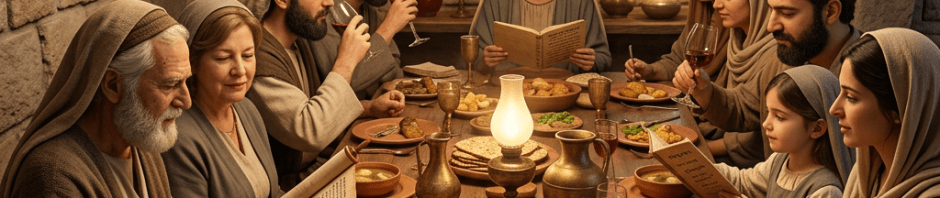
Previously, Jesus, in what seemed to be a push into the public eye, began His ministry by getting baptized by His cousin, John, the baptizer. The Holy Spirit publicly announced the Father’s acceptance of Jesus, His Son, by saying,
Matthew 3:13-17 NASB “Then Jesus *arrived from Galilee at the Jordan, coming to John, to be baptized by him. 14) But John tried to prevent Him, saying, “I have need to be baptized by You, and do You come to me?” 15) But Jesus, answering, said to him, “Permit it at this time; for in this way it is fitting for us to fulfill all righteousness.” Then he *permitted Him. 16) After being baptized, Jesus came up immediately from the water; and behold, the heavens were opened, and he saw the Spirit of God descending as a dove and lighting on Him, 17) and behold, a voice out of the heavens said, “This is My beloved Son, in whom I am well-pleased.”
While being announced by the Father is dramatic, no one but Jesus understood what was being said as God spoke out (I suppose that leaves us with the inference that Jesus eventually explained what took place)
The next event was the Holy Spirit driving Jesus into the wilderness to be tested.
Mark 1:12-13 NASB “Immediately the Spirit *impelled Him to go out into the wilderness. 13) And He was in the wilderness forty days being tempted by Satan; and He was with the wild beasts, and the angels were ministering to Him.”
The testing ended, and though we don’t see the transition, His mother makes sure He and His new friends come to the wedding in Cana. The push by mom clearly indicates that this was a relative or a close friend.
The changing of the water into wine.
A question: how many people at the wedding reception were aware of this dramatic miracle? We are not told how many people were in attendance, nor do we know how many people were aware that there had been a problem, but it would be a reasonable assumption to think that this handful of disciples, such as Peter, Andrew, James, John, Philip, and Nathanael, might have been. This was, evidently, a large wedding reception, a social event not to be outdone, and it is easy to assume many of the crowd had expensive tastes. In the televised series “The Chosen,” the host, a “rich” man, made a big deal of the splendid taste of the fresh wine which Jesus made (although he never knew that Jesus played a role in creating the wine). Consider for a moment the thought that Jesus made wine (whatever the extent and definition of that wine)
In John 2:13, we see that the Passover was near, but there might have been a problem.
John 2:13 NASB “The Passover of the Jews was near, and Jesus went up to Jerusalem.”
It was now thought of as the Passover of the Jews. In my last post, I pointed out that the Passover had been Jesus’ Passover.
Where do we find the initiation of the Passover?
The Passover is presented to us in Exodus chapter 12 and is part of God’s wrath meant to motivate Pharaoh to release God’s people. On the 10th day of the first month, each household was to take a lamb into their houses. To remember this day is to remember God’s mercy on His people.
Exodus 12:2-3 NASB “This month shall be the beginning of months for you; it is to be the first month of the year to you. 3) “Speak to all the congregation of Israel, saying, ‘On the tenth of this month they are each one to take a lamb for themselves, according to their fathers’ households, a lamb for each household.”
I can assure you that many of the people, categorized as God’s people, had no understanding or confidence in the God of Moses; why, even Moses, who pulled aside to see this bush that was burning and yet not consumed, had to be taught a few quick lessons about God. This statement concerning the overall lack of knowledge is not true of all the people, such as Moses’s mother and family, because this is where Aaron comes from, and the command is not exclusive, because once we see Israel outside of Egypt, we find an excellent man called Caleb, who was NOT a Jew. Our understanding of Caleb has to include the possibility that an Israelite invited Caleb and his family into their home. However, based upon the directions that we see in Exodus 12:3, where each household was to take a lamb, it was NOT directed exclusively to the Jews. This implies that Caleb’s family joined in and followed the directions. Again, we have questions that we may struggle to answer.
Clearly, it is the Lord’s Passover.
Exodus 12:11 NASB ‘Now you shall eat it in this manner: with your loins girded, your sandals on your feet, and your staff in your hand; and you shall eat it in haste–it is the LORD’S Passover.”
Nonetheless, Jesus is now headed to Jerusalem. John 2:14
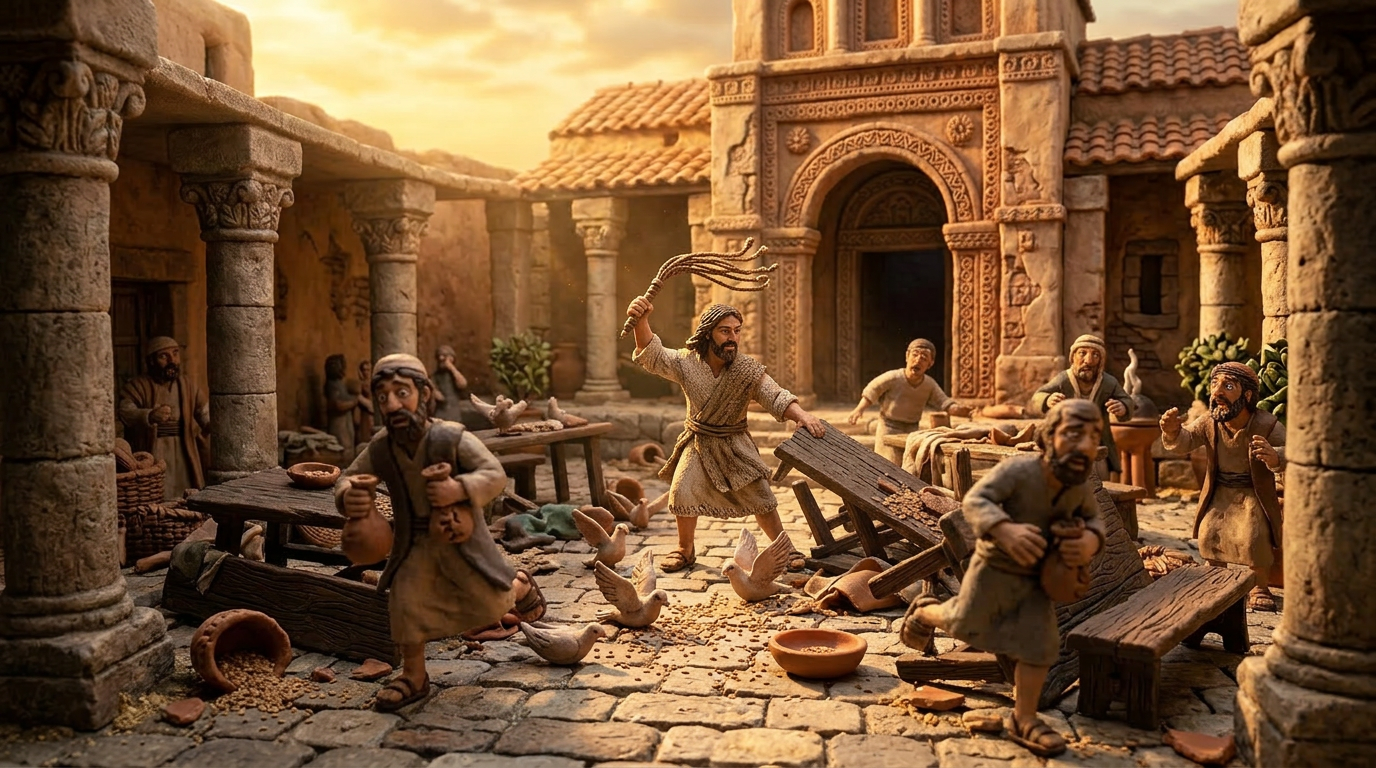
John 2:14 NASB “And He found in the temple those who were selling oxen and sheep and doves, and the money changers seated at their tables.”
None of these people and their activities would have been allowed in the temple, so we should be reminded that they were only allowed in the outer courts, the court of the Gentiles.
No one, that I can remember, as I sat on a bench seat at church, said anything that expounded on the whip.
John 2:15-16 NASB “And He made a scourge of cords, and drove them all out of the temple, with the sheep and the oxen; and He poured out the coins of the money changers and overturned their tables; 16) and to those who were selling the doves He said, “Take these things away; stop making My Father’s house a place of business.”
Years ago, I went to a men’s camp. The entirety of the camp was based upon a book written by John Eldredge, called Wild at Heart. The book and camp focused upon the brokenness within the heart of almost every man. Those who claim no damage are probably lying. In one of the talks, the speaker brought out how Jesus, with purpose, planning, and intent, fashioned this scourge and then used it. We are not told that sellers received lashes, but that scourge played a role in their clearing out of the temple courts.
In Matthew’s account, we are simply told that He overthrew their tables and drove them out.
Matthew 21:12 NASB “And Jesus entered the temple and drove out all those who were buying and selling in the temple, and overturned the tables of the money changers and the seats of those who were selling doves.”
Perhaps the reason for this lack of elaboration may lie in the fact that the Greek word phragellion is only used once in scripture. It can be portrayed as a whip or a scourge (the Roman soldiers who whipped Jesus used a specific type of scourge meant to cut deep and draw blood) If you are like me and had a father that used his belt and fists to punish you, whether you deserved it or not, then you may struggle with anger issues and think that the belt, or a whip, is the answer to everything life throws at you.
Paul, in writing to the church in Corinth, tells us that God made His Son, who knew no sin, to be sin. He did this on the cross.
2 Corinthians 5:21 NASB 21) “He made Him who knew no sin to be sin on our behalf, so that we might become the righteousness of God in Him.”
Jesus was sinless. How is that possible when He deliberately made a scourge, and probably hit a few of these vendors, as He chased them out of the temple courts?
I can guarantee you that if I had done that, there would be sin involved. The difference between Jesus and humanity has everything to do with the fact that Jesus has NO human DNA in Him. No, He is not an alien, but He is certainly not of this world. God created an egg, fertilized by Himself – no sex involved- and then He contracted with Mary, a young girl who was willing to carry that embryo to its maturity, knowing full well that she would be an outcast. An outcast? Well, yes, because, in the Jewish world where prophecy is pattern, however, no pattern demonstrated such a thing, and before her pregnancy, nothing like this had ever happened before.
A brief attempt at an explanation:
Sin was introduced into a “perfect” world, the garden.
(Stop here a moment. Ask yourself a question. Was sin a new thing that day? The answer is NO, and God, who knows everything, knew the definition of sin. Some would try to tell you that Satan only created one thing, sin. I don’t think so, but I do think that Satan saw what looked like an opportunity to overthrow God’s leadership by destroying the two people that God put on this earth, having dominion over everything, and to take care of it. I do not believe this caught God off guard. I also believe that this mutiny was, therefore, included in God’s plan with the purpose of, once and for all, stripping sin and its effects out of existence.)
For Adam and Eve, the law boiled down to one command, “Do Not eat from that tree.” We are told that Eve was deceived, but Adam was not, and he made a choice. An acquaintance of mine said, ” What was Adam thinking?” The thought process of Adam and the ramifications of his wife’s death were beyond understanding.
Having gone through the ordeal of forced mask usage just to fight off some man-made virus, we should have some understanding that modern science has created vaccines that can change your DNA.
Eating the fruit off the forbidden tree changed their DNA; as a result, every human since Adam carries the exact same damaged genetic pattern, a genetic sequence that is now understood to be a common marker throughout all of humanity. This particular sequence (and no, I don’t know which one it is) is the “sin” that motivates us – primarily, to do what we want, not what God wants us to do. In short, it is sin that lives within us, and God will NOT allow sin into the Holy City or eternity.
John 2:15-16 NKJV When He had made a whip of cords, He drove them all out of the temple, with the sheep and the oxen, and poured out the changers’ money and overturned the tables. 16) And He said to those who sold doves, “Take these things away! Do not make My Father’s house a house of merchandise!”
At some point, someone said, ” You can see that, Jesus said to those who sold doves, take these things away!” Whoever pointed this out was trying to demonstrate how Jesus was gentle with such a delicate creature. I am not sure if this is relevant, but it does not seem to be in the character of Jesus to harm something that cannot protect itself; that, and we never saw Jesus harm innocent people. In other words, He only went after the scribes and the Pharisees.
John 2:17 NKJV Then His disciples remembered that it was written, “ZEAL FOR YOUR HOUSE HAS EATEN ME UP.”
Give some consideration to the context that includes this passage.
Psalms 69:6-9 NKJV Let not those who wait for You, O Lord GOD of hosts, be ashamed because of me; Let not those who seek You be confounded because of me, O God of Israel. 7) Because for Your sake I have borne reproach; Shame has covered my face. 8) I have become a stranger to my brothers, and an alien to my mother’s children; 9) Because zeal for Your house has eaten me up, and the reproaches of those who reproach You have fallen on me.
In effect, the passage is talking about those who wait for you. It goes to plead with God for those who choose to adopt His ways, when David says, “Let not those who seek You be confounded because of me” (Considering the behavior of King David, especially with Bathsheba – a married woman with whom he committed adultery, and her husband – whom David had killed, then I can totally understand why he would make such a statement.)
To be honest, I am lost on this statement.
“Because for Your sake I have borne reproach; Shame has covered my face.”
He did not take Bathsheba as a present from the Lord, so what is he talking about?
My Dake’s Annotated Bible states, “This verse could refer to both David and Christ. Both suffered reproach and shame from enemies and friends.”
Examples that King David wrote, but also speaks about Jesus.
Psalms 22:6-8 KJV But I am a worm, and no man; A reproach of men, and despised by the people. NKJV 7) All those who see Me ridicule Me; They shoot out the lip, they shake the head, saying, 8) “He trusted in the LORD, let Him rescue Him; Let Him deliver Him, since He delights in Him!”
We are told that Jesus was the lamb of God slain for us. How did David know that? In the television series “The Chosen,” they portrayed Jesus, the lamb, entering Jerusalem through the sheep gate. He did that, and it is fascinating that the producers chose to point that out to us.
Psalms 44:22 BSB Yet for Your sake we face death all day long; we are considered as sheep to be slaughtered.
After clearing the outer courts of the temple in Jerusalem, we see the disciples saying this,
John 2:17 BSB “His disciples remembered that it is written: ‘Zeal for Your house will consume Me.”
His zeal oozed out in a manner they did not expect.
John 2:18 BSB “On account of this, the Jews demanded, ‘What sign can You show us to prove Your authority to do these things?”
What would they have said if He called down fire from heaven? He could have easily done that. Remember that James and John espoused doing that when a town rejected them. Jesus response to the young men who were willing to use such a radical approach was that killing such a vast number of people, just to prove a point, is not how we are going to operate. In other words, Jesus did merely beat them up verbally.
His response.
John 2:19 BSB Jesus answered, “Destroy this temple, and in three days I will raise it up again.”
I can easily picture Jesus popping His hand against His chest, as He said: “Destroy this temple, and in three days I will raise it up again.”
Having looked at Dr. McGee’s commentary, he points out the Greek word that Jesus used for destroy is lúō. You have to dig a bit to find the concept of destruction. In contrast to destroying another option for translation, and that’s to loose or unbind.
The Word Study Dictionary tells us something that seems to stand in opposition to destroy, “whatsoever you shall loose on earth,” (a.t.) or declare as not a part of the individual anymore, such as his sins, having been forgiven.
Here is the problem. Some people will say to you, “I will only use the authorized version, the King James version, of the bible”. So, at the demand of the state church, at that time, the translation went through multiple changes to suit the Catholic/State church. At that time, there were functional, readable, “English” translations, but that was not good enough, nor did it serve the purpose of the Catholic church.
Obviously, one of those changes can be seen in “Destroy this temple…” when the reality of Jesus’ statement comes across much less harshly.
If I compared Jesus’ response here to a comparable response when He said, the only sign I will give you will be the Prophet, Jonah. Why Jonah? Because Jonah, in an attempt to commit suicide, was dead for three days in the belly of the great fish. Yes, they have such a fish in the Mediterranean Ocean, called the Megamouth shark; they eat krill, but their mouth can handle swallowing a human. If being loosed can be related to death, then yes, Jesus would experience death; that death, however, meant life for us, should we accept it.
John 2:20-22 NASB “The Jews then said, ‘It took forty-six years to build this temple, and will You raise it up in three days?” 21) But He was speaking of the temple of His body. 22) So when He was raised from the dead, His disciples remembered that He said this; and they believed the Scripture and the word which Jesus had spoken.”
These verses show that the Jews did not understand that He was speaking of His body, but the disciples, although it took some time, did understand once He rose from the grave.


